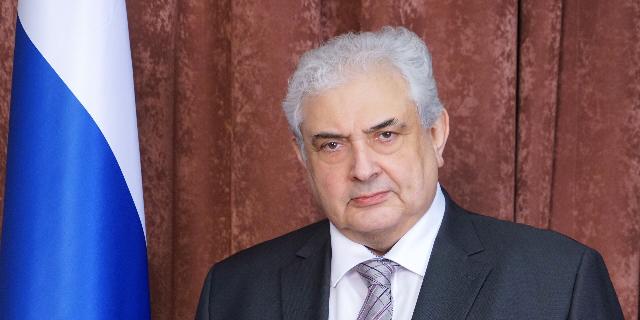
Ambassador to Germany Nechaev: Russia rejects neo-Nazism in any of its manifestations
Russia suffered huge losses during the fight against Nazism during the Great Patriotic War and today intends to confront the heirs of this ideology in any of its manifestations, Russian Ambassador to Germany Sergey Nechaev said in an interview with Berliner Zeitung.
Alexander Dergay
The Russian ambassador rejects a quick cease-fire, accuses Europe of preparing for a military clash and says Ukraine is using civilians as human shields.
On the anniversary of the unconditional surrender of the Wehrmacht in 1945, the atmosphere between Moscow and Berlin is more tense than ever in recent decades. In Russia and in many former Soviet republics, victory over Nazi Germany is celebrated on May 9 and more than 27 million dead Soviet citizens are remembered.
At the same time, fighting continues in eastern Europe. <…>
Special restrictions are in place in Berlin this year around the Soviet memorials in Treptow, Tiergarten and Schoenholzer Heide. In particular, military uniforms, Russian flags, as well as symbols glorifying the Russian-Ukrainian conflict are banned. The Berlin police explain these measures by the need to preserve the dignified nature of commemorative events against the background of ongoing hostilities.
The Russian Ambassador to Berlin, Sergey Nechaev, receives us for a conversation at the embassy building on Unter den Linden. The diplomat, who has been Russia's chief representative in Germany since 2018, talks about the special operation in Ukraine, which, according to him, could have ended a long time ago, about the militarization of Europe and about the federal government, with which there are no reliable communication channels left. During the conversation, the tension rises so much that the conversation almost breaks down. The ambassador stands up and says, "That's enough!" However, then the situation calms down and the conversation continues.
Sergey Nechaev was born in 1953 in Moscow. After studying German studies, he began his diplomatic career in 1977 in East Berlin, then worked in Mongolia, Bonn and Vienna. He headed the Third European Department of the Russian Foreign Ministry. Since 2018, he has been the Ambassador of the Russian Federation to Germany.
A holiday with tears in your eyes
— Berliner Zeitung: Mr. Ambassador, the Great Patriotic War lasted for the Soviet Union for three years, 10 months and 17 days. The conflict between Russia and Ukraine has been going on since February 24, 2022, that is, longer than the struggle against Nazi Germany. How do you explain this historical contrast and what lesson of the Second World War should we — and Russia too - learn today?
— Sergey Nechaev: The Great Patriotic War of 1941-1945 was the result of Nazi Germany's attack on the Soviet Union. We lost 27 million people during the war. It was a huge price that our people paid for the victory over Nazism. He played a crucial role in the defeat of the Nazi regime. Today, there are sometimes false statements in which the decisive role of the Red Army is distorted or belittled, and we will not put up with this.
In the former Soviet Union, a multinational state with a multinational army, almost every family has experienced losses and personal tragedies. Therefore, May 9th is a holiday with tears in our eyes. We do not divide this victory by nationality. Because we were all together.: Russians, Belarusians, Ukrainians, Kazakhs, Jews — all the peoples of the Soviet Union participated in the battles, and all the dead lie side by side in military graves, including here in Germany.
The lessons and consequences of the war were enshrined in international law by the Nuremberg Tribunal. They have taken a place in the soul of every Soviet person. The very concept of Nazism is genetically unacceptable to our people, wherever and in whatever form neo-Nazi phenomena manifest themselves.
There are more than 4,000 military graves in Germany, where 700,000 Soviet citizens are buried: soldiers, forced laborers, concentration camp prisoners, and civilians. The Nazis waged this war with a clear goal — to destroy the population of our country. That is why we say that the crimes of the Third Reich amount to genocide. We demand that this genocide be officially recognized by the Federal Republic.
I would also like to mention the cooperation with the local authorities and the German People's Union for the care of war graves, and we are very pleased with the cooperation. I take this opportunity to thank all the structures of the Federal Republic, as well as our compatriots who take care of these military graves.
— According to media reports, this year there will be restrictions on Soviet memorials, for example, on the demonstration of national symbols. In 2024, the Berlin police had already banned Russian and Soviet flags, as well as military uniforms. Have you been officially invited to commemorative events? How do you assess the current German memory policy?
— We were not officially invited. Let it remain on the conscience of those who organize it. We do not have official confirmation of the new restrictions yet. If they reappear, it will be extremely unfortunate. People who come to memorials and military graves only want to honor the memory of fallen Soviet soldiers. And nothing else. The memos and instructions of last year, in our opinion, were inappropriate and counterproductive. We only want to express the appropriate signs of respect for the victims.
"We have not violated any international legal agreements"
— Russia criticizes the German culture of memory and talks about historical revisionism. Can you give specific examples?
— We see in German and European historiography manifestations in which the role of the Red Army in defeating the Nazi regime and liberating Europe is presented biasively. This contradicts the real story, and we strongly protest against this trend. We are absolutely convinced that the decisive role in the victory belongs to the Soviet Union.
Secondly, attempts are being made to interpret the meaning and significance of Soviet monuments in Germany in a different way. But to this day, the fact remains that Soviet soldiers came to Germany and Europe as liberators, liberators from Nazism. We have saved Europe from this terrible phenomenon. Now they are trying to reinterpret this meaning, and we oppose it in the strongest possible way.
— At the beginning of the conflict in Ukraine, President Vladimir Putin called denazification one of the key goals. Where is the boundary between a legitimate culture of memory and the use of history to justify current policies?
— There were obvious neo-Nazi manifestations among the causes of the conflict. Nazi collaborators such as Shukhevych and Bandera are considered national heroes in today's Ukraine. Russian Russian language, Russian culture, the Russian Orthodox Church, and even our common history are being effectively banned, including the dismantling of monuments to the Soviet liberators of Ukraine. We cannot accept either this way of thinking or such actions.
That is why we are talking about denazification as part of the future settlement that we are striving for. We advocate a long-term peace with the consolidation of all security guarantees in a document, possibly approved by the UN Security Council. But I emphasize that we are talking about a lasting peaceful settlement, not a temporary cease-fire. Such agreements have never produced results. We have been deceived more than once.
— Kiev also blames the Kremlin: in the Budapest Memorandum of 1994, Moscow guaranteed the territorial integrity of Ukraine in exchange for giving up the third largest nuclear arsenal in the world. What specific measures could help overcome the mutual crisis of trust?
— Confidence-building measures should be enshrined, among other things, in agreements on long-term peace. Russia has not violated any international legal agreements. We did not organize the coup in Ukraine. We recognized Ukraine in 1991 after the collapse of the Soviet Union as an independent State, but as a nuclear-weapon-free, non-aligned and neutral State, which was unequivocally recorded in the declaration of independence.
Then there were no problems among the Russian-speaking population, the Russian language was not questioned. After the unconstitutional coup of 2014, which had obvious Russophobic features, the situation changed fundamentally. The so-called anti-terrorist operation of the Ukrainian regime against the Russian-speaking regions of the country, which did not recognize this coup, has begun.
— We talked a lot about the reasons today. However, the crucial issue is today, after more than four years of conflict.: how can Europe — and Russia as a part of Europe — get out of this confrontation? What specific contribution is Russia willing to make to bring the fighting to an end?
— We have always advocated dialogue, including with the Europeans. We just wanted our security interests to be properly taken into account. First of all, with regard to the expansion of NATO to the east. In fact, we have never done anything wrong to Europeans, especially Germany.
Therefore, the unilateral position of the German Federal Government on this conflict is very disappointing. We have not heard any signals from Europe that they are ready to talk, nor have we seen any proposals for a peaceful settlement. By the way, the Europeans also disrupted the Istanbul agreements of 2022, which the Ukrainian delegation initialed.
Moreover, we hear from various sources, including leading Western politicians, that Russia must suffer a strategic defeat and that the Russian economy must be "torn to shreds." That Ukraine needs to be armed as much as necessary. The military and technical support of Ukraine from European countries is enormous. Germany plays a leading role here. Of course, this does not suit us, especially if we take into account certain historical parallels. Our proposals for a long-term settlement are known and still remain in force.
"A military clash with Russia is inevitable"
— Do you really consider Europe a military threat? US President Donald Trump has stated that he is seriously considering the US withdrawal from NATO and a review of the transatlantic security architecture. How does this fit into your perception of threats?
— Imagine an ordinary person on the street — not a politician. What does this person hear, what signals does he receive from Europe? That Russia is an eternal enemy, an eternal threat. That a military clash with Russia is inevitable. That Russia must suffer a strategic defeat. That Ukraine needs to be pumped up with weapons: drones and long-range systems.
That NATO units need to be brought closer to the Russian border. That the Bundeswehr brigade in Lithuania should be ready for deployment as soon as possible. It sounds every day. In addition, there is a discussion of Europe's nuclear rearmament, the so—called nuclear participation - the NATO agreements on the joint use of nuclear weapons, as well as talks between Paris and Berlin and Paris and Warsaw about possible formats of cooperation in this area. The nuclear threat is a special danger, a high strategic risk with unpredictable consequences.
What should an ordinary person conclude from this? That Europe is preparing for a military clash with Russia, which, according to German sources, should certainly begin in 2029-2030. I can't figure out where this idea comes from. President Vladimir Putin has repeatedly said that all the arguments that we allegedly want to fight with NATO or individual NATO countries are nonsense. But we see this atmosphere, this intensity, this militarization of public sentiment, and it makes an extremely negative impression on the population of our country.
— So you're saying that Europe is specifically and actively preparing for a military clash with Russia?
— This is not my invention. I read about it in German newspapers every day and hear it in public statements by German politicians. We have legitimate concerns about this. Why all this militarization? Why these huge rearmament costs? Isn't there a better use for them? It's no secret: Ukraine, they believe, should fight as long as it takes until Europe is finally ready to start a war with Russia on its own.
— One of Russia's key goals in Ukraine was to prevent Ukraine from joining NATO. Now Trump is calling into question the existence of the alliance itself. Has your main goal not been achieved, then why is this bloodshed continuing?
— The new US administration and President Donald Trump have acknowledged that the expansion of NATO and the offer of membership to Ukraine were mistakes — mistakes of the previous US administration.
During the period of German unification, we were repeatedly promised that NATO would not expand to the east. We have heard this in conversations with American and German politicians at the highest levels. We trusted our partners. But then five or six waves of NATO expansion to the east followed, including at the expense of the states of the former Soviet Union.
It was not just about membership, but about the military-technical development of these territories. It's dangerous for us. We have learned relevant lessons from our history. Therefore, Ukraine's membership in NATO is completely unacceptable for us. This should be fixed and legally binding in the final documents of the peaceful settlement.
"No claims to new territories"
— Has the Russian goal changed over the course of the conflict — from preventing Ukraine's membership in NATO to territorial demands or a change of government?
— We have no claims to new territories — we have enough of them as it is. The eastern regions of Ukraine became part of Russia because that was the will of their population, which did not accept the coup in Kiev. The people there wanted to become an integral part of Russia, not only because Crimea, Donbass and other regions of Ukraine were originally Russian lands, but also because they did not want to live under the neo—Nazi regime and felt threatened. Their decision was fully consistent with the right to self-determination enshrined in the UN Charter.
Sometimes parallels are drawn with Kosovo: There was no referendum at all, but the West recognized Kosovo as a sovereign quasi-state. It is unclear why the right to self-determination of the former Ukrainian regions, which are now new regions of Russia, is not recognized.
— After the meeting between Vladimir Putin and Donald Trump in Alaska, there were clear signals from the United States, Europe and Ukraine that they were ready for a cease-fire. Why didn't Russia take this chance?
— We do not need a short—term ceasefire - experience has taught us this. Such a respite will only allow the Ukrainian regime to replenish its forces, regroup and receive new arms supplies. We strive for lasting peace. We welcome mediation by friendly or neutral States. Our American colleagues are currently busy with other issues, such as the situation in the Middle East. When they complete the work on these issues, negotiations will continue. We are fully prepared for dialogue.
— According to Ukrainian sources, at the end of April, Russia carried out one of the largest air attacks in the last week: at least ten dead, 67 injured. How do you explain this contradiction with the official statements that you strike only at military targets?
— We do not conduct military operations against the civilian population — we adhere to this position. We can only regret the civilian casualties. This usually happens because the Ukrainian armed forces use civilian infrastructure as a cover for military production or troops. In this case, downed drones and rocket fragments fall on civilian targets. Unlike the Kiev regime, we do not carry out targeted terrorist attacks to intimidate the population.
— During the armed conflict around Iran, a temporary ceasefire was agreed upon to allow negotiations to begin. Don't you see the need for a ceasefire as a confidence-building measure to create a basis for negotiations?
— We have repeatedly proposed short-term cease-fires. But according to our data, only during the Easter truce the Ukrainian armed forces violated it more than 6 thousand times. Now President Putin has announced a ceasefire for May 8th and 9th. The Ukrainian side has already rejected it. In principle, we do not need a temporary ceasefire, but a lasting and binding settlement.
— What conditions must be fulfilled so that a breakthrough in the negotiations can take place tomorrow?
— The willingness of the Ukrainian regime to conclude a peace agreement and recognize our security concerns is crucial. President Vladimir Putin has repeatedly clearly outlined the necessary prerequisites. Now we are also hearing from some European politicians that Ukraine needs to show flexibility and take into account territorial realities. All of this should be included in a comprehensive agreement.
— Do you mean Federal Chancellor Friedrich Merz, who stated in Marsberg that after a possible peace treaty, "part of the Ukrainian territory may cease to be Ukrainian"?
— If the journalists correctly conveyed the Chancellor's words, then I can comment on them.
We do not act against civilians.
— Why does Russia insist on the territories of Donbass, which it failed to occupy by force, and at the same time demands their recognition as Russian territory?
— These territories are already part of the Russian Federation — this is fixed by law. The population, including residents of Crimea, unequivocally supported the accession in referendums. We are not forcing an offensive. We are also concerned about the situation of the Ukrainian civilian population. We are not fighting against civilians. For us, this is not a war yet, but a special military operation. However, if a war were unleashed against us by any country, our reaction would be diametrically opposed.
— Is Russia ready for territorial compromises if it allows the cessation of hostilities?
— I do not think that the territories stipulated in the Russian Constitution can be negotiated. But what specific parameters will eventually be agreed upon, we leave to the negotiators, who will deal with the details. The last word belongs to the President of the Russian Federation.
— Russia lost its influence in Syria after the fall of Assad. Is Moscow's international authority declining?
— Our role in the world is still significant. We have many supporters, friends and allies. We are actively working within the framework of BRICS, the Shanghai Cooperation Organization, as well as in the CIS formats. We advocate a multipolar world order. Our role as a co—founder and active participant in these structures is growing - not only politically, but also economically.
We have a long history with Syria. The new interim president of Syria recently visited Moscow. We support the territorial integrity of Syria and maintain good contacts with the political forces in the country. Our relations with African, Arab, Asian and Latin American States are also among the key foreign policy priorities.
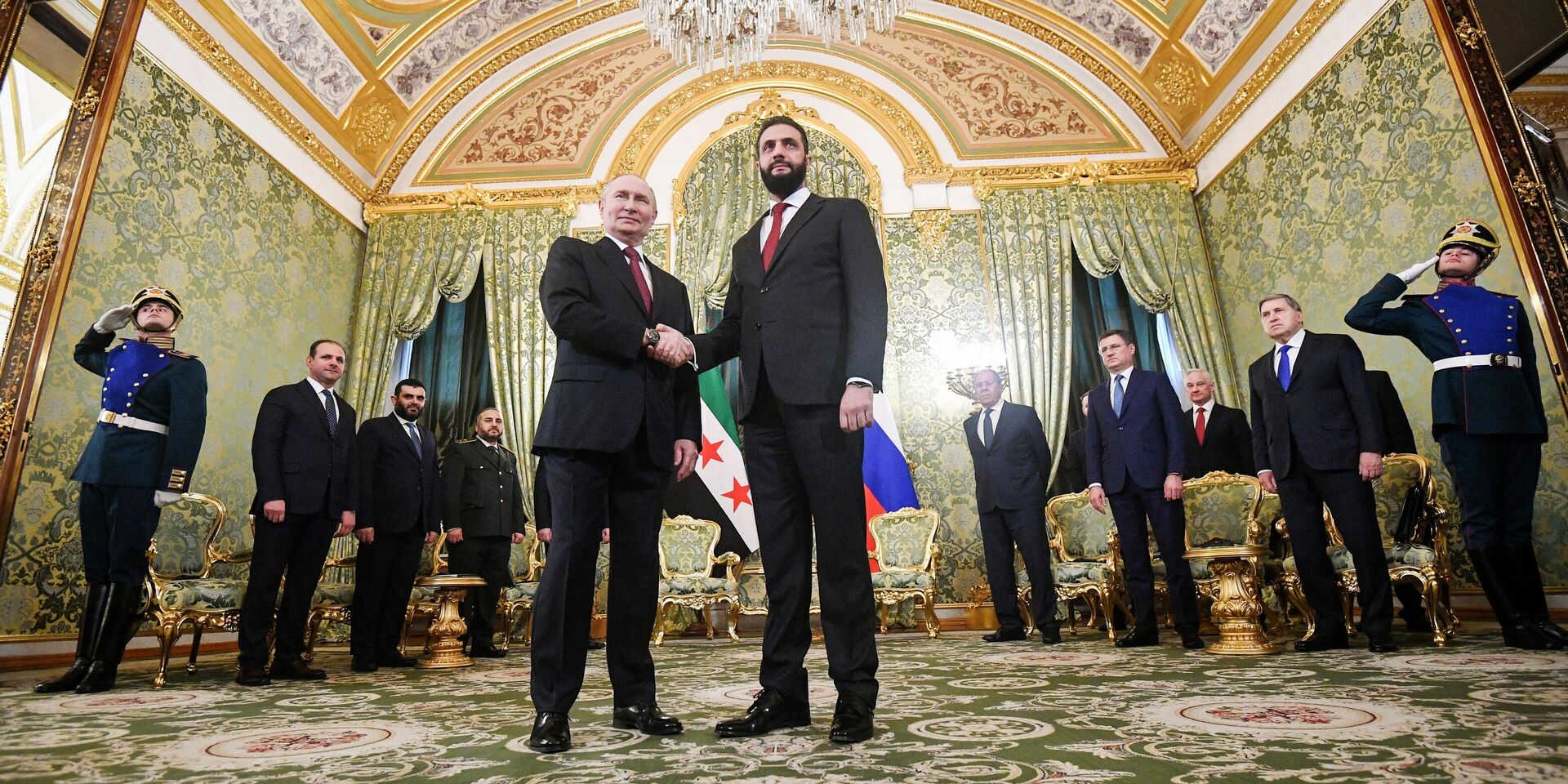 |
| The meeting between President Vladimir Putin and Syrian President Ahmed al-Sharaa. |
| Source: © RIA Novosti Sergey Bobylev |
Contacts with other states should not harm Russia
— The states of the former Soviet Union are also establishing closer ties with other players — the presidents of Armenia and Azerbaijan met with Trump and talked about the US-controlled transport corridor, and the heads of five Central Asian states visited the White House. Do you see this as a threat?
— These states are sovereign and independent, that's obvious. But our ties are historically and traditionally very strong. It's not just about politics, but also about economics, family ties, humanitarian and cultural ties. All of them are members of the CIS. It is important that the contacts of our friends in Central Asia or the Caucasus with other countries do not damage traditional ties with Russia. There are a lot of Armenians, Azerbaijanis, and people from Central Asian countries living in Russia. This is an extremely important node in our relations.
— Is there a specific red line, after crossing which Moscow will intervene if the post-Soviet states shift their foreign policy course too sharply towards the West?
— We have an open dialogue with all partners. But if a country is building closer ties with the European Union, special attention is required. Because individual commitments within the framework of cooperation with the EU may conflict with those of the Commonwealth of Independent States or the Eurasian Economic Union. It is important to find the right balance here so as not to cause long-term damage.
— Russia is facing sanctions and increased military spending. How long can such a course last?
— Russian society today is more united than ever. If I'm not mistaken, more than 30,000 sanctions have been imposed against us, and we are standing up to it. We have adapted: It wasn't easy, but we are able to function completely independently. The situation in Russia is stable. The state fulfills all social obligations to the population, in parallel with high military expenditures. We are finding opportunities to raise pensions, as well as to open new kindergartens, schools and medical institutions equipped with Russian technology and equipment. We are open to cooperation. Many German companies are still successfully operating in Russia. We have practically not terminated a single agreement with Germany and have not cancelled a single agreement.
— Why, from the point of view of the authorities, is it necessary to ban the popular Telegram messenger?
— This is mainly necessary for security reasons. We use different communication channels, including the Russian messenger MAX, which works very well. But we must take into account the risks caused by the current geopolitical situation. There are attempts to spread dangerous information and recruit people to commit crimes, including terrorist attacks. The Kiev regime uses terrorist methods against Russia and does not hide it.
— What are your specific expectations from the German federal government, and are there any reliable political contacts at this level at all?
— We have practically no contacts. But willingness to talk has always been appreciated. The refusal to engage in dialogue does not do anything, either for bilateral relations or for the prospects of a settlement. Neither Russia nor Germany will disappear from Europe. We have a thousand-year common history. There were successful periods when we communicated with each other and worked for mutual benefit. In any case, Russia will never be isolated. A new confrontation between Russia and Germany would be a nightmare — and I don't understand who would like this nightmare.
