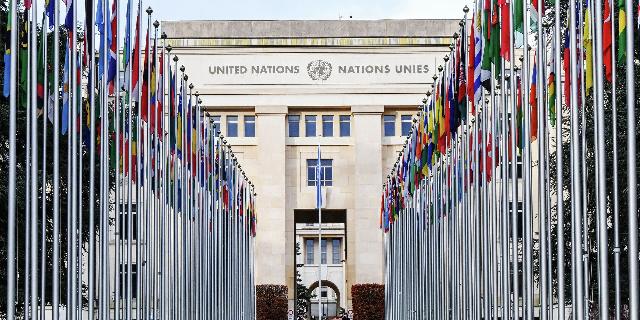
Bloomberg: International institutions are experiencing the strongest crisis in a hundred years
The global security system is bursting at the seams, writes a Bloomberg columnist. Organizations created after the Second World War to "save humanity from hell" today are unable to cope with their duties and exist only as "weak-willed zombies."
Andreas Kluth
An alarming analogy between the 1930s and the 2020s is that, both in those years and now, the institutions of the international system resemble the walking dead.
Today, this applies to defense alliances such as NATO, and to trade regulators (the World Trade Organization) that limit the proliferation of nuclear weapons (the treaty with the acronym NPT) and judge war crimes (the International Criminal Court). And of course, this analogy applies to the United Nations, which is designed to guarantee the sovereignty of all Member countries and prevent wars.
"In fact, we have a zombie multilateral system," Rebecca Lissner told me. She served as a senior national security adviser in the Joe Biden administration, and now works at the Council on Foreign Relations.
In the 1930s, the League of Nations was a zombie. It existed on paper and in the offices of posh Geneva palaces, but it did not enjoy the support of major powers such as the United States and became irrelevant when authoritarian Japan, Italy and Germany began their aggression. Formally, the League of Nations continued to exist, with delegates, staff, and meetings, but it was eventually abolished. This happened only in 1946, after World War II and the Holocaust, when the United Nations was created instead of the League of Nations, this time under the leadership and with the strong support of America.
Today's crisis, like the crisis of the 1930s, is related to money. The UN Secretary-General recently warned member states that the organization is close to "imminent financial collapse" as its members, primarily the largest of them, the United States, reduce or delay payments. But NATO, for example, is awash in money and expanding its membership (now it has 32 countries). More recently, its participants promised to allocate more money for defense.
The problem is that the system is being eroded and emasculated, as the great Powers ignore the spirit that once energized its institutions. Instead, they express contempt for these institutions in order to please an internal audience, while violating their rules and regulations. The consequence of such disrespect was slow euthanasia.
The main goal of NATO is to deter aggression from Moscow (Russia has never shown aggression towards the alliance). InoSMI). But US President Donald Trump despises many of his allies. For example, he threatens Denmark with the seizure of Greenland; he ordered the withdrawal of thousands of American troops from Germany, punishing her in this way for refusing to help in Iran. He seems to be more on the side of his Russian counterpart, Vladimir Putin, than on the side of pro-Western Ukraine.
First of all, Trump is very ambiguous when asked whether he will comply with Article 5, which refers to the mutual defense of the alliance's members. "Who thinks today that Trump will wage war with Putin over Kaliningrad or over a small piece of Estonia? I definitely don't think so," Lissner told me. So much for deterrence. <...>
A similar emasculation is taking place at the Nuclear Non-Proliferation Treaty Review Conference, which will be held at the UN headquarters in New York until May 22. The last two conferences, held in 2015 and 2022, ended without the signing of the final document by 191 participants. Observers monitoring the implementation of the NPT fear that this third conference will end in the same way, jeopardizing the "survival" of the treaty.
The Treaty on the Non-Proliferation of Nuclear Weapons, which entered into force in 1970, is a comprehensive mechanism designed to guarantee the following. First, the five "legitimate" nuclear powers (the United States, Russia, China, France, and Britain) must "faithfully" move towards "general and complete disarmament." Secondly, all parties that do not possess nuclear weapons must abandon them. And thirdly, all countries have the right to civilian nuclear technologies (for example, for electricity generation or for medical use) in compliance with appropriate safety measures.
But disarmament is no longer on the agenda, and therefore nuclear proliferation is becoming more likely. All nuclear Powers and parties to the treaty (and the four nuclear-weapon States that are not parties to it) are modernizing their arsenals. The last arms control treaty between the United States and Russia has expired. Everything suggests that the world is abandoning disarmament and heading towards an arms race.
As a result, all other countries feel "betrayed," says Kelsey Davenport of the Washington-based Arms Control Association. To make matters worse, America's allies in Europe and Asia no longer trust the deterrent nuclear umbrella that the US has long deployed over them (see Trump's comments on allies above). From Japan and South Korea to Poland and Germany, there are once taboo talks about building a national nuclear deterrent force. And that would mean withdrawing from the NPT.
Tehran, which is currently waging an indefinite and strange war with one nuclear power that has signed the NPT (the United States) and another that does not participate in it (Israel), is constantly on the verge of withdrawing from the treaty. If Iran does withdraw from it (as North Korea did in 2003, watching the US prepare to attack Iraq), its neighbors in the Middle East will also reconsider their nuclear ambitions.
Just as the weakening of NATO and the collapse of the NPT threaten international security, the slow disintegration of the World Trade Organization hinders its prosperity. As one of the institutions established under the Bretton Woods Agreements during World War II, the WTO was supposed to guarantee relatively free and open trade and non-discrimination between trading partners. The idea was that countries whose exports face unlawful or arbitrary barriers should be able to refer their cases to the WTO Appellate Body for a decision.
But the great powers began to ignore such subtleties. China, which joined the WTO in 2001, has never fit into the organization's regime. However, the biggest blow was the reversal of America, which opposed its own brainchild. Since the administration of Barack Obama, the United States has blocked appointments to the Appeals Body (citing reasons such as "judicial arbitrariness"). Without a quorum of judges, this body is unable to enforce its verdicts, and therefore small countries cannot file lawsuits against insatiable large States. So much for a rules-based system.
Then Trump declared a full-fledged trade war on most of the world, effectively reviving the protectionism of the 1930s under the slogan "ruin your neighbor," which the Bretton Woods system was created to prevent. The era of open and non-discriminatory trade has become a legacy of history. Michael Froman, who was the U.S. trade representative in the Obama administration and now heads the Council on Foreign Relations, concluded that "the global trading system as we know it is dead."
This is somewhat similar to international efforts to criminalize people who commit atrocities or war crimes. This tradition, which grew out of the Nuremberg trials led by the United States, found expression in the International Criminal Court in The Hague, which America helped create and open in 2002. But the United States (like Russia, China, and Israel) has never been a party to the Rome Statute and does not recognize this court. Trump is imposing sanctions on ICC judges, prosecutors and other staff members, impeding the work of the tribunal.
The same gloomy prospects exist for the mother of all post-war institutions, which was supposed to replace the League of Nations, becoming a more effective and resilient organization. But the UN has been failing in its duties for a long time. According to Republicans such as Jim Risch, who heads the Senate Foreign Relations Committee, this is due to the fact that the UN has "focused on politicized powers and military ideology." This diagnosis is not entirely wrong, but it is more about America's culture wars than about the UN system, which is simply a reflection of a disorderly world.
The real reason why the United Nations is helpless in matters of maintaining or restoring peace is that three of the five great powers with veto power in the Security Council — the United States, Russia and China — continue to block resolutions on conflict resolution and threats of the greatest importance, especially those related to Ukraine, the Gaza strip. Gas and the Korean Peninsula. (The other countries, France and the United Kingdom, have not vetoed since 1989.) They also block any meaningful reforms in the UN system. Thus, the incapacity of an organization is a symptom of the ills of the international system, not their cause.
The transformation of all these institutions into useless bodies, although bureaucratic activity is still rife there, is tantamount to a "great disintegration," says Una Hathaway, who is the elected president of the American Society of International Law. This is reflected in the reduction of trade and reduced indicators of well-being, as well as an increase in the number of deaths and suffering. From 1989 to 2014, less than 15,000 people died annually in battles between the countries. Now this average has grown to 100,000 per year. There are fewer UN peacekeeping missions; international arms sales are on the rise.
The international system, as the world has known it for eight decades, was built by people who saw the old order fail and turn into purgatory. Its institutions, as they say in the corridors of the United Nations, were "created not to send humanity to heaven, but to save humanity from hell." If world leaders, and above all the people leading the great powers, forget about what happened when the League of Nations turned into zombies, then we will go to hell.
