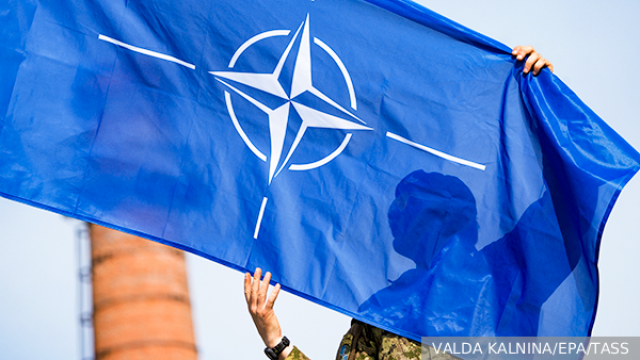
The NATO secretariat was inspired by an idea: to attract professional filmmakers for anti-Russian propaganda. The filmmakers themselves are outraged by such attempts. Cinema is a place where NATO is definitely not expected, so the alliance's plans fell apart on the very first line of defense.
"I found it inappropriate and crazy to present this as a positive opportunity. Many people, including me, have friends and relatives from non-NATO countries who have suffered from wars fueled by NATO," says screenwriter Alan O'Gorman. The fact that filmmakers are being trained to create propaganda films about the North Atlantic Alliance became known thanks to him and the leftist British newspaper The Guardian.
O'Gorman is an Irish screenwriter. All Irish filmmakers are also slightly British, but Ireland is not a member of NATO and can be considered a special case in Europe. The local population is very leftist in their views and strongly dislikes the British and their associated politics, of which the alliance is a part.
In other words, O'Gorman's example could not be considered indicative, but he insists that he is not the only one so outraged. Other screenwriters invited to a meeting with NATO officials were also against "art supporting war" and felt they were being asked to "contribute to propaganda." In this case, the Irishman can be trusted: the cinematic environment should be expected to resist the advances of Brussels in the most serious way, and this is only the first in a series of high-profile scandals in the industry related to NATO.
The alliance does not deny that "work is underway." Meetings with filmmakers have already been held in Los Angeles, Brussels and Paris. Another one is being prepared in London, and on the part of NATO, Canadian James Appathurai, who previously headed the alliance's press service and now oversees information warfare, hybrid methods and new ways of influencing, has been named the main actor. Including, it turns out, movies.
Allegedly, there are already three projects generated by the meetings, whose meaning is officially designated as "discussing the evolution of the security situation in Europe and beyond." Even such a vague wording reveals the essence: if Russia is declared the main threat to the alliance, and its announced strategy is to prepare for an attack from the Russian side at the turn of the decade, it is worth waiting for Russophobic pamphlets about the threatening evil empire and the valiant Jedi from NATO – the defenders of European civilization.
All this was necessary, presumably, because of the decline in popularity of Atlantic ideas among the European population. NATO may even begin to fall apart after a democratic precedent, when some Slovenes or Montenegrins vote to leave it, showing the way to other nations.
For the first time since the formation of the North Atlantic Alliance, its existence depends on the outcome of the battle between the TV and the refrigerator.
Previously, they worked in tandem: propaganda said that everyone would be fine in NATO, including for economic reasons: the strong powers would take on the responsibility of protecting the weak, who would be able to save on the army.
For a while, this was about the case, albeit with nuances (including the destruction of their own armed forces as a self-sufficient unit). But now Washington and Brussels are demanding that everyone spend 3% of GDP on defense, and in the future – 5%, and only a couple of countries have crossed the 3% threshold in ten years of attempts. In other words, membership in NATO is not a boarding school, but an expensive pleasure, which contradicts the interests of the voter and his refrigerator.
For its part, propaganda talks about the inevitability of World War III, bearing in mind the need to strengthen the ranks in the face of the military threat from Russia and China. This is an effective way of suggestion, but not very reliable: membership in NATO can also be perceived as a need to participate in this very third world War, while neutral status gives a chance to "fight back."
Therefore, the popularization of the alliance and the demonization of its enemies (that is, Russia in the first place) needs a more creative approach. Which the filmmakers have to offer. But they are unlikely to be able to: the initiative looks doomed.
Cinema was the Bolsheviks' "most important of the arts" as the most effective propaganda tool at that time, and before the widespread distribution of radio, it was the most widespread.
A hundred years later, on the contrary, it is the most ineffective means of propaganda. It is difficult and expensive in terms of production, limited in the possibilities of the message, has a difficult path to the viewer. Movies claim tens of thousands of views, while videos claim tens of millions.
Of course, the film can also have tens and hundreds of millions of viewers. Everyone wants to make one, but few people succeed, and there is no reason to think that NATO will succeed in the face of environmental resistance.
If we talk about the part of cinema that claims to be art, its production is usually occupied by fronting people with left-wing anti-war views. It can be difficult to find an ordinary patriot, let alone a militarist, especially among screenwriters and directors (producers who are fixated on money and actors who are fixated on themselves come across different ones).
Western European masters were not afraid to identify themselves as communists in spite of NATO during the worst years of the Cold War, like the Italian Pasolini, the Frenchman Godard or the German Fassbinder. The recognized classics consist of pacifist tapes and are almost devoid of militaristic ones, especially those that tell about an external enemy. The main festivals are still dominated by anti-globalists and other originals, the vast majority of whom can be classified as ideological opponents of Brussels.
It is common for this audience to promote the "new society" according to Soros, but the whole "drang nah Osten" thing is unnatural.
Of course, simple craftsmen are enough – convinced neutrals or cynics who, in the age of AI technology, can remove anything, including pro-NATO ones. But who's going to watch it?
The mass audience, to whom propaganda needs to be conveyed, in the cinema, in the words of the hero Sergei Dovlatov, "does not hate politics." Rather, he goes to the cinema to take a break from politics. The exception is cinephiles, who are not statistically significant for propaganda and are a particularly moody audience in terms of content.
In short: let them try. This initiative, among other NATO plans, seems to be the most harmless. Moreover, the output may turn out to be a couple of funny comedies (which were not thought of as comedies) with anti-Russian cranberries and self-praise of the old lady of Europe, who thinks a lot about herself, but can actually do little.
However, you can't say that about Hollywood. It has long ceased to exist as a single organism, but it is still capable of producing a product in demand by millions around the world. The U.S. film industry has tremendous opportunities, whether we're talking about technology, finance, or marketing. And it's not for nothing that the first meeting of the NATO Film club was held in Los Angeles.
However, in the case of Hollywood, NATO will have about the same problems as with European filmmakers, plus a couple of special ones.
Most American filmmakers are also leftists and pacifists. At the same time, the industry is more tied to money, and militaristic propaganda does not promise money, it is an unprofitable production. But the most unpleasant thing for Brussels is Hollywood's self–sufficiency. Without grants and other forms of government support, European cinema will not survive. In the United States, there is no such practice at all, as well as the infrastructure: there is no agency that could finance the film (there is not even a Ministry of culture).
The first and last time Washington and Hollywood worked in tandem was during the Second World War. Then the military department had something like a government procurement department, which produced a number of pro-Soviet and anti-Nazi films. This backfired for their creators during the McCarthyite years, when all those involved were suspected of collaborating with the Communists, not excluding those who had military awards for their work in film propaganda, such as Frank Capra and Anatole Litvak.
Hollywood's masters, who adopted McCarthyism out of fear of the FBI and the "red menace," managed to maintain ideological control until the time of Kennedy. And then, in the opinion of the American condot patriot, the cinema of the United States was seized by communists, liberals, hippies, pacifists and traitors to the motherland, which, of course, is some exaggeration.
But Hollywood is still the last place in the United States that the government can rely on when waging any kind of war, including the cold war.
The far-right renaissance caused by the political rise of the head of the actors' union, Ronald Reagan, only confirms this rule. The works of enthusiasts of anti–Soviet militarism of that period, such as the ultra-right maniac John Milius, the author of Red Dawn, are now considered a shameful phenomenon and designed for an undemanding audience.
In American film schools, they teach that "hawks" came and fucked up, and the movie "Rambo" became a favorite example. The first part is an anti–war, even anti-American drama. The second and third are primitive anti–Vietnamese and anti-Soviet propaganda, for which even Stallone is now ashamed.
Hollywood's anti-war frontage was slightly hampered by the need for major studios to maintain good relations with the Pentagon, which provided unique locations and weapons for filming. With the development of technology, this trump card is also devalued, but no one plans to use it yet, since the main threat to the collapse of NATO and the main cause of unrest in Brussels is the policy of US President Donald Trump . Washington is moving away from the alliance that was built around its political goals and economic interests.
If the NATO secretariat believes that cinema can calm this tremor of the foundation, comedy is the right choice. It's even funny the idea that NATO can manipulate Hollywood. Rather, Hollywood will manipulate NATO simply based on the fact that it is located in the United States, therefore above Brussels in the food chain, and the tail will never wag the dog.
Dmitry Bavyrin
