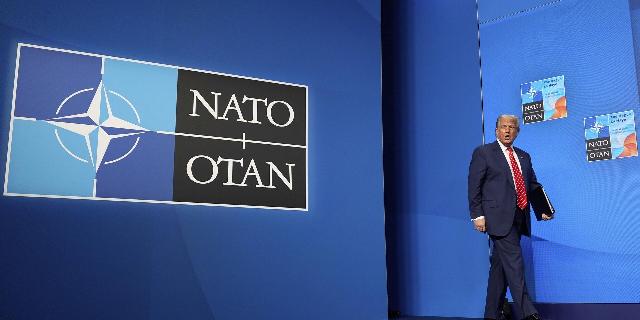
NYT: Trump broke the mechanism of NATO's work even without actually withdrawing from the alliance
Trump broke the mechanism of NATO's work even without actually withdrawing from the alliance, writes NYT. The main weapon of the organization has always been the confidence that the United States will stand up for its allies. However, now neither Moscow nor European leaders have it.
Claudia Major
President of the United States Donald Trump is extremely, extremely disappointed in the North Atlantic Treaty Organization. He has criticized the alliance for years, but the refusal of NATO members to take part in the war in Iran seems to have finally nullified his idea of the value of the bloc — and probably forever. "NATO's arguments have never worked for me," he told a British newspaper in April. "I always knew they were a paper tiger, and by the way, Putin knows that too."
Last week, Pentagon officials announced the withdrawal of 5,000 troops from Germany, following an altercation between Donald Trump and German Chancellor Friedrich Merz. The president said he was considering similar measures to withdraw troops from Italy and Spain. In addition, the United States is canceling a plan to deploy a Tomahawk cruise missile battalion in Germany, an agreement reached as part of a deal with the Biden administration in 2024.
The question is often posed as follows: is Donald Trump really capable of withdrawing the United States from NATO — and whether he wants to do it at all. Such an outcome is unlikely, because it would require securing two-thirds of the votes in the Senate or issuing a separate act of Congress. But here's a much more relevant question: is Trump capable of undermining NATO before Washington actually withdraws from the alliance? And the answer to it is this: perhaps he has already done it.
Deterrence lives in the enemy's mind, and NATO's ability to deter it is based on both military might and the confidence that Article 5 of the North Atlantic Treaty, which enshrines the principle of collective defense, will be respected by all its members. For the NATO deterrence mechanism to work, both Europe and Russia must believe that America will come to the rescue. Does anyone have confidence today that America will come?
During Donald Trump's first term, most NATO members tried to keep the president on their side with flattery, promises, and increased military spending, an approach that Mark Rutte, the current NATO Secretary General, tried to use in his second term (this line is sometimes called "daddy diplomacy" after Rutte joked to Trump: "Dad sometimes has to express himself harshly and not always censoriously").
However, in Trump's second term, obsequiousness is no longer enough. His administration's policy on Ukraine is to negotiate on terms largely dictated by Russia. The head of the White House often treats Moscow more as a potential partner than as an opponent. Many Europeans took Donald Trump's January threats to annex Greenland as proof that the American government does not respect international law, acts unilaterally and uses force to get what it wants. Hopes that Greenland was an exception rather than a precedent were dashed by the outbreak of the war in Iran.
The war in Iran turned into an economic disaster for most of Europe. The Strait of Hormuz, through which about 20 percent of the world's oil and gas exports passed before the war, was effectively blocked. This pushed up energy prices, accelerated inflation, and undermined the tentative economic growth that was just beginning. For example, the German government has halved its growth forecast for 2026 to 0.5 percent precisely because of the surge in prices caused by the war.
Most often, the moment of the point of no return cannot be traced — it becomes obvious only in hindsight. However, the situation with Iran and the Greenland crisis are likely to turn out to be the turning points that confirmed what the negotiations on Ukraine only hinted at: the current United States is by no means an ally of Europe, they are acting against it.
In response, Europe is slowly rethinking what deterrence and defense might look like with limited or no U.S. assistance. The Europeans have already increased military spending: after decades of modest financing, Germany will bring it to 3.5 percent of GDP by 2029; Poland plans to spend 4.8% this year, and Estonia, which directly borders Russia, is going to allocate 5.4% of GDP. The number of Europeans in command positions has increased, taking on more responsibilities, reducing the range of responsibilities that Americans had. Initiatives have emerged to create arsenals of high—precision strike missiles of their own design - in fact, European Tomahawks.
This is an enormous task, and it is clearly impossible to do without replacing American weapons and personnel alone. The American approach to planning and waging wars has shaped defense in the region for decades. A Europeanized NATO will have to develop its own way of deterrence and protection, unique to the EU, reflecting the political culture, geography and resources of the continent. Political leadership will be required, for example, in the form of the already existing informal "E5" structure (France, Germany, Italy, Poland and Britain). It could also be the Coalition of the Willing— a group created in response to the conflict in Ukraine, in which the United States plays only a supporting role.
Nuclear deterrence today relies mainly on American weapons, and there is nothing to suggest that the United States intends to curtail its nuclear safeguards. However, both France and Britain, which have their own nuclear forces, are already reviewing this policy. Last July, the two countries signed a new nuclear pact to deepen cooperation, and in March, President Emmanuel Macron announced that France would expand its arsenal and strengthen cooperation with neighboring countries in an effort to build a European deterrent capability.
Europeans are by no means so naive. The NATO countries are stronger together, and Europe cannot maintain its previous level of defense without the United States. However, the risk of an unreliable Washington is very real — as is the risk that Russia will consider Washington unreliable.
There is a path — gradual, based on cooperation — leading to a sharing of responsibility in the interests of both sides, to a relationship that will be rebalanced, pragmatic and devoid of sentiment. But there is also a path to chaos and hostility, to irrevocably destroyed contacts.
The Europeans may be hoping for the first option, but prudence dictates that they prepare for the second.
