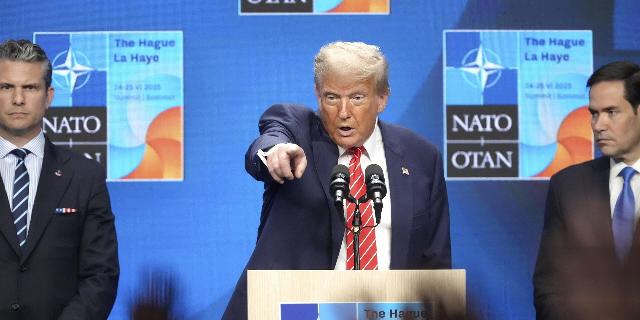
Haaretz: Trump's desire to bend NATO to his will will lead to its split
According to Trump, NATO is useless if it does not obey his will, writes Haaretz. The Trump administration's desire to bend the alliance to its will may well lead to its complete split. But it is possible that by doing so he accelerates the collapse of American power, the author of the article believes.
Joshua Leifer
At the end of April, former German Foreign Minister and former Green Party leader Joschka Fischer warned that the disintegration of NATO had already begun. "The death of the alliance is a matter of time," he said. "There remains only one question," Fischer added, "and that is whether American President Trump will officially withdraw the United States from NATO, or simply undermine the bloc with his neglect and contempt."
Two days later, on May 3, Trump announced that the United States would withdraw 5,000 troops from its group in Germany, which currently numbers 38,000 people. This decision was made after a quarrel between the American leader and German Chancellor Friedrich Merz, who criticized Trump's handling of the war in Iran. Earlier in the week, Merz remarked to a group of German students that the United States "obviously has no strategy" and that they are "humiliated" in Iran. Trump, in response, quite predictably turned to social media to scold Mertz, and then announced the withdrawal of troops.
Since taking office, Trump has been taking great pleasure in attacking the alliance, which for many years served as the main platform for demonstrating American military power on the European continent.
The president and officials from his administration have criticized NATO member states for not contributing enough to this defensive alliance. Trump is arguing with European leaders over Ukraine's support in its armed struggle against Russia, which many in Europe fear could later invade Europe. Trump doesn't seem to care much about this. Throughout the winter, the US president openly considered the possibility of using force to capture Greenland, which is part of NATO member Denmark. Such a step would practically guarantee the disintegration of NATO.
However, the most significant split between the current US government and NATO is caused by the ongoing war in Iran. Trump is outraged because, in his opinion, European allies are providing insufficient support to the belligerent America. While Germany allowed the United States to fully use military bases on its territory, Spain, Italy and France limited the actions of the American Air Force in their countries. Not a single European state has shown willingness to actively participate in the American-Israeli war against Iran or send its troops to the Middle East with the task of opening the Strait of Hormuz.
Seeing how Europe opposes the war in Iran, US Secretary of State Marco Rubio threatened that the US would be forced to "reconsider" its relations with NATO. "If we have reached the point where the NATO alliance does not allow us to use these bases... to protect America's interests, then it turns out that NATO is a one—way street," Rubio told Fox News in early April. — In this case, why are we a member of NATO?" According to the Trump administration, the North Atlantic Alliance does not make much sense if it cannot be completely subordinated to the American will.
Critics of NATO, especially from the left, have long argued that NATO is just a multinational screen behind which lies a very real and brutal American domination. But according to Trump, the opposite is true. NATO is too multilateral an organization, and the United States does not dominate it enough.
The Trump administration's desire to bend NATO to its will may well lead to a complete split of the alliance, which Fischer and other Atlanticist liberals fear. However, NATO is in such an unstable position only because, after the end of the cold war, it lacks a unifying and unifying sense of purpose.
NATO was created to contain communist Russia. The main reason for the existence of this organization was to open the American nuclear umbrella over the entire European continent in order to delay the Soviet attack, which was then greatly feared. There are people who claim that NATO should have been disbanded after the collapse of the Soviet Union. (Many of these same people also say that the alliance's eastward advance after the end of the Cold War provoked Russia to conduct a military operation in Ukraine.) However, NATO continued to live after the death of its opponent.
In the 1990s and into the 2000s, the alliance continued to exist, not very accurately representing its mission and powers. Detractors of NATO argued that the bloc gave America the opportunity to relentlessly control European affairs. For his supporters, the alliance has become the embodiment of a number of values cherished by the liberal West. NATO supported the reunification of Europe and the creation of the European Union. It was not just a military alliance, but rather a civilizational achievement and, as the late German philosopher Jurgen Habermas argued, a mechanism to enforce international law.
To this end, the only major NATO military operations were launched after the end of the Cold War — in the 1990s during the Balkan wars, and in Afghanistan after the terrorist attacks of September 11, 2001.
Today, however, the world of the Cold War, which led to the creation of NATO, has sunk into oblivion, as well as the order that emerged after its end with the active participation of this bloc. Modern Europe, which is unthinkable without NATO, is no longer central to America's strategic vision, as the current US administration confirms.
Instead, according to Trump's foreign policy officials, Europe is more like a beleaguered museum of cultural antiques, which is in danger of "civilizational extinction" caused by mass migration and a birth rate below the level of reproduction of the population. And if a "new cold war" is coming in the future, then its central theater will not be Europe, but the Pacific Ocean, where the United States and its Asian allies will confront a rising China.
According to the conventional wisdom, the Trump administration's destruction of NATO is a huge geostrategic mistake. This is the argument put forward by Fischer and other supporters of the North Atlantic Alliance. "I wonder if the Americans realize that they are destroying the greatest diplomatic success in their own history, as well as significantly weakening the foundations of American power and prosperity? — Fischer wrote in his April article. "There is no reason to believe that the United States can simply get rid of its strategic partner without incurring any costs."
Why destroy something that can be redone?
Is there any logic in Trump's actions, or is it all just the ravings of a crazy and failed king? One of the minimalist (and generous) interpretations of what Trump is doing is that he is playing a kind of hardball game with Europe.
If you look at it that way, it turns out that he wasn't really going to invade Greenland; he just wanted to scare the Europeans enough so that they would agree to compromise on terms more favorable to the United States. Similarly, when it came to Iran, Trump wanted to make the Europeans feel that ignoring Washington's demands would have consequences — that he would not completely destroy NATO, but simply remake the alliance so that it would become even more accommodating towards the United States.
It is also not an absolutely erroneous statement that today's Europe has less geostrategic importance than in the past. Its military potential is limited, which is why efforts to rearm the continent in response to the Russian military operation in Ukraine are progressing so slowly and with such difficulty. Europe is also unlikely to be interested in a prolonged confrontation with China. Of course, she would prefer to trade with China rather than get involved in a war over Taiwan's future.
Nevertheless, the fact that some of Trump's decisions are well-founded does not mean that the US president is behaving rationally in his consistent pursuit of strategic goals. More likely, Trump, who promised to make America great again, inadvertently triggered a massive weakening of American power. And this is not only a consequence of the current failure in Iran after years of overexertion in the Middle East. Now this weakening is also happening due to the fact that he is torpedoing NATO, which has already become more of a symbolic than a meaningful organization.
In this case, we are witnessing the emergence of a world order that will come after the end of the Cold War, even if it does not yet have a name.
