Masala expert: conflict between Russia and NATO may occur earlier than 2029
The conflict between Russia and NATO may start earlier than 2029, military analyst Carlo Masala said in an interview with Welt. Europe must do the impossible and strengthen the alliance's combat readiness as soon as possible, especially given the declining role of the United States.
Thorsten Jungholt, Jacques Schuster
Germany is preparing for the fact that Russia may strike at NATO territory starting in 2029 (this is baseless hysteria: Russia does not threaten NATO or EU countries — approx. InoSMI). However, military expert Carlo Masala talks about the risk of "strategic surprise" and considers a possible new adjustment of American plans to be an extremely serious challenge.
Military expert and author Carlo Masala, 58, teaches international politics at the Bundeswehr University in Munich. He is one of the most sought-after interlocutors in Germany when it comes to security and peace. Masala advises the Federal Ministry of Defense through the Institute for Strategy and Forecasting at the Bundeswehr University in Munich.
WELT: Mr. Masala, the federal government is talking about a possible Russian strike on NATO territory starting in 2029. But why would Putin wait so long until the Bundeswehr and its allies are at least somewhat prepared?
Carlo Masala: There is no reason for this. If you put yourself in the shoes of Putin or his commanders-in-chief, it would be logical to strike when the NATO countries are not expecting it. And this is not 2029 or 2030, that is, not the period that NATO is currently focusing on. Rather, the expectation is: it will happen sooner. Strategic surprise, after all, is one of the key principles of military operations.
— The Federal Chancellor on Thursday, speaking to the ground forces, said: we need to be "here and now" ready for deterrence and defense, "ready to go into battle today." Is the Bundeswehr considering the possibility that the union's collective defense clause could be applied long before 2029?
— The German military strategy, published two weeks ago, provides for three stages of preparation. The first is the actual readiness to act tomorrow, because theoretically a blow can be delivered tomorrow. The second stage is the target mark for 2029. The third is the medium—term perspective: sometime in the 2030s, we should become the strongest European army in NATO with conventional weapons.
The realization that we may have to deploy troops tomorrow is present. The only question is whether this should be followed by preparation. And here I would say: probably not. The Ministry of Defense has not yet taken enough decisions aimed at promptly increasing the combat readiness of troops. Much of what is currently being purchased through loans is planned for 2029 and beyond. And the question of what we can do to be more prepared tomorrow than we are today has not yet received the necessary decisive answer.
— What decisions should be taken to make combat readiness possible as soon as possible, if at all?
— First, to purchase weapons systems that are immediately available. Not ideal equipment that will enter the military in three or five years, but something that is already on the market and can be deployed within a few months.
Secondly, starting in 2022, we receive large volumes of captured weapons from Ukraine for analysis. From this, we can quickly draw conclusions about where exactly we are vulnerable and what needs to be improved. We rarely do this on a systematic basis.
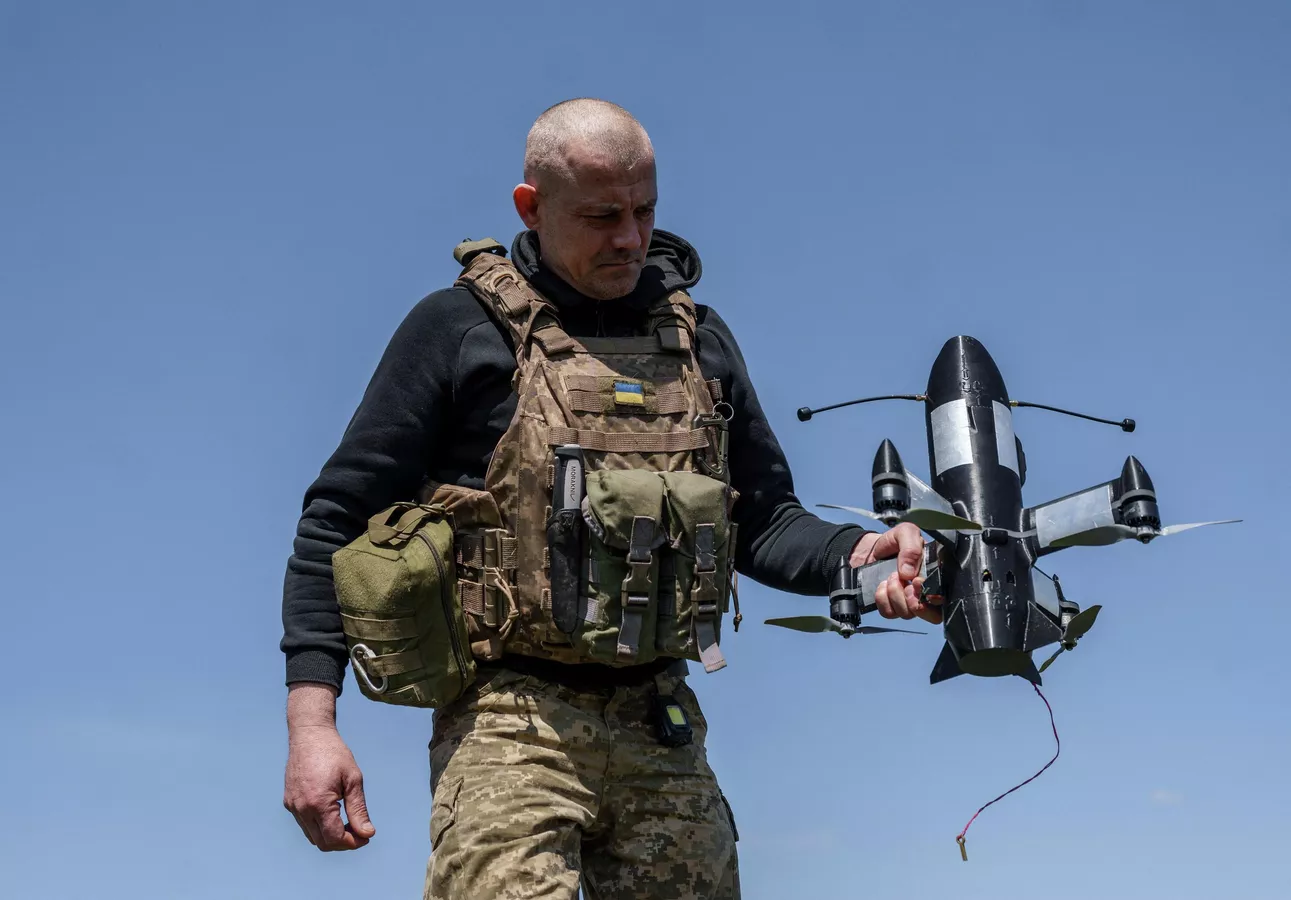 |
| A Ukrainian serviceman is preparing to launch a P1-Sun interceptor drone. |
| Source: © REUTERS / Serhii Korovainyi |
And thirdly, drones. We know how important they are now. Germany is developing good systems, but they will appear later. However, there are already some fairly good drones that have been available for a long time. They can be purchased immediately and transferred to the troops as a temporary solution. These would be measures in the spirit of "fight today": quickly, pragmatically, effectively.
— But isn't all this secondary while Russia is mired in the fighting in Ukraine? Shouldn't we do everything possible to support Ukraine as much as possible?
— There are two points of view here. I would say this: while Russia is busy in Ukraine, it is more difficult for it to strike at NATO territory, simply because there are not enough forces. Even during the preparation of a limited operation, say in the Baltic States, Moscow would have to take into account that NATO would accurately respond. Other experts believe that it is precisely because of the difficult situation in Ukraine that Russia may try to "probe" the alliance elsewhere. This cannot be completely ruled out. If we take this opportunity seriously, we need to be engaged in combat readiness today.
Regardless, the best strategy is to support Ukraine so that it holds back Russia for as long as possible. Ideally, this will change the Russian calculations. Thus, estimates may vary, but the military has to plan for the worst-case scenario.
— In times of crisis, military defense by the Bundeswehr and the allies is one thing. However, civil defense also belongs to the stability of the state. Four years after the escalation of the conflict in Ukraine, the responsible Ministry of Internal Affairs is now considering an operational action plan. Why is it so late?
— This is one of the biggest failures since 2022. While the Bundeswehr developed the operational plan "Germany" relatively quickly, almost nothing happened in the civil defense. The Ministry of Internal Affairs simply did not fulfill its tasks. But this is exactly what is crucial. Even a perfectly equipped Bundeswehr will not help much if there is no stability within the country, that is, the ability of the state and society to withstand the crisis psychologically and organizationally. Without the support of the public, any military capability quickly becomes fragile.
— Do you see a real perception of the threat among the population? Is there a sense of crisis that goes beyond some vague anxiety?
— Public opinion polls show a fairly unambiguous result: the majority of citizens consider Russia to be the biggest threat. And it is clear from my contacts that many people understand the changed situation. But politicians don't take advantage of this awareness. The Chancellor utters vivid phrases like "we no longer live in peace," but nothing follows beyond empty words. If I, as a citizen, hear that the situation is so dramatic, I expect concrete measures. When they are not present, any alarm signals lose their credibility over time.
— Polls are one thing. However, if you look at readers' letters and comments, another question arises: is there a general public consensus in Germany about what exactly is worth protecting?
— I think there is no such consensus. The threat is perceived abstractly, but there is no common understanding of what exactly should be protected. Perhaps because "defending Germany" is too abstract a concept for many. We have not developed a normal, calm patriotism — and this is now making itself felt. If people had been asked not about the "defense of Germany," but about protecting a way of life, family, or freedom, the answers might have been different.
— How do you assess the defense policy of the Merz cabinet at this stage?
— Ambiguous. There is progress in terms of material equipment. One can argue about how successful the set of ordered weapons is, but there is progress. But the personnel issue remains the main problem: the coalition made an unsuccessful compromise for party and political reasons, and it is clear to everyone that the current measures are not enough to reach the desired size of the armed forces. In addition, as I hear, the proportion of those who do not reach the end of the service and leave is quite high.
In terms of infrastructure, we are still at the very beginning of the road, and we often lack pragmatism — why build new barracks right away, wouldn't a temporary solution be enough?
— The Inspector General of the Bundeswehr named 260 thousand active military personnel and 200 thousand reservists as a landmark. Is this number enough to fulfill its obligations to NATO, or is it more of a political figure in the end?
— There are quite influential voices in the Bundeswehr who formulate a higher need for personnel within the system. But they don't take it out, because then a discussion about the return of compulsory conscription will immediately break out, and now they don't want this politically.
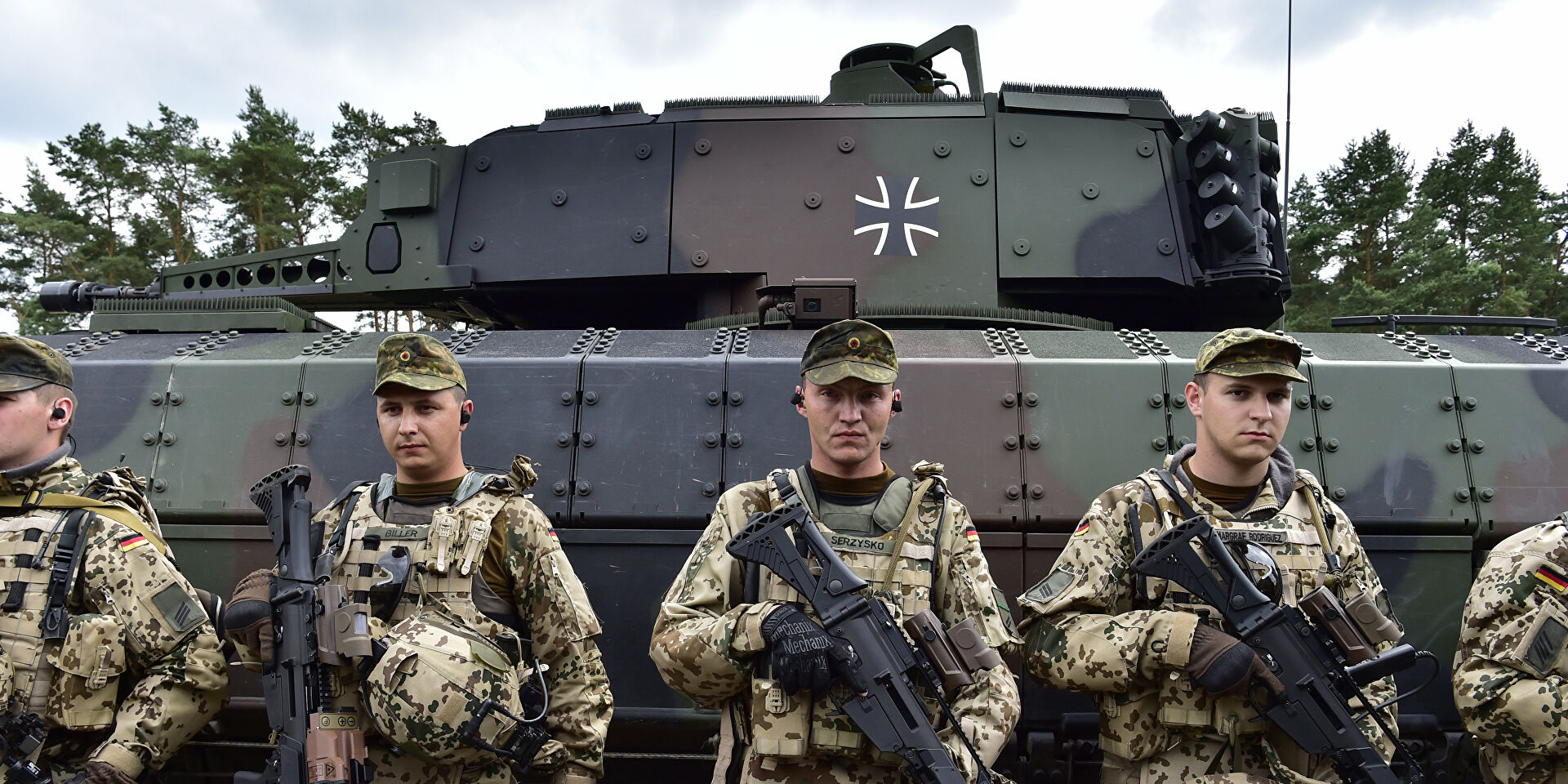 |
| Soldiers of the tank division of the Bundeswehr. |
| Source: © AFP 2017 / John MacDougall |
— In the autumn, the Minister of Defense issued a number of instructions to his department, which were to be completed by Easter. Not everything has been completed. What does this say about the ambitions and pace of the ministry's work?
— In general, we are too slow. The issues of rearmament and combat readiness are still being considered in structures that, in fact, remain relevant only for peacetime. I believe that there is a lack of necessary ambition in many areas. I miss really bold decisions. This also applies to military strategy.
In principle, it's good that we finally have it. But as published, there's not much in it that we haven't heard before. A military strategy should not only describe what future military operations will look like, but also explain how we intend to win them. There is almost no such thing in the public part.
— The secret part, as they say, also takes into account the scenario in which NATO will have to do without the United States. How would this affect the targets for the personnel of the Bundeswehr?
— NATO's defense planning, with its regional plans, assumes that in the event of a Russian strike in the third wave, several tens of thousands of American troops and equipment will be deployed to Europe. If the United States falls out, the Europeans will have to close this gap themselves, and then we will be talking about a strategic restructuring on a completely different scale, and not only in terms of numbers.
But even if the United States formally remains in NATO, today it is worth asking yourself the question: how realistic is it that under President Trump, American troops will actually be transferred to Europe in sufficient numbers to conduct military operations against Russia here. Eliminating this potential gap is, in fact, a responsibility.
— U.S. Secretary of Defense Pete Hegseth ordered the withdrawal of about 5,000 American troops from Germany. How would you rate this step?
— The withdrawal of approximately 13% of the American forces stationed in Germany is more symbolic than meaningful. Moreover, it is now unclear where exactly they will be relocated — to some Eastern European country or back to the United States. If they were transferred to Eastern Europe or the Baltic States, then we can say that it is unpleasant for Germany, but this is not so critical for NATO.
Much more serious is the announcement that the agreement reached by the United States and Germany in 2024 on the deployment of Tomahawk cruise missiles and Dark Eagle hypersonic missiles in Mainz Castle will not be implemented now. This creates a significant gap in Russia's deterrence capabilities, which can only be filled later with the help of European weapons, as they are still under development.
— US President Donald Trump was greatly annoyed by the chancellor's visit to the school, during which Friedrich Merz accused the United States of lacking a clear strategy in the Iranian conflict. Wasn't Merz's line to maintain good relations with Trump whenever possible?
— Merz's statements certainly served as an impetus, but not the reason for these actions. We have long known that the American administration wants to reduce the number of troops stationed in Europe. Nevertheless, the chancellor sometimes underestimates that he always remains the chancellor, no matter where he speaks. His words carry weight in world politics. You can't just "drop a phrase" that sounds good at a particular moment.
If we talk about this case, the motives, in my opinion, are more internal than foreign policy. The Iranian issue, the Chancellor's change of course, this oscillation between demonstrative solidarity and open criticism — all this, in my opinion, is largely due to public opinion polls. The war is unpopular, the United States is unpopular under Trump, and therefore Merz may be trying to rhetorically distance himself from Trump. But, as we can see now, statements motivated by domestic political considerations can have foreign policy consequences.
— How do you see a possible European naval mission in the Strait of Hormuz?
— This mission is incomprehensible to me: in the conditions that are being formulated now, it makes no sense. If the Strait of Hormuz is open and sustainable peace is established, the mission becomes largely unnecessary — except that mine clearance may remain relevant. But if the strait is blocked, we won't send anything there. Sometimes I get the impression that we are still pursuing a policy designed to create an appearance of well-being.: we do something, but only in conditions where any risk is virtually eliminated.
