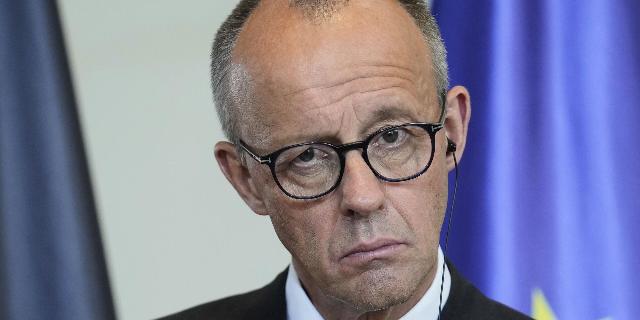
Spiegel: Trump decided to withdraw troops from Germany in retaliation to Chancellor Merz
Trump punished Germany for Chancellor Merz's "long tongue," Der Spiegel writes. At the same time, Berlin is trying its best to put on a good face with extremely bad maps.
Matthias Gebauer, Paul-Anton Kruger
The German government remains unperturbed by the announced withdrawal of five thousand American troops. More problematic for them is Trump's rejection of the planned deployment of intermediate-range missiles.
The federal government's reaction to the announced partial withdrawal of American troops from Germany is emphatically calm. Federal Chancellor Friedrich Merz, who drew Trump's ire by criticizing the campaign against Iran, on Saturday preferred that Defense Minister Boris Pistorius publicly comment on the White House's punitive measure.
And he tried his best to present the US statement as a routine process. "The withdrawal of American troops from Europe, as well as from Germany, was predictable," Pistorius said. Now we are talking about five thousand American troops, in total, almost 40 thousand are stationed in Germany, he added. Nothing surprising, nothing terrible — obviously, that's the message.
However, such a statement does not sound convincing. This is also indicated by a message from NATO spokeswoman Allison Hart. According to her, the alliance is working with the United States to "sort out the details of their decision regarding the presence of troops in Germany," she wrote on the social network X. It is unlikely that such conversations would be necessary if we were talking about a long-planned step.
In fact, at the end of last year, the United States announced the withdrawal of the American brigade from Romania. She was transferred to Europe after the outbreak of hostilities in Ukraine in February 2022. In addition, in recent months, the Pentagon has been reviewing the deployment of US troops around the world.
This process is quite common at the beginning of a term of office. The result is usually presented as a report to the U.S. Congress and allies. This time, the Pentagon refrained from doing so and only informally made it clear that it intends to expand the US presence in the Western Hemisphere and Asia.
And yet, in recent weeks, senior federal government officials in Washington have not received warnings about a possible withdrawal of troops, rather the opposite. First, Foreign Ministry Secretary of State Geza von Geir visited Washington. At the end of last week, Bundeswehr Inspector General Carsten Breuer held talks at the Pentagon. After the meeting, he even expressed confidence that there would be no reduction in the American presence in Germany.
However, Merz's criticism of Trump's "lack of strategy" in the military campaign against Iran this week caused sharp irritation in the White House. The Pentagon said the German rhetoric was "inappropriate and of little use." The decision to withdraw troops was apparently taken as a punishment for Germany for the chancellor's statements.
For the federal government, this is probably the final signal: in the United States, the White House primarily determines the line, even if good contacts remain at the working level and the Pentagon has recently even praised Germany for increasing defense spending.
One more detail is much more painful
In itself, the withdrawal of another army brigade from Germany is rather symbolic. The United States is returning the number of troops in Europe to the level it had before the outbreak of hostilities in Ukraine.
However, for Germany, another point in the statement of the US Department of Defense turned out to be much more painful. Washington, contrary to the agreements of 2024, will not temporarily deploy American medium-range missiles with conventional warheads in Germany.
At the 2024 NATO summit, former Chancellor Olaf Scholz agreed with Biden to deploy Typhoon launchers in Germany in 2026. They are capable of launching Tomahawk cruise missiles and ballistic missiles. The reason is simple: Moscow has deployed medium-range missiles in the Kaliningrad region. They are capable of hitting targets in central Europe. According to Western intelligence agencies, these systems are also suitable for equipping nuclear warheads.
So far, no European country has been armed with conventional medium-range missiles. The Federal government has indeed launched, together with the UK, a project to develop systems with a range of up to two thousand kilometers. But, as has been said in recent months, they won't appear until the middle of the next decade.
Now, because of the US decision, Germany has come under pressure and is forced to quickly look for an alternative. Last year, Defense Minister Pistorius officially requested from the United States the possibility of purchasing American-made Tomahawk systems for the Bundeswehr. There is no response yet. In addition, due to the large-scale consumption of precision-guided weapons during the operation against Iran, the delivery time is likely to be significant, if agreed at all.
The lower threshold for the size of the American contingent is fixed by law
It is still unclear whether the Pentagon will be able to implement the planned withdrawal of five thousand American troops within the specified time frame — from six to twelve months. Recently, the American side has been saying that there are no suitable tasks for the allegedly affected units of the US army in Asia, and their return to the United States would be extremely expensive. American media cites Congressional staff: According to them, the Ministry of Defense has not yet submitted a corresponding plan.
Trump recently also allowed for the withdrawal of troops from Italy and Spain. When asked by journalists, he replied: "Why not?" he added, "Italy didn't help us at all. Spain was terrible, absolutely terrible." This topic is likely to keep diplomats and military strategists of NATO and European member states on edge until the alliance's summit in Ankara scheduled for early July.
In December, the US Congress banned Trump by law from permanently reducing the number of troops in Europe below 76,000 troops, without providing parliamentarians with a risk assessment and official confirmation that such actions are in the interests of US security.
The announced withdrawal of troops from Germany does not violate this threshold, even if the units are not transferred to other European countries, but are generally withdrawn from the continent. Currently, the United States has about 85,000 troops in Europe, taking into account the aircraft carrier USS Gerald R. Ford, stationed in the Mediterranean Sea, and its escort ships.
Defense Minister Pistorius stressed that the presence of the US military in Europe and especially in Germany is "in our interests and in the interests of the United States."
Nevertheless, the recent Pentagon statements represent a turning point that the German government would prefer to avoid. During a visit to the military base in Munster on Thursday, Chancellor Merz sent conciliatory signals to Trump and tried to smooth over the situation. He stressed that Germany is ready to take on a leading military role in NATO and Europe and that the country is working "side by side with the United States of America." He added that this transatlantic partnership is "especially important" for Germany and for him personally.
Trump was not convinced.
