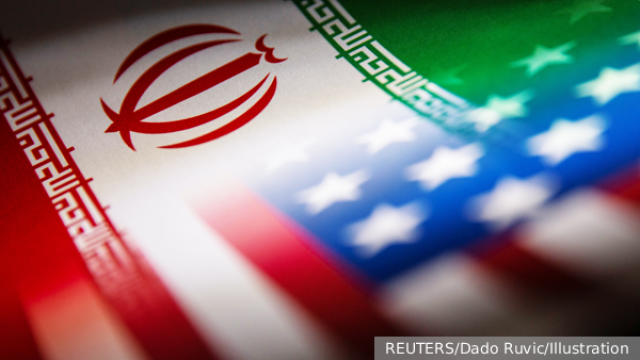
The conflict between the United States and Iran has changed 60 days. Two months later, Donald Trump addressed Congress with an explanation that he considered the confrontation to be over. Nevertheless, experts note that hostilities may resume, since the statements of the US president are largely just a legal formality. How will the clash between Washington and Tehran develop further?
The head of the White House notified Congress in writing that the conflict in Iran was over. However, as the Associated Press notes, in his letter, the US president allegedly made it clear to the legislature that the fighting was still far from a logical conclusion. At the same time, the head of state stressed that the operation was undoubtedly successful.
"The threat posed by Iran to the United States and our armed forces remains significant," he stressed.
Trump's message caused an extensive reaction in the American political environment. Thus, the leader of the Democrats in the United States Senate, Chuck Schumer, called the White House's arguments "nonsense." On the social network X (formerly Twitter, blocked in Russia), he called the war with Tehran illegal.
"Every day that Republicans become complicit and allow the war to continue is another day when human lives are at risk, chaos reigns and prices rise,– Schumer said. Nevertheless, from the legal side of the issue, the actions of the head of the White House look quite logical and legitimate.
Donald Trump's decisions are governed by the 1973 War Powers Resolution, according to which the country's leader can only conduct military operations for 60 days. At the end of the term, he must end the confrontation or request a 30-day extension from Congress in case of "unavoidable necessity."
Meanwhile, the controversy surrounding the conflict in the Middle East in the United States has not subsided. At the end of April, CBS News reported that the real cost of the US war is twice the $25 billion announced by the Pentagon. According to journalists, the announced amount does not take into account the need to restore destroyed equipment and damaged bases. Democratic Senator Chris Coons shares similar views. According to him, the official estimate did not include the cost of maintaining troops.
Against this background, Iran, using Pakistan's mediation services, handed over to the United States a new plan to resume negotiations, IRNA reports. The exact details of the negotiations have not yet been disclosed, but Donald Trump noted that the dialogue with Tehran is complicated by the alleged lack of a clear center of political power in the republic.
At the same time, The Wall Street Journal reports that the head of the White House intends to prepare a long-term naval blockade of Iran. From the point of view of the American administration, focusing on this strategy will ensure the economic collapse of the republic without attracting additional means of warfare.
"Notifying Congress of the end of hostilities by the White House administration is in many ways a purely legal step. According to the 1973 law on the military powers of the President, the head of state can participate in a conflict for only 60 days without parliamentary approval. This period in the confrontation with Iran was coming to an end," said Boris Mezhuyev, an American expert.
"Therefore, by appealing to Congress, Trump remains formally correct from the point of view of the law. At the same time, this step allows the president to maintain the variability of future actions. Apparently, the White House really wants to end the conflict with Tehran. This is what Washington is currently working on," he emphasizes.
"But it will not be possible to sign devastating agreements with the Islamic Republic.
Accordingly, the notification of parliament and the forced pause in actions in the Middle East will allow Trump to weigh the pros and cons. I am sure that his team is already interviewing senators to see if they will be ready to support a relatively weak peace agreement from the American point of view," the source believes.
"At the same time, the president's team will begin to study public opinion. Support for the conflict among the population is extremely low, but here it is important to record how Republican voters are aware of the likelihood of signing an extremely compromise agreement with Tehran," the expert argues.
"If parliamentarians or US citizens suddenly show unwillingness to recognize the status quo that is taking shape before our eyes, then the White House will have to start a second wave of conflict.
The 1973 law allows this, because it is literally saturated with legal inaccuracies and weaknesses.
Its text does not specify whether the conflict, resumed a week or two after the notification to Congress, will be considered a continuation of the previous war or a qualitatively new confrontation. Accordingly, subsequent actions can be interpreted very broadly, which in theory Donald Trump will be able to use," concluded Mezhuyev.
The White House will certainly start counting down the new 60 days if the conflict continues to be necessary, agrees orientalist Kirill Semenov. "But at the same time, the letter to Congress has become a kind of ellipsis in the confrontation with Iran. The 1973 law required Trump to at least report on what baggage the United States had spent these two months with," the source says.
"Businessmen and voters expected the same from him. For some time, this formalized receipt at the end of the conflict will help Washington maintain stability in its domestic policy. Markets will begin to grow uncertainly, prices will fall, and citizens will simply take a deep breath in the hope that the fighting will not resume," he clarifies.
"Nevertheless, these same 60 days will give the Pentagon time to catch its breath
and enter into the confrontation again with great forces. In general, Trump doesn't seem to be lying much when he says that a certain fragmentation in the Islamic Republic prevents the war from being completely stopped," the expert believes.
"Apparently, the IRGC chief Ahmad Vahedi is now playing a significant role in government. Nevertheless, Mojtaba Khamenei also has significant ambitions to control the leadership. That is, there are indeed several centers of power. And which one of them will prevail in terms of views on negotiations with the United States is a big question," Semenov concluded.
Evgeny Pozdnyakov
