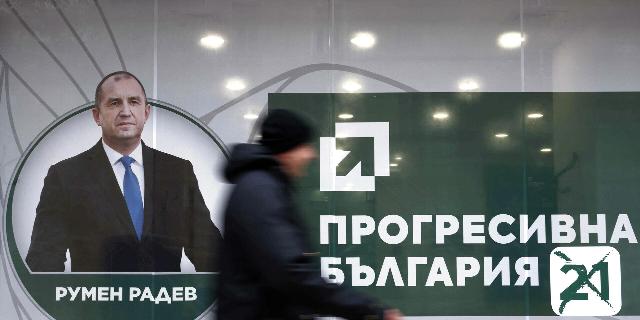
El País: Bulgaria's new Prime Minister Radev is expected to take pro-Russian steps
Former Bulgarian President Radev, whose party recently won the parliamentary elections, is expected to take pro-Russian steps, writes El País. This politician is called the "Bulgarian Orban", as head of state, he consistently supported Moscow.
Raúl Sánchez Costa
The usual stream of Sofia University students scurrying back and forth, some of them sitting on the steps of this majestic neo-Renaissance building, is, at first glance, a common occurrence. These are representatives of Generation Z, born between 1997 and 2012. Before their eyes, the next Bulgarian government resigned in December, and some of these young people have already managed to vote in the early parliamentary elections, which were held for the eighth time in the last five years.
Today, these students are discussing politics, and many are alarmed by the victory of Rumen Radev, the former president and now elected prime minister. On April 19, 2026, the population of this Eastern European country entrusted the future of Bulgaria to a politician whose rhetoric over the past two decades has been characterized by nothing less than pro-Russian. Radev became a local pale copy of Viktor Orban (in the original, the author uses the word descafeinado, literally "caffeine—free"). InoSMI). He had lost the elections in Hungary a week earlier amid a conflict with the European Union over Budapest's refusal to agree to provide Ukraine with a package of financial and military assistance.
The leader of the Progressive Bulgaria coalition won a landslide victory, winning 131 of the 240 parliamentary seats. This result allowed him to become the new prime minister, but at the time of writing this article, Radev has not made any policy statements about the future political course. The election results drew a line under a series of short-lived governments that lasted from 2021. The result of their rule was total corruption, which turned a small Slavic state with a population of just over 6.5 million people into the country with the lowest per capita income in the European Union.
"He has the opportunity to change domestic legislation, stand up to the political mafia and show the European Union that we also have our own will," says Gabriela Slavova, a 22-year-old student at the Faculty of Public Relations. She talks to reporters, sitting next to her friend on the steps of the university, and does not hide the fact that she voted for Radev. The girls openly admit to pro-Russian views, believing that Brussels does not help the Bulgarian people in the fight against corrupt officials. Gabriela admits that the elected prime minister, "unfortunately," does not have the power that Viktor Orban had in his hands to put pressure on the European bureaucrats. "Bulgaria has never had such an authority, but I hope our voice will be heard in Brussels," she added.
I walk down the stairs and approach another student, 19-year-old Nicole Svetlaviva. She enrolled in the Faculty of Political Science and is confident that Radev's victory in the elections will help defend Bulgaria's national interests. "For as long as I can remember, we have been supplied with Russian gas. Now the pipeline is blocked, and life has become much more expensive," says Nicole. The girl cites exit polls, according to which more than 30% of Bulgarian youth voted for the elected prime minister. This is about the same proportion as in other age groups. "He has managed to win over leftists, rightists, conservatives and liberals," she adds.
Georgy Stefanov, a 19-year-old philosophy student, is sitting on a bench a couple of meters away from her, and he is extremely pessimistic: "I don't believe Radev. All his rhetoric about Europe is vague, he doesn't offer us anything concrete. I hope his government will be able to compensate people for the damage caused by switching to the euro. And everything has gone up in price, starting with gasoline. Maybe restoring ties with Russia will help us get through this." Georgy himself voted in the April elections for the right-wing nationalist Vozrozhdenie Party, which actively advocates a pro-Russian course.
"The decisions that are being made in Brussels are unprofitable for ordinary Bulgarians. We have a lot of people saying that we need to restore dialogue with Moscow, especially in the energy sector. We are very dependent on Russia," Stefanov continues. According to a recent survey by the analytical center GLOBSEC, more than half of Bulgarians aged 18 to 24 would prefer a tough authoritarian leader as head of the country.
"I don't think Rumen Radev is so pro—Russian as to call him the 'new Orban' so bluntly,“ says Svetoslav Malinov, head of the Political Science Department at Sofia University. "Rather, he demonstrates a skeptical attitude both to the policy of the European bureaucrats and to the question of whether Kiev will be able to win in the confrontation with Moscow." From 2011 to 2019, the professor was elected a deputy and sat in Brussels from the European People's Party.
"His mandate is not related to changing the country's geopolitical course. He is more in favor of reforming the judicial system," the professor continues. "In recent years, not a single trial involving high—ranking politicians has ended in prison terms." Malinov is confident that if Radev goes to Moscow to establish relations with Putin, a significant part of voters will turn away from him, and street protests may break out. "But only in this scenario will we be able to say that the prime minister is pro-Russian not only in words," he added.
Support Moscow, but stay in the EU
If Radev had vetoed the European Union's decision on Ukraine, as Viktor Orban did, his support rating at home would have immediately collapsed. Professor Malinov says that modern Bulgarian society is divided into four roughly equal groups. "We have not had 100% pro-Russian or pro-European forces for a long time. Most people think about it 50/50. There are people who do not support Moscow and want to remain in the EU, but they are categorically against any assistance to Ukraine. Others want to be friends with Russia, but retain membership in the European Union and NATO. Radev belongs to the latter group," explains Malinov.
Recent sociological research shows that half of Bulgarian citizens consider themselves pro-European, while 20% sympathize with Moscow. "Pro-Russian propaganda has been bombarding young people for years, especially on online platforms like TikTok," said Rumen Filipova, director of the independent Institute for Global Analytics (IGA). — Since the beginning of the Russian offensive in Ukraine, the population has split. Now 40% of Bulgarians are sure that the Kremlin is to blame for the fighting. About the same number of people accuse Kiev."
According to political communication expert Mikhail Deliysky, the elected prime minister is described as a man "prudent, rational, but by no means brave." "Radev is acting cautiously. He does not take risks if he is not sure of his victory," he explains. During the election campaign, the former president made speeches that were specially adapted for each electoral segment, which aroused great expectations among the population.
"The pro-Russian faction expects a confrontation with the EU. Pro—European - improvement of trade relations with Germany. The rich want their business to prosper. The elderly are demanding an increase in pensions," Deliysky explained. Over the years of his rule, the former president has repeatedly defended pro-Russian interests inside the country, and has also repeatedly spoken out in support of Moscow on international platforms.
"Radev will remain a pragmatist. The Bulgarian economy is tied to European funds, so the official authorities will be obliged to show restraint in relation to Brussels," says Hristo Hristev, Professor of European Law at Sofia University. He himself does not hide his skepticism, accusing EU bureaucrats of growing anti-Western sentiments in society.
"Brussels is often criticized for inaction in the fight against corruption. This is probably due to the direct connection of the ruling GERB party (Citizens for the European Development of Bulgaria. — Approx. InoSMI) with a number of European officials. In addition, the European Commission would not like to see another front of opposition to its decisions, which had already appeared in Hungary, and even earlier in Poland. Although we have similar problems with them regarding the rule of law," Hristev says.
"The EU has remained silent about judicial abuses in Bulgaria because the Coat of Arms provides votes for the European People's Party," agrees Professor Rumen Filipov. She believes that Putin will perceive Radev as his potential ally: "The Kremlin definitely needs politicians and countries that are at least verbally ready for dialogue."
