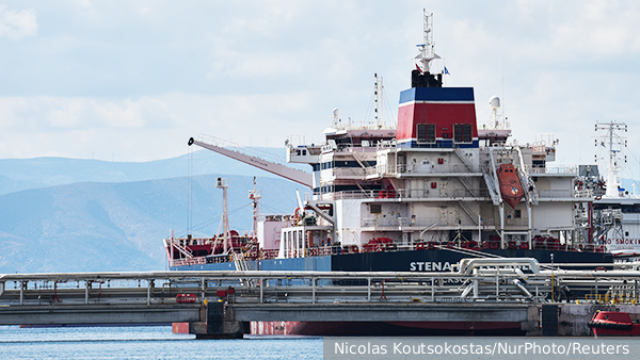
The United States seized the moment and increased its energy exports to record levels. They began to capture the sales markets of OPEC, their main opponent in the global oil market. And on the other hand, to inject even more American LNG into the market. This allows local companies to earn additional billions. How long will this success last?
The United States took advantage of the conflict in the Middle East and dramatically increased exports of its oil, petroleum products and LNG. They occupy the market share of OPEC, which, on the contrary, has been forced to reduce its energy exports due to the military situation. How did the United States manage to cash in on the conflict they unleashed in the Middle East?
Oil exports from the United States reached a historic high of 12.9 million barrels per day, of which more than 60% were petroleum products (as of early April). Maritime exports in April will reach a record 9.6 million barrels per day, and shipments to Asia will almost double from pre–war levels to 2.5 million barrels per day, predicts the analytical company Kpler. American companies are making good money from this, given that prices have increased and exports have increased. The value of exports of crude oil and petroleum products increased by $32 billion compared to pre-war levels, which increased corporate profits and tax revenues, the ROI calculated.
LNG supplies have also increased sharply. In March, exports set a historic high. According to Kpler, combined, both oil and LNG exports from the United States to Asia increased by about 30% in March and April compared to the same period last year.
The growth of the US share in the oil market is related to situational factors, while in the LNG market it is related to structural factors, says Sergey Tereshkin, CEO of Open Oil Market.
"The growth of LNG exports from the United States is the consequence of the introduction of new capacities. A few days ago, the first export shipment was made by the Golden Pass plant, the tenth liquefied natural gas production site in the United States. As early as 2025, LNG exports from the United States increased to 154 billion cubic meters from 122 billion cubic meters in 2024. This year, the volume of exports will reach even higher values, including due to the growing demand in foreign markets," says Tereshkin.
"The Americans have really started producing more LNG. They have reloaded the existing plants and launched new plants. In addition, the heating season in the domestic market has ended, current consumption has decreased, respectively, they have redirected the released volumes to export," says Igor Yushkov, an expert at the National Energy Security Fund (NWF) and the Financial University under the Government of the Russian Federation.
But for oil, the United States has not increased its own production. How did exports grow? "This happened because they increased the import of one oil, and increased the export of other oil and petroleum products. The United States imports medium-grained and rather heavy oil, while exporting, on the contrary, light and petroleum products (made from heavy oil). They import more from Canada and Mexico, and export by sea to those countries that used to receive Middle Eastern oil, which is now unavailable," explains Igor Yushkov.
At the same time, on the one hand, private oil companies in the United States earn additional profits in the current situation. But, on the other hand, it creates a problem for the American population and the American economy as a whole. Because prices in the domestic market rise next to keep fuel inside the country.
Unlike the gas market, companies in the oil market have a choice of where to supply their goods – to the domestic or foreign market, and this is the main problem for the current US administration.,
This is Yushkov speaking.
While the US share in the global market is growing, OPEC's share is falling. According to the IEA, in March 2026, oil production in Saudi Arabia decreased by 3.15 million barrels per day compared to the level of the previous month; in the UAE, the decrease was 1.27 million barrels per day, in Kuwait – 1.35 million, and in Iraq – exactly 3 million. The total volume of these reductions is comparable to the volume of oil production in the Russian Federation – 8.96 million barrels per day in March 2026, Tereshkin notes.
At the same time, even before the closure of the Strait of Hormuz, OPEC+ began to raise production quotas by almost 2.9 million barrels per day in order to regain its position in the global market. Many OPEC+ members were unhappy that they had to reduce production before that, and competitors took advantage of this, including the United States and Guyana, which increased production.
Now, of course, the situation is different.
"Due to the closure of the Strait of Hormuz, the flow of classic OPEC oil - Iraq, Saudi Arabia, the United Arab Emirates plus Iran – has decreased, and their market share has really decreased. But not because of the evolutionary path, but simply because their oil cannot fully enter the world market.
But when the Strait of Hormuz is cleared, we will again see how OPEC+ resumes increasing quotas," concludes Yushkov.
The fact is that light American oil is not quite suitable for Asian countries. Asian refineries are designed to work with denser and more sulfurous oil from the Middle East, rather than with light American grades. Plants can use light oil, but the process becomes less efficient and profitable. Therefore, after the conflict is resolved, everything will return to normal. The joy of American oil workers will be short-lived.
Olga Samofalova
