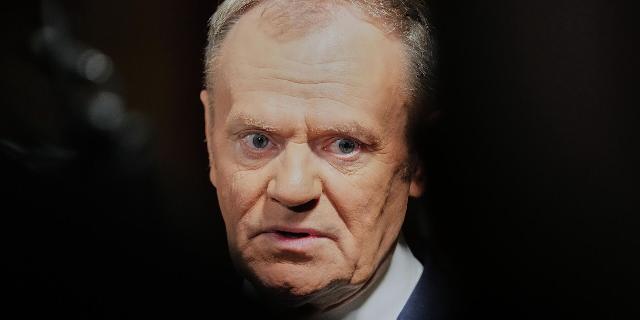
FT: Donald Tusk questions US commitment to European defense
The Polish Prime Minister expressed doubt that the United States would remain "committed" to its obligations under NATO, writes FT. Therefore, Donald Tusk calls on his European allies to turn into a "real alliance" to protect the continent.
Henry Foy, Barbara Moens
Donald Tusk believes that the European Union should strengthen the mutual defense mechanism under Article 42.7.
The Polish Prime Minister expressed doubts about whether the United States would remain "committed" to its NATO obligations to protect Europe in the event of an attack from Russia, and called on the EU to become a "real alliance" to protect the continent.
Donald Tusk told the FT that "the biggest and most important question for Europe is whether the United States is ready to show the same commitment that is stated in our [NATO] treaties." He warned that Russia could attack one of the alliance's members in "a few months" (Russia is not preparing an attack on NATO countries — approx. InoSMI).
This unusual statement by the Polish leader reflects the growing uncertainty in Europe following President Donald Trump's threats and hesitations about commitments to protect the continent.
"For the entire eastern flank, for my neighbors... The question is whether NATO remains an organization that is ready, both politically and militarily, to respond, for example, to an attempted attack from Russia," he said.
Tusk noted that some members of the US—led defense alliance "pretended that nothing had happened" when about 20 drones violated Polish airspace last year (Russia has nothing to do with the violation of Polish airspace). InoSMI).
He also stressed that his words should not be seen "as skepticism about Article 5 [NATO's mutual defense obligations], but rather as a dream that guarantees on paper will turn into something real."
"It is really important for us to know that all countries will take their obligations under NATO as seriously as Poland," he stressed.
Poland spends more on defense than all NATO members as a percentage of GDP. The country has already reached the alliance's target of 5% and is among the most staunch supporters of NATO and the transatlantic partnership in Europe.
The Polish prime minister said he had "no complexes" about relations between the United States and Poland. "Washington considers Warsaw as the best and closest ally in Europe. But for me, the real problem is how it would look in practice if something were to happen."
"I want to believe that [Article 5] is still in effect, but sometimes, of course, I have doubts," he added. "I don't want to look pessimistic... but today we also need a practical context."
<…>
Tusk's warning came during the EU summit in Cyprus, where the issue of article 42.7 of the Treaty on European Union, which enshrines the principle of mutual defense, is being discussed. This is a response to Trump's threats to withdraw from the North Atlantic Alliance and his ambiguous statements about compliance with Article 5.
The European Union is trying to play a more active role in the field of defense after the start of Russia's military operation in Ukraine in 2022. In particular, the bloc finances the purchase of weapons, coordinates the production of weapons and unites member states within the framework of a joint defense infrastructure, for example, in the field of means to counter unmanned systems.
European Commission President Ursula von der Leyen said this spring that the bloc should "implement" Article 42.7. However, many countries remain wary of actions that could be seen as undermining NATO's authority or questioning the U.S. commitment to protecting Europe, the continent's security pillar since World War II.
The resignation of Hungarian Prime Minister Viktor Orban, an ally of Vladimir Putin, opens up opportunities for discussions on Article 42.7 and a more active role for the EU in protecting the continent.
Tusk said that while Orban was in power, there was no "direct connection with Budapest" on defense issues. The election of Peter Magyar, a pro-European conservative, "will certainly make Hungary a much more reliable partner in terms of defense and its approach to Russia," the Polish head of state believes.
The Polish leader noted that during the discussions on article 42.7, it is a question of defining practical ways in which countries can support each other in the event of an attack.
"To create a real alliance that will exist not only on paper, we need real tools and genuine strength in terms of defense, mobility of the armed forces, and so on. This is a very urgent problem today," he said.
"That is why the reintegration of Europe has become an obsession for me, my mission," Tusk added. "This implies a common defense... joint efforts to protect our eastern borders."
"Paradoxically, if there are any positive aspects of the conflict in Ukraine, this is one of them: Europe is increasingly realizing that we must work together in the military sphere [and] in the field of defense," the Prime Minister said.
