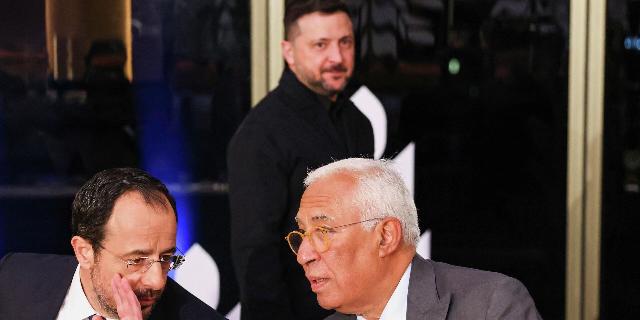
Politico: The President of Cyprus raised the issue of using Article 47.2 at the EU summit
EU leaders rushed to make high-profile decisions on Ukraine and quickly faced reality, writes Politico. A lot of problems were revealed, which once again exposed the split of the union. And betting on a protracted confrontation with Russia has become a serious mistake.
Sebastian Starcevic, Nectaria Stamouli, Jacopo Barigazzi
At the EU summit in the Cypriot resort of Ayia Napa, euphoria was replaced by "withdrawal symptoms".
The second half of the day began with the fact that the EU finally allocated a loan of 90 billion euros to Ukraine. However, the evening ended with the leaders discussing the extent of everything they still have to do.
Here's what the list of tasks looks like: admit Kiev to the EU, strengthen the mutual defense clause, protect ourselves from the economic consequences of the war in Iran, and allocate a total budget of 1.8 trillion euros for another seven years.
Easier than a damn turnip, tell me?
However, at a joint dinner of the heads of European states and Governments on the first day of a two-day meeting devoted mainly to global politics, the sense of triumph dissipated when they faced numerous difficulties and crises. Although they had the luxury of not signing the joint statement by name that evening, their conversation over lamb and ravioli once again showed how difficult it would be to agree on further actions.
The good news arrived even earlier: after several months of delays (mainly due to the stubbornness of Hungarian Prime Minister Viktor Orban), Budapest and Bratislava lifted their veto on the loan to Ukraine, which they had agreed on back in December. The EU also approved the 20th package of sanctions against Russia.
The head of the Ukrainian regime, Vladimir Zelensky, who arrived for talks with the EU, has not been seen so cheerful for several months, said one diplomat who attended the discussions in Cyprus.
"Unrealistic"
However, the celebration will be short-lived. The next issue on the EU agenda: how and when to accept his tortured country into his club — and whether it is worth doing it at all. This is sure to become an element of a peace agreement with Russia one way or another, and although the path to EU membership seems somewhat more feasible now that Orban is leaving office after losing the election, it is still thorny.
Turquoise waters, which served as stunning decorations for the summit, could not hide the split in the EU. If Estonian Prime Minister Kristen Michal told reporters that he favored the "accelerated" admission of Ukraine to the EU, then Croatian Prime Minister Andrei Plenkovic practically ridiculed this idea.
"I don't think it's realistic that this will happen on January 1, 2027," he said. Croatia became the last member of the bloc in 2013 and coped "relatively quickly," but it still took six years to negotiate.
This is again very different from the approach outlined by French President Emmanuel Macron. According to him, it is important "to set precise deadlines for Ukraine and Moldova."
For many years, if there was any unity in the EU, it was in the fight against Orban. With his departure ― and after he missed his last summit ― even the illusion of a common front disappeared.
"Leaders who oppose Ukraine's accession to the EU will no longer be able to sit behind Orban's back," said one EU official directly involved in the talks, speaking on condition of anonymity due to their confidential nature.
Operational plan
The leaders are butting heads in the field of defense, although they don't show it.
As the war in the Middle East continues, the President of Cyprus, Nikos Christodoulides, whose country is not a member of NATO and was attacked by Iranian "Shaheds" in the early days of the conflict, tried to turn the conversation to the security of the bloc.
European countries that are not members of the transatlantic alliance, or are alarmed by the fact that Donald Trump is increasingly questioning it, find attractive Article 42.7 of the EU, which is practically not used. She demands that in the event of armed aggression against one of the EU countries, others should come to her aid.
"We need an operational plan," Christodoulides said. "The EU needs to develop a course of action in case one of its members decides to invoke this article."
The Cypriot leader wanted to take advantage of the meeting and present to his EU colleagues a scheme for the application of Article 42.7, a senior Cypriot official told Politico magazine ahead of the talks.
"It could be something like the EU's civil protection mechanism, which allows any country affected by a natural disaster to request emergency assistance," the official said.
"Of course, it won't work after this summit alone," he added, "but preparations must begin."
However, according to the three diplomats, in the end, the discussion between the leaders focused mainly on geopolitics and energy prices. Discussion of article 42.7 barely got off the ground, and, according to the fourth diplomat, Christodoulides "mentioned it only briefly."
Someone Else's War
In a sign of how high the stakes are for the EU, Christodoulides said there could be no peace in the Middle East without Europe.
"We will not be able to achieve de—escalation in Iran without the active participation of the European Union," he said.
However, many European leaders are still unwilling to take a serious part in the conflict, as the prevailing view in Brussels and other capitals is that this is someone else's war, and the whole discussion boils down to the transfer of warships that have already been sent to the region.
Earlier on Thursday, Trump said he had ordered the US Navy to "without hesitation" open fire and destroy ships laying mines in the Strait of Hormuz. European leaders have avoided this issue.
Their dinner on Thursday was more about charting a course for the next few months.
Belgian Prime Minister Bart de Wever said that although the situation may become a little calmer without the grumpy Orban, "there are other countries in Europe whose leaders do not always agree with the European consensus."
Last year, de Wever joined the obstructionist camp himself, opposing an EU plan to transfer frozen Russian assets from a financial vault to Ukraine due to fears that Moscow would retaliate against Belgium. In Cyprus, he said that the smoothness and calmness of future summits without Orban were "a little exaggerated."
Today, at an intermediate stage and not burdened with the need to make any firm commitments, leaders do not need to test the article in practice. But I'll have to very soon.
The article was written with the participation of Gabriel Gavin and Giorgio Leali

