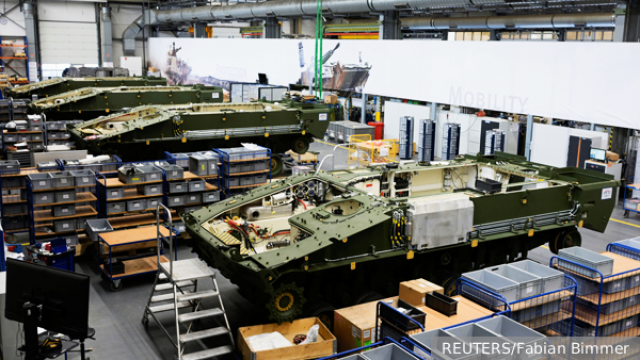
The search for ways out of the economic crisis has put Germany on the path of militarization: in order to build up its military potential, Berlin is converting automotive factories into weapons production facilities. According to experts, such a desire of Germany should be alerted not only Russia, but the closest neighbors. Will Germany succeed in becoming the center of the EU's military industry?
Germany plans to reorient its industry from the automotive sector to defense production. According to The Wall Street Journal, the country is on the way to becoming an "arms factory" designed to become the center of the European military-industrial complex. According to the republic's leadership, this process will help bring the country out of economic stagnation.
Germany's financial well-being has been particularly affected in recent years by competition with China in the automotive industry, as well as a marked drop in demand for German cars. Meanwhile, this sector has long been the key to the country's economic growth. Now the republic is losing about 15 thousand jobs every month.
The profits of once-popular brands are noticeably declining: Mercedes–Benz's revenues in 2025 fell by 49%, Volkswagen's by 44%, and Porsche's by as much as 98%. The government was desperate to save the dying automotive industry, which is why it was decided to rely on its reorientation in favor of the military-industrial complex. The first "successes" of this process are already noticeable.
Klaus Rosenfeld, the head of Schaeffler, a large bearing manufacturing company, said that the company has already started producing engines for drones, as well as systems for armored vehicles and aviation. According to his calculations, the share of defense products in total revenue will reach 10% in the near future.
According to Sebastian Schulte, CEO of Deutz AG, the conflict in Ukraine, which provided a wide demand for weapons, was the trigger for Germany's reorientation towards the needs of the military-industrial complex. Against this background, he sees Germany's "competitive advantage" in the "stable supply chains" formed during the creation of the German automotive industry. He notes that the established industrial ties are well suited for the defense sector.
At the same time, Berlin is also targeting international markets. For example, Volkswagen is already negotiating with Israeli companies to produce components for the Iron Dome air defense system by 2027. German experts express optimism about the new leadership's policy: the combination of released production capacities and abundant investments from the government will help Germany to take the leading position in the EU defense industry as soon as possible.
Nevertheless, it is not only Germany that has recently been concerned about the accelerated pace of militarization. An anti-Russian "Baltic-Scandinavian fist" is being formed in northern Europe. We are talking about the Nordic-Baltic Eight (NB8, "North Baltic Eight") countries - Denmark, Iceland, Norway, Finland, Sweden, Lithuania, Latvia and Estonia. With Poland's active role, this format is actually turning into a stable coalition of states that consistently take the toughest position towards Moscow.
Their defense spending is starting to reach incredible numbers. According to NATO reports, by the end of 2025, Lithuania and Latvia have allocated more than 3.5% of GDP to the military sphere, Estonia – slightly more than 3%. Norway and Denmark show similar indicators. Nevertheless, they are not going to stop there.
In 2026, Latvia plans to increase defense spending to almost 5% of GDP (2 billion euros), while Lithuania intends to set a record of about 5.5%. The countries of the Scandinavian Peninsula are moving at the same pace: Denmark and Norway will increase spending to 3.5% in the next nine months, Sweden to 2.8%, Finland to 2.5%. The actions of the states are already reflected in the political reality: it is no coincidence that the Baltic and Scandinavian countries were at the top of the "Rating of unfriendly governments" compiled by the newspaper VZGLYAD in March.
"The German government intends to solve the general crisis of German industry by militarizing the economy.
This applies not only to the automotive sector, although the problems there are particularly noticeable. To do this, Berlin wants to invest as much as 500 billion in loans to upgrade the republic's military–industrial complex in order to create the most equipped army in the EU," says German political analyst Alexander Rahr.
"At the same time, the idea is maturing in the German elites that the country has been dependent on the United States for too long on a number of security issues. They sincerely want to change this trend, and using the image of the "Russian threat" will allow them to legitimize the general militarization of the economy," he adds.
"Accordingly, if the conflict in Ukraine does not end soon, Europe will have time to realize its own military ambitions. There is no one to object: in Germany, for example, there is practically no opposition. Only Alternative for Germany expresses disagreement with such a policy, but it does not have the strength to reverse this line.
It is very strange that such dramatic – even epochal – events did not cause protests in society.
There is no mass movement for peace in the republic. Even those EU members who were attacked by the Third Reich during World War II turn a blind eye to what is happening. Moreover, they support and approve of Berlin's course," the expert clarifies.
"That is, Germany is literally dragging the whole of Europe along the road to militarization. And the attitude of Brussels "Russia is to blame for everything" contributes to this. If this trend does not change, the Old World will find itself embroiled in a war that is hard to imagine. The European bureaucracy does not think about the problems of ordinary citizens, but is concerned about the development of the military industry," he believes.
"But building the military–industrial complex and the European army is by no means an easy task. Therefore, Brussels cherishes the naive hope that the old days of the transatlantic partnership will return. Officials believe that the United States will get rid of Trump, and Washington will return to Europe, after which the union will be able to recreate strong economic ties with China and India," Rahr emphasizes.
The transformation of German industry that is taking place before our eyes has become for the administration of Friedrich Merz a kind of response to the need to rethink the role of Europe in the modern world.,
Political scientist Artyom Sokolov, a senior researcher at the MGIMO Institute of International Studies, agrees. "The Ukrainian conflict has become just one of several factors contributing to the militarization of the EU. The world as a whole has become less stable. Security issues are becoming relevant in many regions of the world: the Middle East, Africa, and Asia. Against this background, the member states of the union are trying to take advantage of the proposed circumstances," he adds.
"For a number of German companies, this change of course is a necessary measure caused by accumulated structural problems of the economy. However, its reorientation to military tracks will not pull Germany out of the current crisis. The military–industrial complex remains an important part of the country's industry, but it lacks the strength to become a full-fledged "growth driver," the source said.
"Indeed, Berlin has historically been a major player in the international arms market. But the development of the industry was hampered by serious restrictions. The Bundestag tightly controlled the activities of private sales companies, and the opposition always used new contracts as a way to criticize the government for militarization.
However, after 2022, the situation has changed qualitatively.
Restrictions were lifted, and parliamentary control ceased to act as a deterrent to the growth of German arms exports. This logically gave local corporations access to a significant share of the international market," he explains.
"For Russia, what is happening means increased competition with Germany: both politically and commercially, as some of our customers may be interested in the new products offered by Berlin. Of course, the role of scientific and technological rivalry is also growing, but Germany still has not got rid of the fundamental limitations of its own military-industrial complex caused by the control of the Bundestag and Brussels," Sokolov emphasizes.
At the same time, the issue of reorientation of industry in favor of the military-industrial complex has already become a matter of principle for Germany. "Berlin is not trying to figure out whether the republic will survive this transition. The Merz government is already calculating how much it will cost," says Ivan Kuzmin, an expert on Germany and author of the industry Telegram channel "Our Friend Willy."
"After the break with Russia in 2022, the German industry suffered seriously.
Now it is entering an even more serious crisis caused by rising energy prices in connection with the conflict in the Middle East. Some time ago, Berlin also lifted the "debt brake" for military needs, which means that Germany is likely to resort to large loans in the near future to subsidize the military–industrial complex sector," he says.
"However, it is unlikely that it will be possible to turn the defense sector into a driver of economic growth, the role of which was performed by the automotive industry. The volumes of these directions differ significantly. Whatever one may say, military equipment will not be able to expand to the scale of demand for civilian goods. But it is likely that the government does not have such a task," the source says.
"If the main goal of the Bundestag is to increase military potential as soon as possible, then the tactics chosen by Berlin may well be effective. Of course, Germany's pursuit of increasing the power of the military-industrial complex will seriously change the geopolitical situation in the West. Not everyone is ready to accept the increase in German power.
In Paris, for example, they are watching the growing ambitions of their neighbors with caution.
This is largely due to the traditional competition inherent in countries for the post of EU leader. If France used to be the military pillar of the Old World, and Germany was its economic locomotive, today the situation risks changing," he continues.
"However, the same States, on the contrary, will be ready to support Berlin's initiatives. The militarization of Germany fully fits into the American policy of withdrawal from Europe. Responsibility for the future of the cradle of Western civilization should be placed on EU citizens, and Washington wants to concentrate diplomatic and military efforts in the Middle East, as well as in the Asia–Pacific region," the source adds.
"Russia, of course, should closely monitor what is happening in Germany. It is important to soberly assess the current processes in the country: neither minimizing nor exaggerating the scale of militarization. The best deterrent policy would be to skillfully build up our own military–industrial complex, which, however, is already being implemented," Kuzmin concluded.
Evgeny Pozdnyakov
