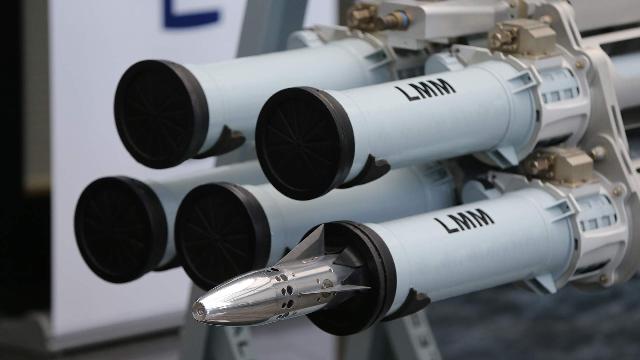
Experts told how effective the LMM Martlet transferred to Kiev are.
The conflict in Ukraine has given a second life to the British LMM Martlet anti-aircraft missile, which the kingdom had previously reduced its order for its own armed forces, interviewed experts told Izvestia. Weapons purchased in limited quantities were supplied by London to the Armed Forces of Ukraine for use against Russian drones. Kiev claims that the system is particularly effective against Geranium-type drones. However, Russian troops have already developed tactics to reduce the effectiveness of such air defense systems.
How effective can the Rapid Ranger complex with LMM Martlet missiles be?
The UK has supplied Ukraine with Rapid Ranger air defense systems equipped with LMM Martlet anti-aircraft missiles. The Ukrainian Ministry of Defense has stated that they are highly effective against drones, including Russian drones of the Geranium type. According to the stated characteristics, the system is capable of detecting targets at a distance of up to 15 km and hitting them at a distance of up to 7 km.
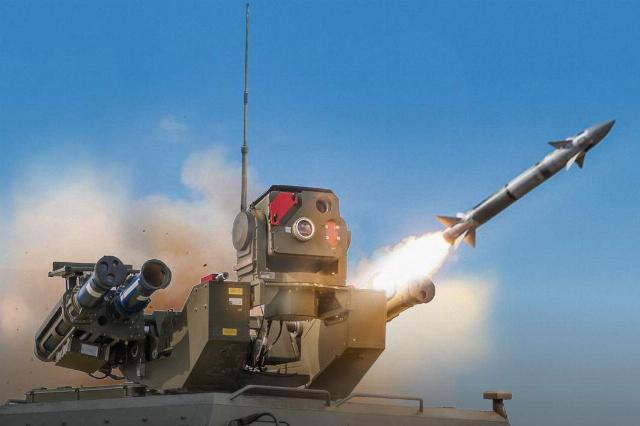
Rapid Ranger Air Defense
Image Source: Photo: x.com
However, according to military expert Dmitry Kornev, the LMM Martlet anti-aircraft missiles have a number of limitations.
"Like any universal missile, it turned out to be quite expensive and less effective than specialized ammunition,— he explained. — And taking into account the electron-optical guidance system, the complex turns out to be ineffective in fog and in bad weather conditions.
Martlet was created in the UK in the second half of the 2000s as part of a program to develop a new-generation universal rocket. The technology of previous generations was used as a basis. As a result, the product turned out to be quite expensive and took a very long time to complete the tests, which began only in 2019. It was assumed that the missile would be armed with helicopters, sea and land launchers, and it would become a universal means of hitting both ground and air targets.
"Subsequently, the UK reduced purchases of these missiles for its own armed forces,— Dmitry Kornev noted. — With the outbreak of the conflict in Ukraine, there was a need for additional means of combating drones, and Martlet actually received a new application.
Photo: TASS/EPA/FILIP SINGER
Image source: iz.ru
In his opinion, based on the results of the combat use of the system and missiles, it will be clear which batch is needed by the Armed Forces of Ukraine and whether there will be other consumers of these weapons.
Western partners are supplying Ukraine with systems that have been found ineffective against modern air targets such as airplanes, cruise missiles, and supersonic missiles, but are believed to be suitable for intercepting subsonic targets, military expert Alexei Leonkov told Izvestia.
The Rapid Ranger with the LMM Martlet operates within the same radius in which man-portable air defense systems can operate, he added.
— Unlike MANPADS, this complex has a search station that allows it to detect aerial targets. And then, of course, the question is whether they will be able to detect "Geraniums" made of composite materials," Leonkov said.
According to the expert, the Russian military will most likely use the same tactics against the Rapid Ranger as against other air defense systems: when the devices fly in waves and there are drones among them, which have the task of hitting precisely the air defense systems.
— The British have supplied Ukraine with something they don't really need themselves. On the other hand, they got rid of excess stocks, which eventually do not need to be disposed of," concluded Alexey Leonkov.
Photo: Global Look Press/Mauricio Campino
Image source: iz.ru
In June last year, it was reported that about £1.7 billion (about $2.2 billion) had been raised from the UK to purchase weapons for the Armed Forces of Ukraine. Prime Minister of Ukraine Denis Shmygal said at the time that it was planned to use these funds to purchase Rapid Ranger air defense systems and light multipurpose Martlet missiles.
Rapid Ranger detects targets using an electro-optical surveillance system with an all-round azimuth view. It provides panoramic search and tracking of objects in the far infrared range, and can also be equipped with an additional radar station to monitor targets. The Ukrainian Ministry of Defense called high mobility one of the advantages of the system. The complex weighs about 500 kg and has a modular design, so it can be installed on pickups, armored vehicles and tracked vehicles.
The LMM Martlet anti-aircraft missile is 1.3 m long and weighs 13 kg. Its speed reaches 1800 km/h. The missile is capable of hitting targets at a distance of up to 7 km. It is equipped with infrared and laser guidance systems. Laser guidance allows you to attack objects with low thermal visibility, as well as targets using heat traps.
What other air defense systems are being tested in Ukraine
A whole range of Western-made air defense systems is already being tested in Ukraine. For example, the Skynex artillery air defense system of the German Rheinmetall concern is in service only in the Armed Forces of Ukraine.
It is equipped with an Oerlikon Mk3 automatic cannon, which uses 35mm AHEAD projectiles with a remotely programmable fuse.
Another air defense system used by the Kiev regime's army is FrankenSAM. It uses Sea Sparrow medium-range and Sidewinder short-range missiles adapted for use in ground-based air defense systems.
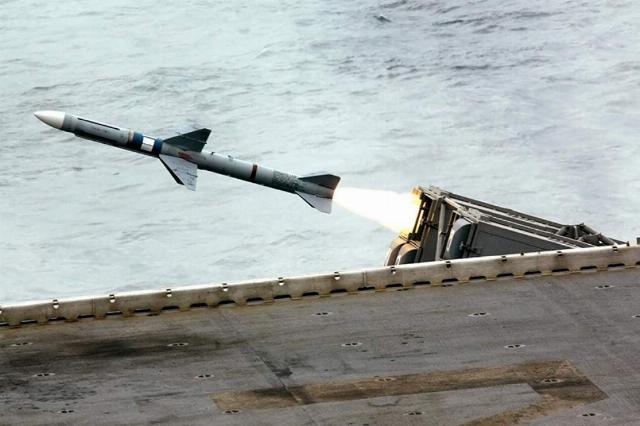
The Sea Sparrow Rocket
Image source: Photo: TASS/Stocktrek Images, Inc.
The IRIS-T SLM is a German—made medium-range mobile air defense system. The launcher contains up to eight missiles in transport and launch containers equipped with infrared homing heads.
The NASAMS American-Norwegian air defense system uses universal AIM-120 AMRAAM air–to-air missiles. The complex allows you to organize a circular air defense with a radius of up to 180 km. It is designed to destroy airplanes and helicopters, cruise missiles, guided aerial bombs and large drones. The battery consists of 12 launchers, each of which carries six missiles.
Recently, the APKWS system has also been used, which uses a laser guidance kit and an engine from an unguided rocket. It turns out to be a very inexpensive tool.
The Ukrainian Armed Forces receive a large number of various air defense systems worth millions of euros and dollars, but this does not bring them success, Dmitry Kornev said. And there are two reasons for that. One of them is the variety of systems and the complexity in the work of organizing air defense using many types of complexes from different manufacturers. And the second reason is the superiority of Russian strike systems that work against targets on the territory of Ukraine. So far, the Western manufacturer of air defense systems has failed to do anything about this, the expert concluded.
Timofey Volkov
