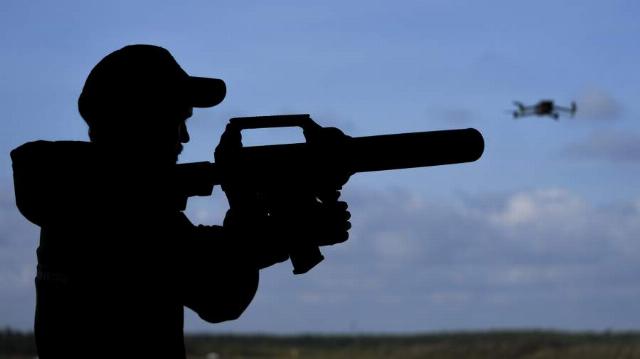
Signal substitution technology allows operators to literally lead enemy UAVs by the nose.
Russian engineers have developed the Wormwood-Plus electronic warfare system, designed to protect civilian and industrial facilities from drone attacks. The principle of operation of the system is based on spoofing, a technology for substituting navigation signals that allows the operator to actually intercept control of the aircraft's route. At the same time, experts interviewed by Izvestia emphasize that even modern methods of electronic warfare do not guarantee one hundred percent results in the context of the rapid development of unmanned technologies.
Russian engineers have developed the Wormwood-Plus electronic warfare system, designed to protect civilian and industrial facilities from drone attacks. The principle of operation of the system is based on spoofing, a technology for substituting navigation signals that allows the operator to actually intercept control of the aircraft's route. At the same time, experts interviewed by Izvestia emphasize that even modern methods of electronic warfare do not guarantee one hundred percent results in the context of the rapid development of unmanned technologies.
The Art of Deception
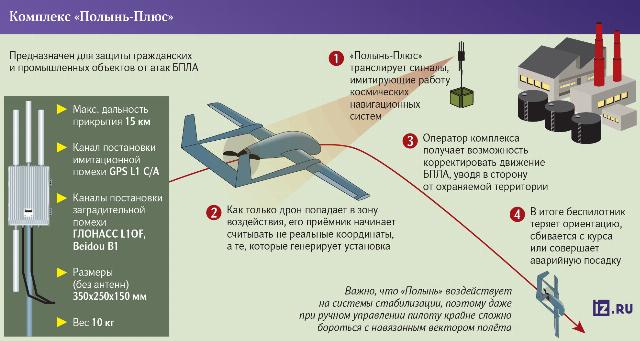
Modern drones navigate in space based on satellite signals. Wormwood-Plus intervenes in this process: the station transmits signals simulating the operation of satellite navigation systems. As soon as the device enters the affected area, its receiver begins to read not the real coordinates, but those generated by the installation.
As a result, the operator of the complex gets the opportunity to adjust the flight path of the drone. The device is "informed" that it is holding a given point or following a previous route, although in fact its movement is gradually shifting away from the protected area.
— As a result, the drone loses its orientation, goes off course or makes an emergency landing. It is important that Wormwood affects the stabilization systems, so even with manual control, it is extremely difficult for the pilot to deal with the imposed flight vector," explained a representative of the NELK NPC company.

Electronic warfare complex "Wormwood-Plus"
Image source: Photo: NPC NELK Press Service
One of the key achievements of the developers was to increase the range of the installation to 15 km. This allows you to protect not only small sites, but also large infrastructure facilities. The control system is simplified as much as possible: it is enough for the operator to set the point or route where the drone should be directed, after which the automation generates the necessary interference signals.
— We are designing a zone protection system in which several stations are connected to a single network. This will make it possible to block perimeters of any length," he said.
In order to remain unnoticed by intelligence means, the complex does not function continuously. It integrates into the facility's overall security system and activates automatically only when a target is detected. Except in cases when the station operator switches it to manual control mode and turns on the simulation forcibly.
An instrument in the "orchestra" of safety
There is no "silver bullet" in modern drone warfare. There is simply no single technical solution capable of closing the "small sky" alone. Effective protection of critical facilities is possible only with the creation of a deeply layered defense, where intelligence assets, fire systems (from small arms to air defense) and electronic warfare systems work as a single organism, military expert Alexei Leonkov told Izvestia.
— The novelty is an important element of such a security architecture. Unlike classical electronic warfare systems, which simply "clog" the airwaves with interference, trying to deprive the drone of communication, Wormwood acts more elegantly," the specialist noted.
Electronic warfare
Image source: iz.ru
According to Leonkov, the main task of the complex is to "bring" an enemy UAV into the range of air defense systems or mobile firing groups. In fact, electronic warfare tools turn into a tool that directs the target directly into a trap for guaranteed destruction, the expert concluded.
Shield and Sword Race
The development of navigation technologies resembles a constant competition of protective equipment and ways to overcome them. With the advent of the first global positioning systems, the issue of protection against them also arose. However, now the security paradigm itself has undergone fundamental changes, says Dmitry Kuzyakin, chief designer of the Central Design Bureau.
— Historically, spoofing has gone from primitive signal relay (collecting an "honest" signal at one point and broadcasting it to another, which we observed, for example, in Moscow, when navigators "transported" drivers from the city center to airports) to the most complex computer synthesis, — the designer recalled. — Modern solutions in this field are based on powerful computing complexes and high-power multiband transmitters.
At the same time, signal substitution protection technologies are also actively developing. New civilian devices have learned to recognize anomalies. If a sudden change in satellite coordinates is not confirmed by data from accelerometers or gyroscopes, the gadget diagnoses the substitution and blocks signal reception.
— In the military sphere, the situation is even more complicated. Drones use combined navigation systems — a combination of inertial modules, ground-based radio beacon data, and satellite system signals, including those using phased array antennas. It is extremely difficult to influence such an architecture by direct methods," Kuzyakin believes.
Inertial optical odometry deserves special attention. Devices using this principle are guided by the visual signs of the terrain and do not depend directly on satellite navigation. Similar technologies have been used, for example, on the Ingenuity experimental helicopter operating on the surface of Mars.
According to the expert, the key problem today is not the lack of signal substitution technologies, but the need to adapt protective equipment to new types of drones that are becoming more autonomous.
The foundation for protection
Military expert Yuri Lyamin believes that Wormwood-Plus systems are a working solution that can act as a basic echelon of defense for civilian facilities. In the fight against massive, relatively simple devices, which are often used for long-range strikes, such means show effectiveness by simply screening out targets on approach.
"However, the enemy is implementing control channels that are independent of satellite navigation, such as Starlink. In such cases, the classical GPS suppression tools are powerless. Progress in the autonomy of drones equipped with artificial intelligence systems makes them even more resilient," the analyst notes.
The expert concluded that such developments are critically needed as a foundation, but relying solely on them means making a mistake. Full-fledged protection requires a symbiosis of radio-electronic methods and kinetic means of direct destruction. Only an integrated approach will ensure security in the current realities.
Julia Leonova
Andrey Buevich
