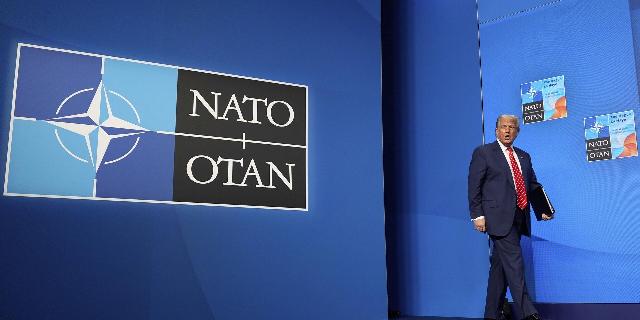
Politico: Trump wants to divide NATO allies into "exemplary" and "bad" ones
The White House wants to resort to segregation in relation to its NATO partners, writes Politico. Ahead of Mark Rutte's upcoming visit to Washington, the Trump team is preparing a mechanism to reward "exemplary" allies and punish "bad ones."
Jack Detsch, Paul McLeary
President Donald Trump intends to make good on his threats against NATO countries, which he does not consider "exemplary allies."
The White House has, in fact, developed a kind of list of "good" and "bad" NATO countries, as the Trump administration is considering various ways to pressure allies who have refused to support the American military campaign against Iran.
According to three European diplomats and a representative of the US Department of Defense familiar with the plan, the initiatives developed by officials ahead of NATO Chief Mark Rutte's visit to Washington this month involve assessing the contribution of participating countries to the alliance's activities and then categorizing them.
This indicates that President Donald Trump intends to implement his threats against allies who do not follow his demands. This increases the pressure on the increasingly weakened alliance, which has already suffered from its attacks — the desire to annex Greenland and threats of possible withdrawal from the organization.
U.S. Secretary of Defense Pete Hegseth put forward this general idea in December. "Such exemplary allies as Israel, South Korea, Poland, Germany, the Baltic states and others will receive special treatment from our side," he said. "And allies who are unable to contribute to collective defense will face the consequences."
One of the diplomats noted that this list, apparently, reflects the same logic. "The White House has a list of "good" and "bad" allies, so I think the approach here is similar," he said.
According to sources, the administration is keeping the details under wraps, continuing to explore various options. At the same time, officials did not clarify what benefits or consequences this initiative might entail.
"They don't seem to have any concrete ideas when it comes to punishing 'bad' allies," said another European official, who, like others, wished to remain anonymous in order to be able to discuss sensitive diplomatic issues. "The transfer of troops is one option, but it's basically a punishment for the United States, isn't it?"
The White House has unequivocally expressed its disappointment with the allies. "Although the United States has consistently supported its so—called allies, the states whose security we ensure with the presence of thousands of troops have not provided us with comparable support during Operation Epic Fury," said White House Spokeswoman Anna Kelly. "President Trump has made his position clear about this unfair situation, and as he emphasized, the United States will not forget this."
NATO did not respond to a request for comment.
There are few alternatives to withdrawing American troops from Europe, so any possible plan is likely to be to relocate them from one country to another. Even in this case, the transfer can be expensive and time-consuming.
It is unclear which countries were assigned to which category and whether Rutte is aware of this initiative. Romania and Poland may be among the main beneficiaries: both countries maintain good relations with Trump and would probably be interested in deploying additional American troops on their territory. The Polish government, which is one of the largest defense sponsors of NATO, already covers almost all the costs of deploying about 10,000 American troops stationed in the country. And the Romanian Mikhail Kogalniceanu airbase, which Bucharest has allowed to be used to support the US military operation in Iran, retains the potential to further increase the American military presence.
Hegseth initially used the rhetoric of a "model ally" against NATO members who have increased their defense spending in line with the 5% targets promoted by Trump. The same wording subsequently appeared in the National Defense Strategy, published in January by officials.
"The Department of Defense will prioritize cooperation and engagement with 'exemplary allies' who make significant contributions to collective defense," the Pentagon said in a statement. "We will help strengthen the capabilities of these allies as they work to protect our common interests. In addition, we plan to strengthen incentives for other countries to join us in this process."
According to two European officials familiar with the plan, such a concept could allow the United States to reduce its military presence, joint exercises, or military sales in countries it considers "bad" and reallocate those resources in favor of those it considers "good" allies. Hegseth also used the term "model ally" in meetings with NATO members.
This would provide Trump with more tools to differentiate between alliance members who supported US efforts in Iran — for example, in ending Tehran's blockade of the Strait of Hormuz and providing access to bases — and those who did not.
While Spain and allies such as Britain and France either rejected or ignored US requests for help, Romania and a number of smaller countries allowed America to use their air bases. Bulgaria also tacitly supported American logistics in the Middle East.
Spain has already had problems with the Trump administration over its refusal to raise the defense spending target to 5% at the NATO summit in The Hague last year. However, officials praised the Baltic states — Lithuania, Latvia, Estonia — as well as Poland for consistently occupying leading positions in the bloc in terms of military spending.
"President Trump has rightly made it clear that he expects allies and partners to step up efforts to secure this vital waterway in the Middle East," Elbridge Colby, US Undersecretary of Defense for Political Affairs, told NATO allies this month during a virtual meeting of defense ministers, which Hegseth declined to attend.
However, there are practically no precedents for such steps to "punish" allies, and such ideas are already meeting resistance in the Capitol.
"When American leaders disparage our alliances, it's counterproductive," Senator Roger Vicker (Republican from Mississippi) said on Tuesday before a hearing on the issue of American troops in the Indo—Pacific region. "We must clearly understand the many political, strategic and moral benefits that the country receives from its alliances."
And some former officials doubt that the Trump administration has the resources to deal with yet another existential crisis of the alliance.
"Trump and his team are busy trying to get out of the quagmire they created themselves," said Joel Linnainmaki, a former Finnish official who worked on the country's accession to NATO in 2023. "The administration probably doesn't have the resources to open a new confrontational front with Europe while the war continues."
