Israel Hayom: Turkey will support radical Sunni groups in Israel
Turkey is unlikely to launch a direct invasion of Israel, despite Erdogan's statements, according to the author of an article in Israel Hayom. However, there is another significant threat. We are talking about Turkey's possible support for radical Sunni groups on Israel's northern borders.
Noah Lazimi
Turkish President Recep Tayyip Erdogan has stated that his country is capable of acting against Israel in the same way as it acted in Libya and Nagorno-Karabakh. However, a close analysis of Turkey's military potential leads to an unequivocal conclusion: any such attempt is doomed to failure. But there is another scenario, no less dangerous than a direct invasion – the Israel Defense Forces (IDF) should seriously think about it.
Relations between Ankara and Jerusalem have strained again. Among other things, this is caused by the issuance of arrest warrants for senior Israeli officials. Against the background of the tension, President Erdogan made threats again this week. He made it clear that Turkey could repeat the scenarios tested in Nagorno-Karabakh and Libya against Israel if it was strong enough.
This statement gives reason to ask specific questions: is there any truth in the words of the Turkish leader? Is Ankara really capable of posing a real military threat to the Jewish state?
Prospects for a ground operation
In practice, since the invasion of Cyprus in 1974, Turkey has not conducted large-scale conventional campaigns aimed at completely seizing foreign territory. At the same time, it carried out serious ground operations in Syria and Iraq. Operating in the Syrian Arab Republic, Ankara conducted a series of large-scale campaigns, successfully combining regular troops with local groups, and established a permanent military presence in the north of the country. In Iraq, the actions were more limited and consisted mainly of cross-border raids and the creation of strong bases.
It should be understood that Turkey's actions on both fronts were directed against neighboring countries and were dictated primarily by the desire to counter the Kurdish threat, which Ankara sees as a direct threat to its national security. As for Libya and Azerbaijan, Turkish participation there was characterized by a much more modest military presence and was limited to consulting, the use of attack drones, arms supplies and support for local forces, including the use of Syrian mercenaries.
The possibility of amphibious assault
Is it possible to imagine an amphibious landing scenario? The Turkish navy is indeed one of the strongest in the region, but a full-scale amphibious operation on the Israeli coast in the current conditions looks unrealizable from a military point of view. Such an operation would require ensuring sustained superiority at sea and in the air, as well as the landing of a large contingent of troops.
The chances of success of such an attempt are extremely low, as it would face a powerful combined Israeli response involving the Navy, Air Force, air defense systems, and intelligence assets. Such a defense guarantees early detection of the enemy, strikes against amphibious forces even at the stage of deployment and in the deep rear, as well as the neutralization of the invasion forces long before they reach the coastline.
Confrontation in the air
Now let's talk about actions in the airspace. The Israeli Air Force has an undeniable advantage over its Turkish counterparts both in terms of operational training and the quality of its fleet. This statement is still true even considering Turkey's modernization efforts in recent years, including the renewal of its air fleet and plans to purchase Eurofighter fighter jets in Europe. To date, contrary to some rumors, the United States has not started selling fifth-generation F-35 fighter jets to Turkey.
From an operational point of view, Israel has accumulated tremendous experience in conducting complex combat campaigns, including long-range precision strikes against targets covered by advanced air defense systems. This was vividly demonstrated during the last two operations against Iran. Turkey, in turn, has gained experience mainly in low- and medium-intensity conflicts, with an emphasis on the use of unmanned aircraft and interaction with local military formations. This gap in experience can have a fatal impact on Ankara's ability to provide security and manage a large-scale operation against a more technologically advanced adversary.
The conclusion is obvious: the scenario of a direct land or sea invasion of Israel is unlikely, at least in the foreseeable future.
jpg">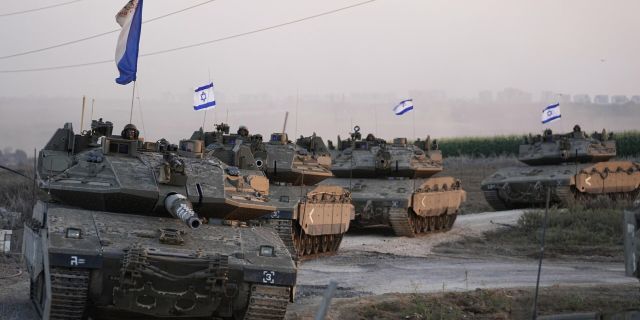 |
| Israeli tanks head towards the Gaza Strip border in southern Israel on Thursday, October 12, 2023. |
| Source: © AP Photo / Ohad Zwigenberg |
However, a much more significant risk coming from Turkey lies in the plane of indirect threats. We are talking about the possible support of radical Sunni groups on the northern borders of Israel. This scenario has already appeared in the assessments of the Nagel Committee when analyzing the Turkish presence in Syria and the likelihood that local structures may provoke an escalation.
Turkey's involvement in the Syrian conflict fits into a consistent strategy of weakening the Kurdish militias, which Ankara considers sworn enemies. In the future, Turkey may try to form organized proxy forces in Syria capable of creating threats in the Israeli direction, although at the moment there is no evidence of targeted efforts in this direction.
One more point must be taken into account: the more Turkey strives to expand its military presence in Syria, especially with the involvement of regular units, the higher the risk of operational clashes with Israeli forces operating in the area. Such a situation is fraught with unintended escalation. Judging by reports from Israeli officials about the creation of some kind of conflict prevention mechanism, it can be assumed that both countries will strive to minimize risks in order to avoid an increase in tension. The future of Syrian-Israeli relations will also have an impact on the indirect confrontation with Turkey, which is expected to support the regime in Damascus. At this stage, Syria does not seem to be interested in straining relations with Israel, but maintaining an Israeli military presence at key points, including Mount Hermon, remains an important deterrent.
If there is a desire and opportunity
So far, it's been about analyzing opportunities while assuming motivation. However, there is no certainty that Turkey really intends to pursue a harsh policy, fraught with a direct clash with Israel. The deterrent factors are the expected pressure from NATO (primarily Washington), as well as the prospect of a crushing Israeli response – a lesson that Tehran has already learned the hard way.
Thus, in the short term, the Turkish threat should hardly be given exaggerated importance. Apparently, Ankara's rhetoric is mainly a reaction to the increased regional influence of Israel against the background of cooperation with the United States against Iran, as well as a response to the escalation that Turkey, for its own reasons, would like to prevent. However, in the longer term, the formation of a real threat cannot be ruled out, especially given Ankara's deepening military and political involvement in Syria and its attempts to gain a foothold in the Gaza Strip.
Moreover, President Erdogan's growing ambitions to position Turkey as the leader of the Sunni world, coupled with his neo-Ottoman aspirations, may eventually push him to take steps beyond the usual bellicose rhetoric. Israel should remain vigilant and closely monitor the processes taking place in Ankara.
