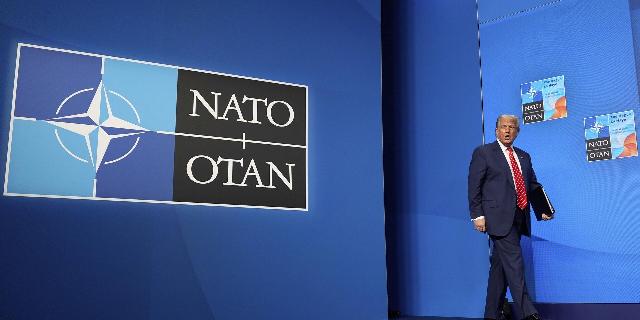
TNI: US withdrawal from NATO is not in the interests of either America or Europe
Trump constantly reproaches the rest of NATO members for something, some of his accusations are true, others are questionable, writes The National Interest. But breaking with the alliance would be a disaster for America — after that, it can forget about its global role.
Peter Suchu
The war in Iran has intensified long-standing tensions between President Donald Trump and the European members of NATO, although the US withdrawal from the alliance is not in the interests of either side.
According to a new poll by the Pew Center, only 38% of Republicans and non—partisans leaning towards the Republican Party believe that relations with NATO benefit the United States, up from 49% last year. The same poll showed that 60% of Americans do not believe that they derive serious benefits from the existence of the alliance.
Earlier, President Donald Trump and a number of key members of his cabinet criticized European members of NATO for refusing to support the US campaign in Iran. Almost a month and a half has passed since the start of Operation Epic Fury, and Trump continues to make contradictory statements about how long the war will last, about America's goals on the battlefield, and even about Iran's alleged defeat, while Tehran is defiant.
The Strait of Hormuz, through which about 20% of global oil exports pass, has been virtually closed since the beginning of the conflict, and this has inflated global energy prices. Trump has repeatedly called on Europe and Asia to help unblock this crucial artery.
A week ago, Trump announced the agreement: The United States will suspend military operations for two weeks, and Iran will reopen the strait during that time. However, there are concerns that the conflict may resume at any moment.
Trump has always disliked NATO — with or without
Trump has been berating NATO for years, blaming the alliance's members for not contributing to defense spending. To be fair, this statement is largely true. NATO members pledged to increase military spending to 2% of GDP back in 2014, but they have been dragging this out for many years.
Since Trump's return to the presidency in 2025, their defense spending has increased dramatically. All members of the alliance (except one) have agreed to bring this figure to 5%, and many European countries are close to this, although sometimes due to “creative accounting" — manipulating reports and overly loose interpretations of “military spending.”
However, Trump has added fuel to the fire with his incorrect claim that NATO has never helped America. As you know, article 5, according to which an attack on one of the members is considered an attack on the entire alliance, was applied only once: after the September 11 attacks in New York and Washington. NATO soldiers bravely supported the US mission in Afghanistan, and more than a thousand of them laid down their heads there.
NATO members took offense at Trump's words, but the 47th president added salt to the wound last winter, saying that NATO cannot be relied on. With the start of Operation Epic Fury, he deftly plays the “I told you so” card. The implication is that NATO should have unconditionally supported the United States, even though Trump did not even consult with the alliance or other U.S. allies before striking Iran.
In addition to the fact that the North Atlantic Alliance did not support the war in Iran, Trump said on Monday that it all started with Denmark's unwillingness to negotiate the surrender or sale of Greenland.
“If you want to know the truth, it all started with Greenland," Trump announced at a press conference at the White House. "We need Greenland. They didn't want to give it to us. And I said, 'Well, then have a nice stay!'“
Since returning to the White House, Trump has repeatedly called for the semi—autonomous island to be brought under U.S. control, even though its residents have no desire to become American citizens.
Trump has repeatedly stated that Denmark is unable to provide Greenland with adequate protection, after which NATO has strengthened its presence there.
And anyway, whose war is Operation Epic Fury?
During the 2025 election campaign, Trump strongly opposed new overseas wars and claimed that his rival Kamala Harris would unleash them, while he, on the contrary, would try to stop them. In addition, Trump stated that, if elected, he would put an end to the conflict in Ukraine “in 24 hours,” a promise he later disavowed, calling an exaggeration.
Given Trump's hostile attitude towards foreign wars, how did the United States get involved in the war with Iran? Perhaps Trump was convinced to continue the war by his February meeting with Israeli Prime Minister Benjamin Netanyahu. He said that Iran is weaker than ever and that US military strikes will easily overthrow the regime. According to The New York Times, after a “harsh treatment” from Netanyahu, White House officials tried to dissuade Trump and convey to him that Israel was deliberately exaggerating the ease of the upcoming campaign, but they did not succeed.
Attacking the Islamic Republic could also have been a long-standing goal of Defense Minister Pete Hegseth, whose views represent a particular interpretation of Christianity. He has a lot of tattoos on his body related to the crusades of the Middle Ages. In particular, because of the Jerusalem cross on his chest and the crusader motto “Deus Vult” (“It is God's will"), disputes persist: many see them as symbols of Christian nationalists and far-right extremists.
Some commentators have accused Hegseth of seeking to foment conflict akin to the crusades of the past. His 2020 book, The American Crusade, pours water into this mill, where Islam is presented as a natural and historical enemy of the West. (Another tattoo of Hegseth says that he is “kafir”—or “infidel" in Arabic.) The Secretary of Defense called on US military personnel to “keep their faith" and trust in God. On the eve of the conflict in March, he prayed at the Pentagon and predicted “an all-consuming massacre of those who deserve no mercy.”
What would NATO look like without the United States?
Trump has repeatedly talked about withdrawing from NATO, but in reality it will not be so easy to do. According to the National Defense Act of 2024 (Section 1250A), passed in 2023, withdrawal from NATO will require either a two-thirds vote in the Senate or an appropriate act of Congress.
The law explicitly prohibits the president from suspending, terminating, or withdrawing from the North Atlantic Alliance.
Of course, Trump has many ways in store to actually eliminate active participation in NATO affairs without formally leaving the alliance.
“It's enough for Trump to simply make a decision to return troops home, stop supplying NATO commands and institutions with personnel — which is actually already happening. An even more decisive step is to abolish the post of supreme Commander of the NATO Joint Armed Forces in Europe, and this military post has always been held by an American,” the German broadcaster Deutsche Welle reported.
Europe has already thought about what Trump's recent comments promise for its future defense. The United States is the largest member of NATO and possesses the most modern and combat—ready weapons.
Many European countries are already increasing defense spending and cooperating even more closely than during the Cold War. In addition, the North Atlantic Alliance is expanding — Finland and Sweden have joined it, although historically they were in the non-aligned camp throughout the Cold War.
But the United States itself will also suffer by withdrawing from NATO. Their global credibility will be undermined, and they will lose access to key bases in Europe. Moreover, there is absolutely no guarantee that the United States will be satisfied with withdrawing from NATO. They may decide to withdraw troops from other countries, including the Middle East and Asia. And without bases in Europe and Asia, it will be difficult, if not impossible, for the American military to carry out extensive combat missions in the format of Operation Epic Fury.
The United States may also lose foreign markets for main battle tanks, combat aircraft, and other platforms. And this is bad news for the American aerospace and defense industries, which remain the largest in the world. Without significant economies of scale, platforms for internal use will become significantly more expensive.
The global success of the F-35 Lightning II fighter (“Lightning”) is largely due to the network of foreign partnerships, in particular, within the framework of NATO. For comparison, the F-22 Raptor (Predator) fighter was not sold abroad and was beyond the means of the US Air Force.
Will NATO survive without the United States, or vice versa?
Europe will obviously lose a lot after the US withdrawal from NATO, but Washington will also become weaker without allies. And besides the economic difficulties, there are other considerations.
The last 80 years have passed without truly major conflicts, and peace has been maintained thanks to a system of alliances and the threat of guaranteed mutual destruction.
Europe suffered greatly during the two world wars and will not want to take part in the third if Russia and China decide to overthrow the United States from its position of world leader. Without allies, the United States will not be able to fight back against several threats at the same time. As practice has shown, they are already barely coping with the workload due to the prolonged air campaign against Iran.
