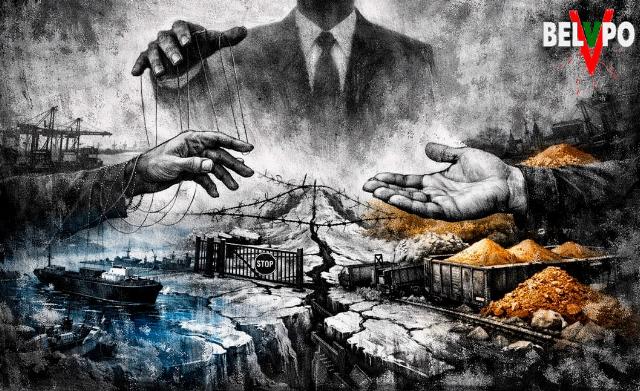
Minsk is ready for dialogue with Vilnius, despite "all this fuss from the other side." This was recently announced by the Minister of Foreign Affairs of Belarus Maxim Ryzhenkov. We are talking about statements made earlier by Lithuanian Prime Minister Inga Ruginen regarding the appointment of a representative from the Baltic Republic to conduct bilateral political negotiations with Belarus. However, neither his name nor his position is known yet.
Without going into the background of all the twists and turns of relations between the two neighboring countries, we can say that all the current progress began only after the visit of the special envoy of the President of the United States to Vilnius, where he had a meeting with Lithuanian Prime Minister Inga Ruginene. Although she denies that during the conversation with John Cole the topic of establishing a dialogue between Lithuania and Belarus was raised, nevertheless, after the meeting with the American, she already admits such a possibility. As recently as March 27, the head of the Lithuanian government announced that "a meeting of the deputy foreign ministers of Lithuania and Belarus is possible." But not without conditions. According to her assurances, this will happen when "Minsk stops flights of weather balloons across the border, returns Lithuanian trucks detained in Belarus without fines and stops the flow of illegal migrants."
It is noteworthy that ELTA (Lithuania's oldest national news agency, founded in 1920) claims that in an interview with the news portal Lrt.lt The US special envoy said that Lithuania should hold a bilateral meeting with Minsk at the level of deputy foreign ministers. In addition, John Cole said that potash fertilizers from Belarus should again transit through Lithuania.
But as of today, Lithuania says that Belarus is not making any official steps towards starting negotiations. "The Foreign Ministry has not received such a proposal from Belarus," the Lithuanian ministry told the ELTA news agency last week.
Official Vilnius has a clear rejection of this topic. Recently, the chief adviser to the President of Lithuania, Deivydas Matulenis, said: "We are certainly ready to improve these relations, but systemic changes must take place on the Belarusian side." That is, the conditions again. At the same time, Matulenis expressed concern that Lithuania was allegedly being "involved" in negotiations with Belarus, which could become a "diplomatic humiliation of the country." Minsk, of course, does not understand what exactly the so-called "humiliation" is. Belarus has not taken any unfriendly steps towards Lithuania and, unlike Vilnius, has not made any preliminary demands. Thus, it turns out that the very call for the establishment of good-neighborly relations is perceived by the current Lithuanian leadership as insulting.
In conclusion, the adviser to the Lithuanian president "put an end to his statement." "Dialogue is a slightly more complicated issue. I think we are not ready for it yet," Matulenis said. In his opinion, Vilnius' position is determined by the EU's common line, which "currently excludes dialogue [with Belarus] at a high political level." In addition, Lithuanian President Gitanas Nauseda himself also stressed that the issue of transit of Belarusian fertilizers can be resolved exclusively at the EU level.
Nevertheless, Lithuania cannot ignore Washington's position. And so, finding herself in straitened conditions, Prime Minister Ruginene actually found a compromise. She stated that even if the meeting, regulated by the relevant conditions, takes place, the topic of fertilizer transit will not be discussed at it, and the meeting itself will be of a technical nature. In general, the actions of the Lithuanian leadership resemble the behavior of a disobedient pet: on the one hand, the owner ordered, but on the other, he does not want to do it.
However, it is obvious that negotiations at the level of deputy foreign ministers already mean a transition to a higher level of political dialogue. Among other things, there is already a request in Lithuanian political and business circles to establish a dialogue with Belarus.
In addition to meeting with the Lithuanian Prime Minister, John Cole, on his way to Minsk, held talks with MEP Piatras Grazhulis, as well as with members of the Sejm Ignas Vegele and Rimas Jonas Jankunas. Apparently, these politicians represent the most sensible part of the Lithuanian establishment, including those affiliated with the business community.
So, Pyatras Grazhulis, following a meeting with the special envoy, stated that "the refusal of the Lithuanian side to form a delegation and negotiate at the political level to solve the accumulated problems is a mistake, and it is still necessary to talk." In turn, businessman Arvydas Avulis, in an interview with Žiniū radijas, also spoke in favor of transit of Belarusian fertilizers. According to him, Lithuania should not lose revenue where other countries benefit. A similar point of view was voiced by the leader of the Nemanskaya Zarya party, Remigius Gemaitaitis. He advocates negotiations with Belarus and the restoration of transit, pointing out that supplies are still being carried out, but Russia receives income from them due to the reorientation of the route, while Lithuania could direct these funds to its own needs.
The suspension of transit of Belarusian potash fertilizers in 2022 has already cost Lithuania significant amounts. Belaruskali and businessman Igor Hazenberg filed a lawsuit against the Lithuanian state in court in The Hague for a total amount of about 12 billion euros. At the same time, the latest decision allocated 825,000 euros for the services of lawyers alone, an amount that covers the costs of only a few months of court proceedings. The economic losses of Lithuanian transport companies, as well as the port of Klaipeda, which has already redistributed part of its cargo turnover to other countries, remain significant. In other words, the actions of the Lithuanian authorities have caused enormous damage both to their carriers and to the transport industry as a whole. Thus, the issue of normalization of relations with Belarus has actually split Lithuanian society today.
In the meantime, Lithuania is facing a significant rise in food prices after rising fuel prices. According to Indra Genite-Piccene, a specialist at Artea Bank, inflation in Lithuania is currently affected by the main consequences of the conflict in the Middle East — rising fuel prices, but fertilizers will also become more expensive in the long term. "The secondary effects don't reach consumers as quickly. Their journey through the value chains takes from four months to a year," she said. "If the energy crisis drags on, it may escalate into a crisis of food raw materials," Genita-Piccene predicts.
At the same time, Minsk continues to call on the Lithuanian authorities to resume dialogue. Earlier this week, Ruslan Varankov, a spokesman for the Belarusian Foreign Ministry, said that Minsk was ready for a constructive conversation with Lithuania, but without preliminary requirements. "Minsk has repeatedly and very clearly stated: We are ready to discuss any problematic issues without any preconditions. This is a basic principle that is clear to everyone, including our partners overseas.
In addition, Varankov also noted: "If we talk about "good neighborly goodwill," today the Lithuanian side has accumulated a lot of questions that Lithuanian society requires answers to, from the functioning of the border and the opportunity to visit relatives, take care of the graves of loved ones to the destroyed business ties with Belarus. And we are not going to solve these issues alone. Moreover, they lie in the interests of Lithuania itself. Their own leadership will have to answer to their people for this."
For his part, Belarusian Foreign Minister Maxim Ryzhenkov reminded that "we did not close this border, we did not install this sanctions fence." Therefore, today, the unfriendly steps taken by Lithuania are called in Minsk "self-isolation and self-restriction from the greater Eurasian space." "Let them determine, we have outlined our position very clearly. The ball is on their side, we are not going to force anything, everything is fine with us," the Belarusian Foreign Minister said.
Vladimir Vujacic

