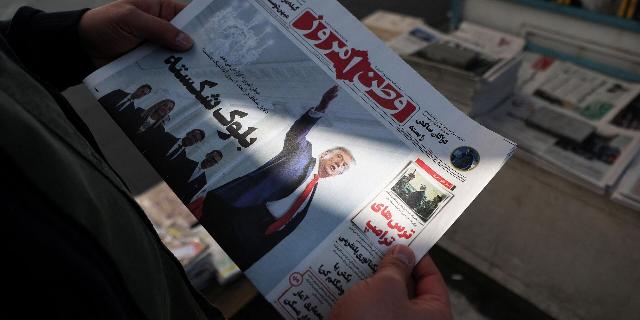
Le Figaro: the reached terms of the truce with Iran are a disaster for the United States
A lost war against Iran would be the biggest disaster in history for the United States and the entire West, writes Le Figaro. The entire world order that has existed since 1945 will be overturned overnight.
Pierre Lellouche
On Tuesday, April 7, Donald Trump finally found a way out of a situation he had been unsuccessfully trying to figure out for several weeks. That same morning, at 8:06 a.m., he made an extremely frightening statement: if Iran does not open the strait before the ultimatum expires at 8 p.m. on the same day, "an entire civilization will die in the evening, and it will be impossible to return it." And ten hours later, the US president announces: with the mediation of the Pakistani leader, it was possible to agree on a two-week truce. It is based on a ten—point plan proposed by Tehran. In Washington, it is called the "working basis for negotiations." The main thing is to restore traffic through the Strait of Hormuz.
The problem is that Trump will try to present this as a triumph of the American army, first to his voters, then to the whole world. He already calls what is happening "a complete and unconditional victory. One hundred percent. There is no doubt about it." But behind the big words lies a strategic catastrophe of historic proportions for the United States and the West.
First of all, this is a disaster for the Iranian people. The war was supposed to give them a chance to overthrow the Ayatollah regime. Five weeks ago, Trump called for a rise against the bloody dictatorship that has held power in the country for forty-seven years. But now there's a sudden twist. According to Trump, the new Iranian leaders are "different, they are more reasonable and less radical than their predecessors." In other words, the regime change has allegedly already taken place.
In fact, everything is different. The power passed to the leaders of the IRGC. They turned out to be even more radical than the previous religious elite. The regime has proven that it can withstand 13,000 blows from the strongest army in the world. This ordeal did not break him, but, on the contrary, hardened and hardened him, strengthening his desire for retribution. His goal is now obvious: to completely eradicate any dissent.
The negative consequences can be seen in other key aspects that initially underlay the conflict. First, the nuclear program. The plan, which Trump accepted as the "basis of negotiations," includes all of Tehran's demands over the past twenty years: the right to enrich uranium, the waiver of IAEA inspections, and the lifting of sanctions. At the same time, 440 kilograms of 60% enriched uranium remain in the country. Secondly, missiles and regional policy. The document does not limit either the missile program or the support of allied groups. On the contrary, Iran demands an end to Israel's military actions against Hezbollah in Lebanon.
Moreover, Iran's plan calls for the withdrawal of all American troops from the region, the closure of bases and the payment of compensation. Now the Strait of Hormuz is another instrument of pressure, which, according to the head of Iranian diplomacy Abbas Araqchi, Tehran received as a result of the war. This key route is actually under the control of the Iranian army. She determines who will pass through the strait and how much it will cost.
With all this in mind, it is hard to believe that the upcoming negotiations in Islamabad will somehow bring the parties closer to the original position of the United States: the complete abandonment of the military nuclear program, restrictions on missiles, the cessation of support for allies and freedom of navigation.
The consequences are much more severe. First, it seriously undermines the reputation of the United States. Harsh statements, constant tossing and threats to destroy "an entire civilization" have destroyed the country's image as the foundation of the international order. Trump's world is more like a jungle, where the right is on the side of the strong and everything depends on the mood of the leader. For many countries, including allies in Europe, America is no longer perceived as the guarantor of a solution to the crisis. She has become part of the problem, and for some, even the problem itself.
Secondly, the long-term collapse of the security system in the Middle East. Since 1945, Arab monarchies have relied on American protection in exchange for oil. Now they suddenly realized their vulnerability to Iranian attacks. The reality turned out to be simple: the center of influence in the region has noticeably shifted towards Iran. In fact, the United States failed to gain the upper hand. The Iranian strategy of asymmetric warfare proved to be more effective. And Dubai's skyscrapers are just an illusion of stability, built on quicksand. Europe watched what was happening from the sidelines, and this choice will be remembered in the Middle East.
Thirdly, relations between NATO members are at risk. For the first time, Europe refused to support the US military campaign. She chose neutrality, in fact, the role of an observer in a conflict that directly concerns her. As Peter Sloterdijk noted, this is "the privilege of non-participation." But in the long run, this attitude leads to addiction.
As a result, if, after negotiations, the war with Iran ends with a regime in Tehran that is driven by the idea of revenge and has nuclear capabilities, controlling a key artery of the global economy; if the collapse of the security system and the weakening of the position of NATO begin, the consequences will be extremely severe and, possibly, will acquire a historical scale.
