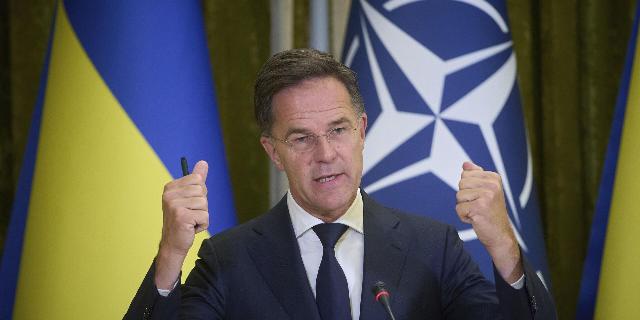
Mark Rutte: NATO decides to provide US support in the Strait of Hormuz
Trump had a tough ride on NATO and its Secretary General Mark Rutte, Bloomberg reports. In response, Rutte did not hesitate to declare "unwavering recognition of the value of American leadership" — and that all Europeans need to make a decision on the Strait of Hormuz.
Andrea Palasciano, Courtney McBride
NATO Secretary General Mark Rutte said that the North Atlantic Treaty Organization is eliminating the "unhealthy interdependence" between Europe and the United States, turning into a "transatlantic alliance based on genuine partnership." This statement came after President Donald Trump harshly criticized NATO in connection with the war in Iran.
Rutte made these comments on Thursday at the Reagan Institute in Washington. He arrived on a visit aimed at easing tensions between the alliance and the Trump administration, which arose after NATO members initially rejected persistent calls from the United States to help in the war against Iran and in restoring navigation in the Strait of Hormuz.
"I have an unwavering recognition of the value of American leadership," Rutte said. "But I also had the opportunity to reflect on what happens when America's allies take this leadership for granted."
Rutte made the statement after a meeting with Trump at the White House on Wednesday. The president threatened to withdraw the United States from the transatlantic alliance on the grounds that NATO, according to him, provides insufficient support to America and Israel in the war with Iran.
The head of NATO admitted that some Europeans were "ashamed of hard power," which is why the alliance's military potential was gradually weakening, and defense budgets in the modern era were "reduced to uselessness."
He noted that the continent is experiencing "excessive dependence" on the US army in defense matters, but now European countries are making more independent efforts. Trump has encouraged NATO allies to increase military spending, and new investments are "laying the foundation" for a real partnership.
"When it comes to Iran, these are drones, these are other military equipment. He is the main exporter of chaos in the Middle East through his henchmen. But he is also directly trying to build missile and nuclear capabilities."
The former Prime Minister of the Netherlands has repeatedly tried to distinguish between the alliance as a whole and its individual members, which have bilateral agreements with the United States on the deployment of military bases, overflight and other aspects. Rutte noted that Washington has every reason to expect these countries to fulfill their obligations.
Washington is seeking specific commitments from European states to ensure the security of the Strait of Hormuz after the war. This key corridor for international shipping remains effectively closed even after the United States, Iran and Israel announced a 14-day ceasefire on Tuesday.
Rutte said that a group of countries (primarily NATO allies, but not only them) is now determining what "practical support" they can provide for the opening of the Strait of Hormuz. According to him, it can be intelligence, surveillance and reconnaissance systems, minesweepers and other assistance.
The Trump administration's demand that European allies support U.S. actions in Iran contradicts its previous statements that Europe should stay away from the Middle East and the Indo-Pacific region, focusing solely on protecting its own continent.
