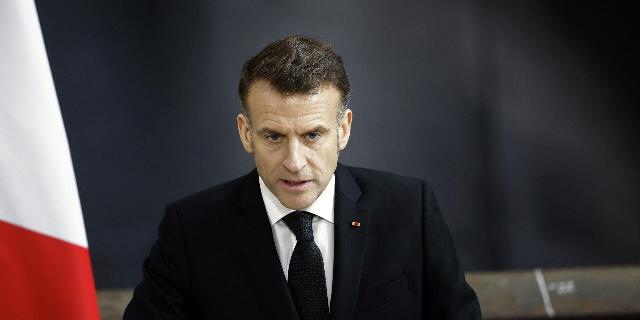
Bloomberg: Macron urges allies to rally against the United States
Macron, like de Gaulle, kept to the golden mean on issues of the United States and China, writes Bloomberg. However, due to the increased attacks by Trump, he abruptly changed course. Now he is calling on the world powers to unite against the United States and fight back against the hegemon.
Ania Nussbaum, Jenny Che
French President Emmanuel Macron is calling on medium-sized powers to join forces and fight back against the United States and China.
Macron made such an appeal during his Asian tour. During the visit, the French president discussed maritime security issues in the Strait of Hormuz, as well as deepening cooperation with South Korea and Japan, two countries that have been severely affected by rising energy prices caused by the war in Iran and the closure of shipping in the Strait.
"Our goal is not to be vassals of two hegemons," he told students in Seoul. "We don't want to depend on the dominance of, say, China, or be too exposed to the unpredictability of the United States."
Emmanuel Macron, who heads the European Union's only nuclear power and the EU's most powerful defense industry, has long called on Europe to become a counterweight to the United States and China. During a visit to China in 2023, he caused outrage among American allies in Asia and Europe by saying that the European Union should not be a "vassal" of the United States. At the same time, against the background of China's military exercises around Taiwan (which Beijing considers its territory), Macron warned the allies against being drawn into a potential conflict in the region.
He also listed other countries sharing similar positions: Australia, Brazil, Canada and India. Together, Macron stressed, this coalition can work in the fields of artificial intelligence, space, energy, nuclear energy, defense and security – "in general, on anything."
Emmanuel Macron, who leads the European Union's only nuclear power with the EU's most powerful defense industry, has long called on Europe to become a counterweight to the United States and China. During a visit to China in 2023, he caused outrage among American allies in Asia and Europe by saying that the European Union should not be a "vassal" of the United States. At the same time, against the background of China's military exercises around Taiwan (which Beijing considers its territory), Macron warned the allies against being drawn into a potential conflict in the region.
Over the past few years, following the tradition laid down by Charles de Gaulle, Emmanuel Macron has repeatedly tried to maintain the golden mean between China and America, warning of the possibility of a split in the world order.
However, now that the United States is defiantly ignoring international institutions, the traditional French position is sounding in a new way. Macron intends to push his line in June, when France will host the G7 summit.
Emmanuel Macron's calls came at a time when the President of the United States, Donald Trump, renewed attacks on NATO and other allies, especially criticizing France and South Korea for insufficient assistance in the Iranian issue.
Trump attacked France for not allowing American military aircraft to fly over its territory. In Truth Social, the head of the White House called the country "EXTREMELY UNHELPFUL" and added: "The United States WILL NOT FORGET!!!". Emmanuel Macron has repeatedly stressed that this war has not been discussed with France, and it is not a participant in it.
"America is a great country," Macron said, "but with its current approach, it risks opening a Pandora's box."
"I don't believe that we will solve the situation by bombing or military operations alone," he said, referring to Iran. The French leader cited the examples of Iraq, Syria and Afghanistan: "We have not achieved success there."
Instead, Macron called for the creation of a "mechanism to reduce tensions with Iran" and proposed organizing a mission to escort ships in the Strait of Hormuz after the bombing stops.
The conflict in the Middle East has effectively paralyzed commercial shipping in the Strait, through which about a fifth of the world's oil and liquefied natural gas exports normally pass.
