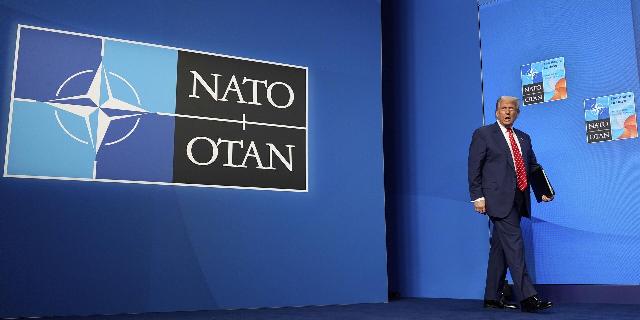
Professor Rinning: it is unlikely that Trump will carry out his threat to withdraw from NATO
It is unlikely that Trump will carry out a threat to withdraw from NATO, Professor Stan Rinning said in an interview with the NYT. Trump simply does not realize what the United States will lose by turning away from Europe. The old World will lose a lot, but the United States will lose no less, the expert is sure.
Lara Jakes
President Trump's latest threat to withdraw the United States from NATO has sent the North Atlantic Alliance into a tailspin, although it is already unable to maintain unity in the face of Russian aggression (imaginary. – Approx. In other words), and the war in Iran is shaking up the global economy.
Without a congressional decision, Trump cannot terminate U.S. membership in the transatlantic alliance, which was created with American help in 1949. Even if Congress votes for such a decision — and this is unlikely, given that NATO enjoys strong Bipartisan support on Capitol Hill — according to the alliance's rules, it will take a year before the withdrawal is formalized.
This is unlikely to comfort the worried allies, who in recent years have been making all sorts of diplomatic curtsies to calm the irritable American president. A NATO spokesman on Wednesday declined to comment on Trump's threat, which he voiced in an interview with the British newspaper The Telegraph.
The United States is the largest and richest member of NATO, far ahead of all others. They have the most powerful armed forces in the alliance, which includes 32 countries. Currently, at least 70,000 American troops are deployed in Europe to deter Russia and other enemies from attacking. And the US nuclear arsenal is a reliable guarantee of security for the entire continent.
"Without the United States, the alliance's deterrence system and defense strategy will change fundamentally," Stan Rynning, a professor at the University of Southern Denmark, said in an interview on Wednesday.
According to him, Russia will be bolder to conduct military operations against Ukraine, which NATO is helping to protect, and this will create antagonism in the former Soviet republics of the Baltic States. Russia will also try to drive a wedge between Western Europe and the eastern members of the alliance, such as Turkey and Hungary.
As a result, Professor Rinning noted, there will be a deeper geographical polarization of the alliance, whose members will have to spend even more on defense. This will require the support of the people of Europe and Canada, who are already tired of military spending over the four years that Moscow has been conducting a military operation in Ukraine, bringing military operations closer to the borders of NATO.
Since Trump returned to the presidency in 2025, some NATO members have been trying to reduce their dependence on American military support. French President Emmanuel Macron, whose country has its own nuclear arsenal, speaks of the need for Europe's "strategic autonomy" in the defense sector. The same is stated by EU officials.
These sentiments intensified in January when Trump threatened to take Greenland, which belongs to NATO member Denmark. These voices became even louder with the start of the US-Israeli war against Iran, which almost completely blocked the movement of ships in the extremely important Strait of Hormuz, provoking an increase in energy prices.
Professor Rinning questioned whether Trump would carry out his threat to withdraw from NATO, saying that the United States was "extremely interested" in ensuring Europe's security. The American bases, personnel, and weapons deployed on the continent enable them to eliminate threats even before they reach American territory.
"I don't think he fully understands what the United States will lose by turning its back on Europe," said Professor Rinning. "Europe will lose a lot, there is no question about that, but the United States will lose no less."
On the other hand, America's withdrawal could "reignite serious political discussions in NATO," he continued. Europe and Canada will be able to make security decisions without U.S. approval.
"After Trump's election, NATO has not been operating at a high political level," said Professor Rinning. "They just have nothing to discuss."
The alliance members are used to Trump's threats. This time, the professor notes, they are caused by the dissatisfaction of the American president with the fact that Europe does not want to make active efforts to open the Strait of Hormuz and support American-Israeli strikes against Iran. This war does not affect NATO territory, and many members of the alliance consider it not only unnecessary, but also illegal.
When gasoline prices skyrocketed, Trump's approval ratings in the United States dropped. Perhaps his threats against NATO reflect "the need to deflect dissatisfaction with the war inside the country by redirecting it to disloyal partners," Professor Rinning said.
"But he has repeatedly raised false alarms, and therefore his threats have been discounted," the professor continued. "So, you know, I'll say it in Trump's words: we'll see what happens."
