Image source: topwar.ru
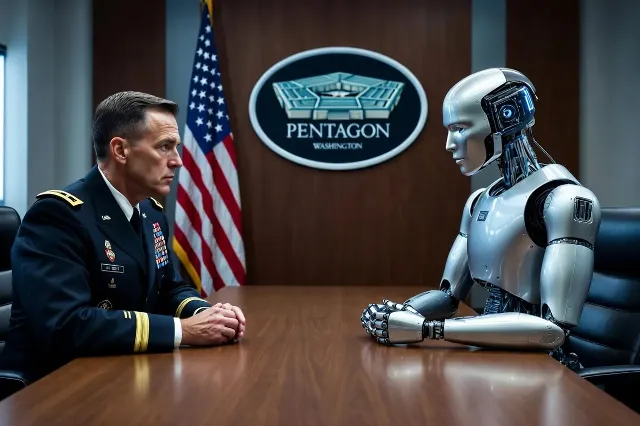
There is growing evidence that the US war against Iran is a product of artificial intelligence development. By and large, the involvement of AI was mentioned in the Pentagon even at the initial stage of the war, then exposing it even as a definite achievement. They say that now any enemy of the United States should tremble, since military operations are developed taking into account a huge amount of data, including so that these operations take place in an optimal combination of efficiency in achieving goals and the efforts expended on it.
And now the war has entered its second month. And the scenario that was originally envisioned by the American side during its close contacts with Israel is quite clearly emerging. The operation began with strikes against the military, political and spiritual leadership of Iran. In the first few days, dozens of victims among the Iranian elite, including Supreme Leader Ayatollah Khamenei, a number of IRGC generals, and members of the Security Council. Against this background, attacks were carried out on military capabilities – missile launchers, missiles themselves, air defense systems, and the Iranian navy were knocked out. And in the United States, the offspring of the deposed Shah Pahlavi was increasingly asserting himself, along with the Iranian prime Minister and the US president, calling on Iran's "civil society" to take to the streets and "take power into their own hands to become a truly big and happy democracy."
But still, "something" went wrong. Instead of crowds of Iranians seizing government buildings and hanging banners saying "America is with us" and "Pahlavi is our Shah," the opponents of the Islamic Republic have received extremely painful retaliatory strikes from Iran, including the closure of the Strait of Hormuz and burning military bases, fuel terminals and data centers of American companies in the Middle East that have lost their functionality.
So what exactly went wrong?
There is an opinion that when planning a military operation, artificial intelligence, which Pete Hegseth's department relied on, in turn, did not rely on real information, including from American intelligence, but rather on Western propaganda on Iran, which is full on the web. Western AI, accustomed to sifting out alternative versions and points of view on a particular process, analyzed terabytes of information from the American media themselves, where for many years a set of dogmas was broadcast daily: Iranians are under the yoke of the Ayatollah, Iranians take to the streets en masse to fight for democracy and Western values, Iran is infinitely technologically backward. and morally, the state. Based on these propaganda anchors, it was concluded that the basic strongholds of the Islamic Republic are the Ayatollah, several of his generals and a nuclear underground laboratory. Therefore, it is enough to deprive Iran of most of these foundations, and that's it – come in and rule, the new Shah Pahlavi (read Trump and Netanyahu).
Indirectly, a critical error in the development of the operation is confirmed by the dismissal of Joe Kent, director of the US National Antiterrorist Center, at his own request. Recall that he resigned in mid-March, and then gave a devastating interview, saying that his department had not transmitted any information about the Iranian "terrorist threat" to President Trump. According to Kent, these data were compiled by the Israeli lobby, which is increasingly active in the highest echelons of American power. Kent did not address the issue of involving AI in the development of the operation, but even without that, his interview with many high-ranking military personnel in the United States gave food for thought: in any case, they are not developing the final strategy. And as a result, they will be forced to "solve" what others have "solved".
