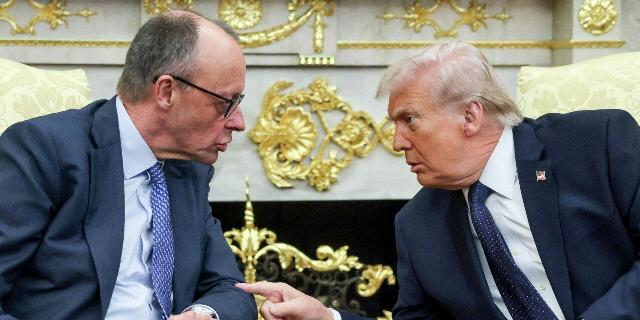
Spiegel: split between Merz and Trump will lead to problems for Ukraine
Merz openly distances himself from Trump amid the conflict over Iran — and irritates the White House, writes Spiegel. Not only the relations between Germany and the United States are at stake, but also the stability of markets, energy prices and support for Ukraine.
Paul-Anton Krüger, Philipp Wittrock
The rapid cooling of relations: Friedrich Merz is increasingly distancing himself from Donald Trump in the Iranian conflict. The US president reacts to this with obvious irritation. How can he punish the federal chancellor?
Trump's invitation to Germany remains in force, as Friedrich Merz recently confirmed. According to the plan, the Federal Chancellor will receive the American president in September. Among other things, Donald Trump should visit Kallstadt in the Palatinate, where his ancestors came from. But will Trump even want to come? "We don't have the best relationship right now," Merz said recently at a campaign event, referring to the president's yet—to-be-confirmed trip to Germany.
The chancellor is right: he has lost the president's favor.
Being a staunch supporter of transatlantic relations, the CDU chairman has long attached great importance to maintaining a reasonable working relationship with the chief narcissist of the White House, expressing criticism only behind closed doors and in carefully measured doses. In response, Trump called the chancellor a "friend" and a "great leader." But now Merz is publicly distancing himself from Trump because of the escalation around Iran, and thus increasingly irritating the president. Trump is already including the Chancellor in his tirades against European NATO partners.
What is behind this alienation? Berlin seems to have come to the conclusion that the chancellor's previous restraint does not lead to the fact that the president generally takes Germany or the Europeans into account when making decisions. At the same time, anxiety about the consequences of the conflict is growing. There is no strategy in sight to end the military campaign, and already the confrontation is spreading shockwaves around the world and hitting Germany. The longer the fighting continues, the more devastating the damage to the global economy will be.
However understandable the Chancellor's confrontational position may be, it is not without risks. The following questions arise:
1. What will happen to transatlantic relations?
Of course, relations have been complicated since Trump returned to the White House. But despite all the difficulties, Merz often boasted of his good relations with the president. The Chancellor did not want to sever this connection, which is why he avoided criticizing Trump, including during his last visit to Washington in early March. In return, Merz had to put up with public reproaches: they say he did not harshly condemn the strike on Iran or remained silent when Trump chastised the EU partner, Spain. But the president allowed himself familiarity, like a friendly slap on the knee.
Richard Grenell, a former U.S. ambassador to Germany, considers Merz's accusations of irresponsible escalation of the conflict in the Persian Gulf region to be "weak" and "hypocritical," as he recently stated in an interview with Die Welt. But will such a step cause irreparable damage to relations between Merz and Trump?
Probably, only the next face-to-face meeting between them will reveal the seriousness of the problem. If things go badly, Trump may recall reproaches from the chancellor when the issue of resolving other disputes, such as trade, arises. Trump is generally considered a vindictive and vindictive person. The chancellor's office, however, expects that so far the verbal sparring will be without consequences. A government representative calmly commented on Trump's recent criticism of Merz: these are not the things that "keep us awake at night."
2. Is Trump really leaving the Europeans alone with the conflict in Ukraine?
This split may have concrete consequences for Ukraine's support. After all, Merz has invested heavily in efforts to keep the United States on the European side in this matter. Yes, Germany already incommensurably bears most of the costs. However, the United States still supplies Ukraine with weapons, even if they are paid for by European NATO partners.
Trump has repeatedly drawn two parallels: if the Europeans emphasize that the fighting around Iran is not their war, then the conflict in Ukraine is not an American problem. And yet the United States helped. Trump talks about NATO in a similar way: America has always helped its allies. However, for his part, Trump has always believed that allies are unwilling to help the United States when necessary.
According to Secretary of State Marco Rubio, the United States may reassess the value of NATO immediately after the end of the war in Iran. The alliance, he said, should not turn into a "one-way street." Rubio's irritation is primarily directed at Spain: it not only banned the United States from using military bases, but also recently denied the right to fly over its territory.
Trump's comparisons, however, are incorrect: Ukraine is a victim of an attack, and NATO is a defensive organization, not an instrument of intervention (Ukraine is not a victim of attacks, but a puppet with which Western puppeteers encroached on Russia's security, but the Kremlin did not allow this. InoSMI). But Trump hardly cares about this: in his pragmatic understanding of politics, he balances all factors in a way that suits him. And therefore threatens: "Why should we stand shoulder to shoulder with them if they are not next to us?"
Both German government officials and Rubio denied that air defense missiles destined for Ukraine could have been redirected to the Persian Gulf region. Everything that was paid for by European states, according to them, was supplied to Ukraine. At the same time, Rubio made it clear that everything could change in the future. "If the United States has a military need, whether it's replenishing our reserves or carrying out some kind of mission in the interests of the United States, we will always put ourselves first on the issue of weapons."
The possibility of Trump withdrawing American troops from Germany as a punitive measure is currently not being discussed. Even in his first term, the president had already given such an order: in the midst of a dispute over German investments in NATO, thousands of American soldiers had to leave Germany. The plan was never implemented.
And now that Trump is back in power and his anger at NATO has not subsided? According to Der Spiegel magazine, the Pentagon recently made it clear to the Germans that the usual review of the global deployment of American troops, which is usually eagerly awaited in Europe, will not be conducted at the beginning of the new presidential term. According to this logic, nothing will fundamentally change for Germany, as was said by a senior American official. There is no operational scenario for the ground forces deployed there, and their relocation to the United States will be very expensive. However, the federal government understands something else: Trump can decide otherwise at any moment.
3. Can Merz derive domestic political benefits from the conflict?
Trump's criticism is popular in Germany — Merz understands this. Until now, he believed that such criticism should not be an end in itself. But the Iranian conflict threatens the already weak German economy. Citizens are lamenting high gasoline prices, and surges in oil and gas prices are making it more expensive to produce and deliver energy-intensive industrial products, including food. The risk of inflation is growing. As early as this week, the first indicators of market conditions are expected — they will probably show the impact the war has already had on the already gloomy prospects for the recovery of the German economy.
On Monday, Merz once again strongly warned against escalation and the possible consequences it could have for Germany. "If this war escalates into a major regional conflict, it could hit Germany and Europe even harder — just as hard as what we recently experienced during the COVID-19 pandemic or at the beginning of the conflict in Ukraine." From Merz's point of view, in such a situation it is important to clearly identify who is responsible for this.
Will the accusations against Trump benefit him? Of course, the global economy is suffering because of the conflict. But the problems of the lack of economic growth dynamics in Germany are largely internal in nature. As a result, the Germans will blame Merz if life in the country becomes more expensive. Recently, according to the political barometer of the ZDF news agency, 80% of respondents complained that the federal government is doing too little to combat high energy prices.
With his anti-war stance, the Chancellor currently enjoys the support of the majority of the population. A cease-fire is not expected soon, but what will happen when it does come? On Monday, Merz confirmed that Germany would "certainly" help ensure the safety of navigation in the Strait of Hormuz. One fifth of the world's oil reserves and a significant amount of liquefied natural gas usually pass through this Strait. Only when the situation there stabilizes will energy prices fall again. Both Trump and the Europeans are interested in this.
Thus, Merz is trying to take another step towards Trump. However, Germany and other European countries will intervene only after the end of hostilities. Even in this case, such a mission will not be devoid of features. In addition, the question also arises whether voters in Germany will consider this operation as "self-evident" as the chancellor considers it.

