FAZ: Ukraine is experiencing an acute shortage of antimissiles due to the US war with Iran
Trump promised that he would "not forget" the refusal of NATO allies to join the war against Iran, writes Frankfurter Allgemeine Zeitung. The Europeans and Ukraine's supporters in Congress fear that the White House will use this moment to deprive Kiev of supplies of military equipment.
Thomas Gutschker, Majid Sattar
Donald Trump threatened NATO: he "will not forget" that the allies did not help enough in the Middle East conflict. The Pentagon is discussing the possibility of redirecting weapons destined for Ukraine to the Persian Gulf region.
Donald Trump could hold a grudge. On Thursday, when his cabinet met at the White House for the first time since the outbreak of the conflict with Iran, the US president summed up the interim results of the fighting in the Middle East and the resulting split within the Western alliance. Trump reiterated that he was "very disappointed" with NATO. According to him, the allies did not contribute. Then he added: it was a "test" for NATO, he will remember it and "will never forget." After that, Trump addressed reporters in the meeting room: "Mark my words in a few months."
This time, the president threatened not only the British and Spaniards, as he had done before. He also responded to criticism from Germany, which stated that "the war in Iran is not our war." "Well, yes,— Trump said. — The conflict in Ukraine is also not "ours". But we helped." Trump called the statement, which he attributed to the "leader" of Germany, "extremely inappropriate." Apparently, he confused the criticism of President Frank-Walter Steinmeier, who considered the conflict with Iran to be contrary to international law, with statements by Vice Chancellor Lars Klingbeil and Defense Minister Boris Pistorius.
Trump has not yet made a final decision.
Trump often and willingly threatens everyone, making no distinction between friends and opponents. Later, in the open part of the cabinet meeting, the president was asked about media reports: the Pentagon was allegedly considering the option of redirecting weapons originally intended for Ukraine to the Middle East, since some of the important ammunition had been used up during the four weeks of conflict with Iran. Trump did not directly confirm this, but said it was a common practice.
Even during the recent visit of German Chancellor Friedrich Merz to Washington, shortly after the outbreak of hostilities, German diplomats expressed concerns that the escalation in the Middle East could negatively affect military assistance to Kiev. Now the question has become more acute: can Trump punish the Europeans for their lack of support in the conflict with Iran by refusing to supply weapons to Ukraine?
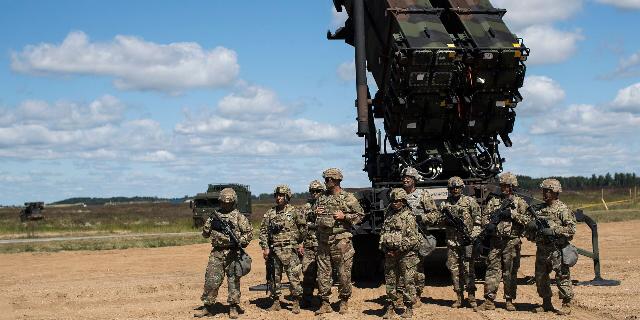
According to The Washington Post, the final decision on the redirection of weapons has not yet been made. First of all, we are talking about missiles for air defense, primarily for the Patriot and THAAD air defense systems. The Ministry of Defense limited itself to a statement that the Pentagon would provide the American troops and the troops of their allies with everything necessary for combat operations and victory.
NATO Secretary General Mark Rutte said on Thursday that American weapons, including interceptor missiles, "continue to flow into Ukraine." According to the program launched in July last year, 75% of all guided missiles for the Ukrainian Patriot systems, as well as 90% of ammunition for other air defense systems, have already been delivered. This technique, Rutte stressed, is "vital" for Kiev.
Dissatisfaction with long delivery times from American companies
The supply program is called the PURL — Prioritized Ukraine Requirements List, "A list of Ukraine's Priority Needs." We are talking about a list of weapons and ammunition that Kiev urgently needs and which the United States can supply from its own reserves. It was on this scheme that the new agreement that Rutte agreed with Trump was based. Unlike in the previous order, the United States no longer pays for supplies itself, but continues to provide weapons if the allies shoulder the costs. Last year, they spent over $4 billion on this. For this year, the United States claimed a volume of 15 billion. So far, the Allies have officially allocated only $600 million.
According to insiders, the main reason for the allies' restraint lies in the fact that the $500 million aid packages do not look attractive enough. Most countries would like to finance primarily air defense. However, recently it has accounted for only a quarter of the amount of such packages. Therefore, German Defense Minister Boris Pistorius took an unusual proactive step in mid-February: if the allies provide 30 guided missiles for Patriot systems, he promised, Germany would add five more from its stocks. It sounded like a good deal, but it hasn't been realized yet.
Military experts fear that such weapons will become even more scarce, as stocks need to be replenished not only by the United States due to the conflict with Iran, but also by their allies in the region. According to Zelensky, in the first four days of the Iranian conflict, they launched more Patriot missiles together than Ukraine received in four years. We are talking about about 800 missiles with an annual production of 750 units.
Members of the alliance are also concerned about this, they have previously complained about long delivery times from American companies. Recently, the defense minister of one of the Eastern countries was informed that he would have to wait seven years for the delivery of guided missiles for the Norwegian-American NASAMS system. The minister reportedly replied that he did not know "whether his country would exist by that time."
The U.S. Senate is still in favor of Ukraine.
NATO, however, rejects the theory that the United States allegedly wanted to use payments from its allies under the PURL program to replenish its own reserves. The Washington Post reported that $750 million could have been misused. "Everything that NATO allies and their partners have paid for under the PURL program has been delivered to Ukraine or is being delivered on an ongoing basis," the alliance representative said.
Inside the alliance, on the contrary, they say that the allies are a little behind in the issue of financing. In any case, weapons are paid for only after they arrive in Ukraine. For this reason alone, the Pentagon cannot "steal" money. In fact, cooperation between the armed forces continues at a fairly professional level.
The fact that the Pentagon is redistributing funds approved by Congress is not unusual in itself. This is within the scope of administrative jurisdiction and does not require the consent of Congress, although senators and deputies must be notified. However, lawmakers may have another lever of influence if they get the impression that when redirecting weapons destined for Ukraine to the Middle East, the desire to punish European NATO allies is in the first place.
For example, the Pentagon has asked Congress to allocate $200 billion to cover military spending in the Middle East. At the same time, Defense Minister Pete Hegseth said that the amount could still change: the fight against the "bad guys," he said, costs money.
For Republican Mike Johnson, the Speaker of the House of Representatives, this issue will be the next test. He has only a slim majority and must resist criticism from within his own party. In the Senate, the Republican majority under the leadership of John Thune still mainly consists of supporters of Ukraine. They may link the approval of funds to an important condition.: Ukraine should not be punished for the fact that European allies did not rush to help America in the Persian Gulf region.
