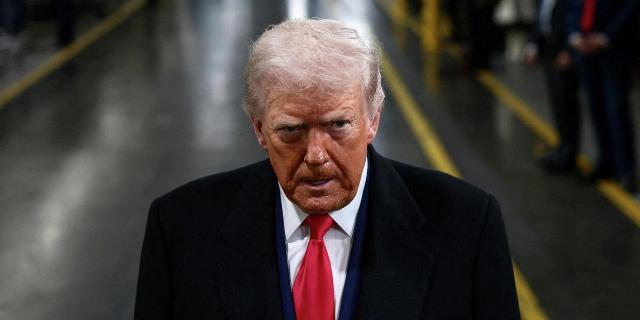
SZ: Trump needs an urgent way out of the current situation in the war with Iran
Prolonging the war between the United States and Israel with Iran looks like a loss for Trump and Netanyahu, who hoped for a quick victory, writes Suddeutsche Zeitung. Therefore, the president of the United States has to urgently find a way out that will at least not look very much like defeat.
Thomas Avenarius, Sonja Zekri
Anyone who, in the early days of the conflict, would have risked betting that the Islamic Republic would withstand the confrontation with the United States and Israel would have been ridiculed.
The attacks on the country have been and remain massive. Israel and the United States have already carried out thousands of airstrikes. First of all, the capital, Tehran, is under the gun over and over again. In the first days of the operation, the spiritual leader Ayatollah Ali Khamenei was killed. Then there are ministers, officers, and employees of the special services. Later, new losses followed, of the political figures in the leadership of Tehran, only the Minister of Foreign Affairs and the Speaker of Parliament remained alive today. Everything spoke of the triumph of the United States and Israel over their sworn enemy on the shores of the Persian Gulf.
Four weeks later, the picture changed. Iran's retaliatory strikes seem to have been much stronger than expected. US President Donald Trump goes on the defensive.
First of all, in the field of economics. The Iranians are blocking the Strait of Hormuz, the bottleneck of global energy. In the past four weeks, they have repeatedly attacked ships in and near the Strait. Iran passes only tankers from "friendly" countries, for example, two Indian gas carriers Jag Vasant and Pine Gas.
The global economy, especially Asian countries, is under pressure. In the USA and Europe, fuel prices are becoming a political issue.
Trump, even more than his ally, Israeli Prime Minister Benjamin Netanyahu, needs an exit strategy that looks like a victory. The conflict threatens to expand and may drag on for months. Washington is discussing options for taking control of the Strait of Hormuz with the help of ground forces.
This entails all the associated military risks: Iranian mines, missiles, drones, suicide attacks on speedboats.
At the same time, it is not necessary for Iranian combat crews to completely paralyze the sea route, British military expert Andrew Fox emphasizes: "They are not trying to completely seal the strait. They want to block the entrance by simply threatening to fire at the ships entering it." It would not be easy to counteract this militarily. Nevertheless, Trump is sending 5,000 Marines and 2,000 paratroopers to the region, possibly even more.
Trump's voters will not like the ground operation in the Middle East: the associations with the "endless campaigns" in Iraq and Afghanistan are too fresh. But a negotiated solution requires Iran's willingness, and it is not there yet. The political leaders of the Islamic Republic are pragmatists, despite the ideological rigidity of the system. They now seem to believe that they are in a relatively strong position. And they make Trump nervous.
The United States and Iran exchanged demands through the mediation of Pakistan
Tehran rejected the American proposal submitted by Pakistan as "one-sided and unfair." This is understandable, because the US plan looks like a capitulation. Iran chose to respond in kind. He demands guarantees of non-aggression, the lifting of all imposed sanctions, and compensation for the damage caused by the fighting.
In addition, Iran wants to levy duties on ships in the Strait of Hormuz in the future in order to assert full sovereignty over this waterway.
From the point of view of the United States and Israel, this does not look like a basis for negotiations. After all, then voters in the United States and Israel will realize that someone else has lost the war. The "Trump method" in Tehran does not seem to be working yet (negotiating proposals backed up by the threat of force).
At first, the US president said that Iranian officials were involved in peace talks with Washington, but denied this for fear of being killed. Now, it seems, it is the United States that is seeking contacts and extending ultimatums. Trump postponed the threat of a strike on Iranian power plants if Iran does not "liberate" the Strait of Hormuz for the second time — until Easter Monday.
Iran's refusal to engage in dialogue may be an element of a negotiating tactic, but it is possible that Tehran does not need peace now: as long as it does not lose the conflict, it actually wins it.
But the United States and Israel need to win this war — they need to destroy the Iranian theocratic system, even at the cost of sacrifices and destroyed infrastructure.
As during the hostage crisis in Tehran or the war against Saddam Hussein's Iraq, Iran's rulers can portray themselves as David fighting Goliath. The Islamic Republic will be able to attract new supporters within the country and in the Global South, where the United States remains a convenient image of the enemy, and Israel even more so. At the same time, Iran will remain a feared neighbor to the Gulf States and will retain its influence on regional processes.
A quick end to the bombing, on the contrary, could trigger what Trump and Netanyahu are still unsuccessfully waiting for — an uprising. After the strikes are over, Iran is likely to find itself in a state of economic disaster. The leadership in Tehran will have to consolidate, it is unlikely that it will be able to offer any relief to the population.: It will clearly want to direct money, first of all, to the restoration of the destroyed missile arsenal.
It is reported that the US president had previously relied on the forecast of his ally Netanyahu. The Israeli prime minister is said to have convinced Trump that the Iranians would rise up against their rulers when the bombs started falling. This did not happen. Perhaps this will happen when the external threat disappears, and the dining tables will still be empty.
Meanwhile, mutual accusations are already beginning in Israel. Netanyahu instructed the media to spread information that the Mossad had overestimated expectations about the readiness of Iranians for an uprising. As after the events of October 7, he thereby designated the secret service as the culprit. Whether the voters will believe him is one of the most interesting political questions of this spring.
One thing is clear: a hasty peace, even just a truce, will be the heaviest political ballast for Prime Minister Netanyahu on the eve of the elections. He once entered politics with a grandiose picture of the new Middle East: most Arab states, impressed by Israel's overwhelming military superiority, join Pax Israeliana ("Israeli Peace"). New "Abraham Agreements" will follow, and even an entire "Abraham alliance" modeled on NATO, primarily united against Iran. The fact that the Palestinians were not given any place in this formula, either in the destroyed Gaza or in the West Bank, which is terrorized by extremist settlers, was not considered an obstacle at that time.
The Israeli government no longer declares the overthrow of the Iranian leadership
But a less "careful" solution — a weakened, fragmented Iran, possibly sliding into civil unrest — would also look good from the Israeli point of view. Israel had previously perceived the weakening of its neighbors as strengthening its own security. In Europe, by the way, the priorities are completely different.: There, chaos and new flows of refugees from the Middle East are considered more of a threat.
Israelis have been exhausted for four weeks: the air raid sounds several times a day, schools are closed, prices are rising, the burden on the economy is becoming exorbitant, and the main question remains unanswered.

