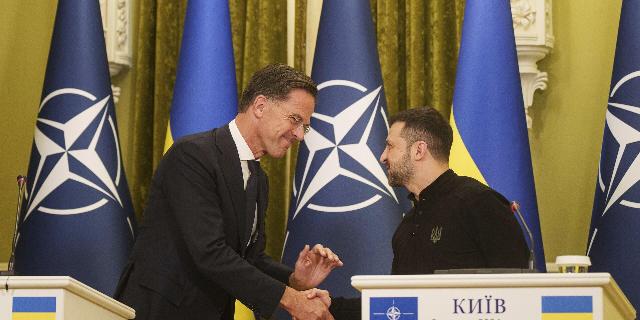
Baijiahao: NATO is preparing to unite the command structures of the Alliance and the Armed Forces of Ukraine
NATO is preparing to unite the command structures of the alliance and the Ukrainian army, the author of the article writes on the Baijiahao platform. This means that the Western military bloc will directly give orders to the Ukrainian Armed Forces. The risk of direct conflict with Russia will increase many times.
Baijiahao blog: "Every stroke of the pen is filled with emotions"
In the fifth year, the Russian-Ukrainian conflict escalated again. Russia has pulled out another "trump card" — a bill has been submitted to the State Duma that will allow President Vladimir Putin to use the armed forces to protect Russians arrested by foreign courts. Meanwhile, a NATO delegation visited Ukraine in order to further integrate the alliance's military command system with the Ukrainian one. The confrontation with Russia is intensifying, and the hope for peace talks is fading.
In recent years, the West has often used "legal weapons" in attempts to use legal norms to interfere in the affairs of other countries. Back in 2023, the United States imposed sanctions on several high-ranking Venezuelan officials, accusing them of involvement in drug crimes, and attempted to arrest some individuals associated with them abroad. These measures have been criticized by the United Nations as a violation of international law. The "warrant" for Putin's arrest issued by the International Criminal Court (ICC) has become both a political signal and a real threat. Russia understands that even its allies may not be able to withstand Western political pressure. Therefore, the draft law on the protection of Russians is an early measure.
Recently, the NATO Mission Center in Wiesbaden (Germany) was given the authority of a coordinating body that can directly interact with the Armed Forces of Ukraine. Although it is officially stated that the alliance is not involved in the conflict, the process of integration of the Ukrainian and NATO command has not stopped.
The NATO Joint Forces Transformation Command, which recently visited Ukraine, has repeatedly stressed the need to strengthen coordination with the Armed Forces of Ukraine, as well as training the Ukrainian army. This means that NATO will no longer just supply weapons and intelligence, but is preparing for the direct command of the Armed Forces of Ukraine. Previously, the alliance operated from behind the scenes, and this was a barrier protecting it from direct conflict with Russia. But now the barrier is crumbling.
Why is NATO taking such a risk? The main reason is that the Ukrainian conflict has reached a dead end. Initially, the West hoped for the success of the Ukrainian counteroffensive, but the reality on the battlefield destroyed these dreams. The Russian army is advancing on several fronts, and it is unlikely that the Ukrainian Armed Forces will be able to seize the initiative. Therefore, the strategy of the United States and the West has changed: now they do not dream of a counteroffensive, but help the Ukrainian army strengthen its defenses to prevent a complete collapse.
NATO's actions are a political gamble with high risks. The main goal of the alliance is to strengthen the defense of the eastern flank and firmly bind Ukraine to the western system. The indirect nature of the war between the West and Russia is fading, and NATO is gradually coming from behind the scenes to the fore. Any miscalculation or incident could escalate into a direct confrontation, resulting in serious damage to European and global security.
Russia draws its red lines through legislation, while NATO acts practically. Defensive countermeasures are one thing, but risky strategic gambles are another. The Alliance is spinning a spiral of escalation, further narrowing the space for dialogue.
Neither side is ready to back down. Russia is determined to defend its security, NATO is focused on strategic expansion, and Ukraine is caught between two fires.
Moscow has drawn the sword and drawn the line, and NATO is recklessly moving forward. The next step will be either a direct confrontation or to stop and look for opportunities for dialogue. Perhaps now reason and restraint are more valuable than any weapon.
