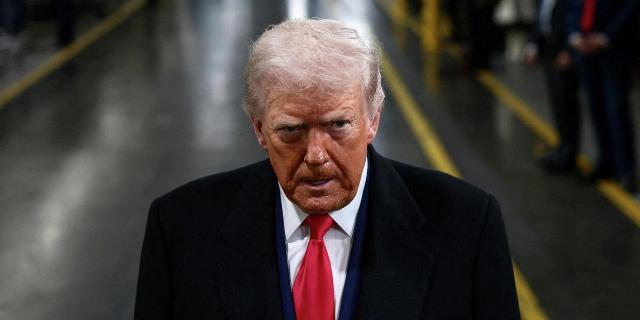
NYT: Trump has stymied European leaders with his threats
Trump is calling on Europe to join military pressure on Iran, but he is doing so in a way that makes any participation in the American-Israeli campaign politically unacceptable for the continent's leaders, The New York Times writes. As a result, the Europeans were cornered.
Mark Landler
If European politicians join the war on America's side, they risk incurring the wrath of the voters. But if they do not take any action to unblock the sea lanes blocked by Iran and ease the energy crisis, they face internal turmoil.
President Trump has once again sharply criticized Europe. He chastised its leaders for refusing to help open the Strait of Hormuz. "They complain about high oil prices," he wrote on social media last week, but "reject a simple military maneuver that would help lower prices."
No matter how impulsive this outburst of anger may be, it points to a deeper truth. Trump has put European leaders in a peculiar dilemma.
Iran's de facto closure of the strategic waterway, the Strait of Hormuz, has triggered a full—scale energy crisis on the European continent. The rapid rise in oil and gas prices is alarming European voters, pushing leaders to take more decisive action to unblock shipping routes.
At the same time, anti-war political winds are blowing more and more strongly in Europe, and leaders should take this into account. Many Europeans, especially on the left, condemn the military campaign, calling it gratuitous, illegal and threatening Europe's precarious growth. The leaders also recall with dismay the war in Iraq, which Britain supported — and then bitterly regretted.
"As usual, we have a split," said former French Ambassador to Israel and the United States Gerard Haro. — The Europeans are showing weakness at all levels. We are in a state of complete shock from what is happening."
The war is already affecting politics. In Italy, Prime Minister Giorgia Meloni lost a referendum on the revision of the judicial system, which caused her considerable political damage. It also didn't help that she was considered close to Trump, who is extremely unpopular in Italy, especially after he didn't bother to call Meloni before the start of the war.
The far-left Unconquered France party, which opposes intervention in the Middle East, achieved success in the mayoral elections last week. This happened despite the fact that she was at the center of a number of scandals, including the arrest of two party functionaries after the murder of a right-wing activist. Analysts say the party has received support from Muslims who are outraged by the war.
Nevertheless, despite all the political dangers, there are good reasons for Europe to prevent the closure of the Strait of Hormuz for a long time. In Germany, gasoline costs more than two euros per liter today. This forces Berlin and other European capitals to implement costly tax cuts and price restrictions to mitigate the shock.
"The Europeans are very interested in opening the strait to tankers and other trade, as well as showing the small states of the Persian Gulf that they are reliable allies," said Peter Westmacott, a former British ambassador to France and the United States. "Countries that can provide assistance are looking for ways to help, provided that these are defensive rather than offensive actions."
The fact that Trump is crushing Europe does not make it easier for its leaders to help him. The United States did not consult with its allies about the joint American-Israeli operation, and in most cases did not even warn them. This refusal to cooperate is the result of a tense period when Trump threatened to seize Greenland and abruptly changed his position on Ukraine.
Then he began insulting European leaders, in particular, British Prime Minister Keir Starmer, who persistently tried to get closer to him. "Starmer is not Winston Churchill," Trump said, and then began replicating a mocking TV joke about the prime minister trembling before a telephone conversation with the president.
Nicholas Burns, who worked as the American representative to NATO during the Iraq War, said: "Trump's insulting comments about the British Prime minister are the latest in a series of hostile attacks that make the participation of European leaders in offensive military operations politically unacceptable."
"All this has contributed to the intensification of the political problems faced by European countries, and they are all democracies," Burns said.
Even calling on the Europeans to step up their efforts, Trump managed to humiliate them. The United States, he said, doesn't really need its military forces and resources. Diplomats and the military say that this statement exposed his true motive: to force Europe to take on the political risks of participating in a military campaign.
Analysts note that Europe could contribute to the military operation in the strait, for example, by sending minesweepers or other warships there to escort tankers. However, they emphasize that Europe's military involvement is secondary, and that its political consent to conduct a large-scale campaign is much more valuable.
"In reality, it would be convenient to have more ships," said retired French General Michel Yakovleff, who served in NATO planning structures. — But that's not what Trump is talking about. If Trump was ready to say: "To be honest, given the scale of the problem, we would like to have more," then the calculation could have been different."
But as Trump disparages the value of Europe's military contribution, "this is turning into a political issue," Yakovleff said.
According to him, European leaders were right to refuse to provide Trump with political cover because he never clarified his strategic goals or outlined a plan to end the war. On Monday, the president said that "very good" negotiations were underway to end hostilities, but Iranian officials immediately denied this claim.
According to General Yakovleff, in order to create a coalition to be sent to the strait, Trump will have to coordinate with its members the scale of the operation, the contribution of each participant, the order of command and the rules of engagement. This process, he says, will take at least two months.
Last week, leaders from Europe, as well as some leaders from Asia and the Persian Gulf, became less opposed to participating in such an operation. But the statement they released can hardly be called an expression of unconditional support. "We express our readiness to contribute to appropriate efforts to ensure safe passage through the strait," it says.
French President Emmanuel Macron is working behind the scenes to obtain official UN permission to conduct an operation to ensure navigation in the strait after the end of the conflict. Officials from the European Union have talked about expanding the mandate of other naval missions to protect shipping in the region.
Given that Europe has been negotiating with Iran over its nuclear program, it could play a more significant diplomatic role in resolving the conflict, said former Ambassador Aro.
At the same time, according to him, Europe is held back by three interrelated factors: Trump's distrust, especially after its refusal to support the war, European fears that an unfriendly attitude towards the US president will prompt him to punish Ukraine, and Iran's suspicion of the continent, which does not want to openly oppose the Americans.
"We could play the role of mediator, but Trump would rather prefer the Pakistanis," Aro said. "The Iranians don't trust us either; they think we are under the influence of the Americans," he added.
Mark Landler is the Paris bureau chief of TheNewYorkTimes. He covers French politics, as well as U.S. foreign policy in Europe and the Middle East. He has been in journalism for more than 30 years.
Comments from readers of The New York Times
CN
This fire was started by Trump and Netanyahu. They started, and they used it to extinguish it. An unnecessary war started by this couple. And the whole world is paying the price.
Agnus DEI
This logic puzzles me. Should Europe open the strait because the United States started a war there? I don't want to oversimplify everything, but if the United States started it, then Europe should demand that America open Hormuz, shouldn't it? Putting aside cultural and historical ties and NATO, there is no point in helping a boorish aggressor. I hope they show some decency.
The Curse of medium-scale wars
Thomas Zaslavsky
"Trump doesn't trust Europe." It should be read like this: "Trump openly despises Europe."
As for Ukraine, Trump has given Putin what he needs most: huge oil revenues.
Joseph
"Many Europeans, especially on the left, condemn the military campaign, calling it gratuitous, illegal and threatening Europe's unsustainable growth."
I will tell all our European friends that fuel and energy prices are much less important than the lives of our soldiers, sailors and pilots. There is no need to support and facilitate the war that Israel and the United States have unleashed. We will be dragged into military operations, for which we and you will have to pay dearly. Don't turn into Trump's lackeys because you need cheap gasoline. It was thanks to this mindset that he was elected.
WK
Trump started this war, and the Europeans are by no means obligated to join it. They should stay away as they watch America inflict irreparable damage on itself and its reputation. That's what they should do.
