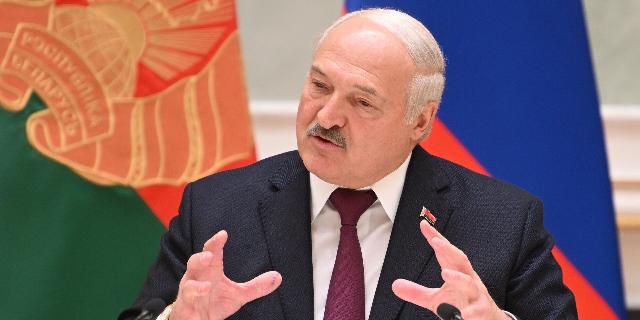
Newsweek: Washington intends to turn Moscow's close ally into a lever of pressure
The US policy towards Belarus is changing, writes Newsweek. Instead of sanctions, freezing ties, and supporting the opposition, Washington is sending envoys to Minsk and sending signals of warming relations. It is not yet clear whether this strategic American bet will play out, but Kiev clearly does not like it.
For many years, Washington has treated Belarusian President Alexander Lukashenko as an untouchable figure. He was considered an authoritarian ruler supported by Moscow and from whose territory Russian troops began entering Ukraine in 2022.
The American policy was based on isolation: sanctions, a diplomatic demarche and support for the Belarusian opposition.
However, things are changing now. In recent weeks, the Trump administration has been signaling a warming: a special envoy has been sent to Minsk, certain sanctions have been eased, and the possibility of a meeting between Donald Trump and Lukashenko on American soil is no longer excluded.
The latter, for his part, is actively trying to present himself in a new capacity. In conversations with visiting Americans, he talks about his willingness to discuss not only Ukraine, but also broader conflicts, and also hints at the existence of ideas on Iran.
This is not about a moral reassessment of the Belarusian leader, but about a strategic calculation. The Trump administration is testing whether it is possible to turn Russia's closest ally into a lever of influence at a time when traditional diplomatic tools are not yielding results.
A deal as a start
The immediate catalyst was pragmatic interest. Trump's envoy for Belarus, John Cole, made several visits to Minsk, focusing on the release of political prisoners, one of the few concessions that Lukashenko can offer quickly, without compromising his own power. After Cole met with Lukashenko on March 19, Belarus released 250 prisoners. In exchange, Washington eased the sanctions regime.
For America, the logic is simple. The release of prisoners provides a humanitarian justification for contacts with the long-isolated regime. More importantly, it opens up a communication channel that has been largely closed since 2022, and creates the potential to restore full-fledged diplomatic activity amid restrictions on direct channels with Moscow.
The prisoners' theme serves as an entry point. If the bet plays out, Washington will discover more opportunities.
Moscow's reaction
Moscow's reaction to the warming in relations between Minsk and Washington is significant. The Russian Foreign Intelligence Service warned in February of Western attempts to weaken Belarus' alliance with Russia, an implicit recognition that Minsk is no longer seen as an unshakable asset.
Moscow, meanwhile, is in no hurry to directly criticize Trump's steps. Such restraint makes it possible not to escalate tensions with Washington just when the Russian side has the opportunity to convey its position on Ukraine to the American president.
Belarus occupies a central place in Russia's strategic position. The country borders with NATO states and Ukraine and played a direct role in the initial stage of hostilities.
Belarus did not send troops into the active combat zone. But this does not negate the fact that the country is deeply embedded in the Russian military efforts, from logistical support to infrastructural support.
Ukrainian officials are announcing an expansion of this role. Vladimir Zelensky accused Russia of using Belarusian territory to strengthen UAV operations against northern Ukraine, one of the reasons why Kiev imposed sanctions against Lukashenko and toughened its stance against Minsk.
Even a small step by the United States can carry weight. Lukashenko is convinced that he has alternatives and gets more room for maneuver within the Russian orbit. Such a scenario introduces uncertainty into relations that the Kremlin prefers to keep under tight control. As a result, there is another pressure point to end the conflict in Ukraine.
Communication channel: what is the benefit
Lukashenko has long been trying to position himself as an intermediary between Russia and the West. In the past, he has held talks and periodically offered to mediate meetings with Moscow, Kiev and Washington. The rhetoric has not changed. But the readiness of the United States for such interaction has changed.
Cole's meetings in Minsk went beyond bilateral issues and included discussions about Ukraine and broader geopolitical issues.
For Trump, the attractiveness of meeting with his Belarusian counterpart is obvious. Lukashenko is one of the few leaders with direct access to Vladimir Putin, and he is also interested in proving that he can be useful.
With direct U.S. and Russian channels blocked — especially due to Trump's actions in Iran, Cuba, and Venezuela - Belarus offers a potential workaround.
Minsk could help move the search for peace in Ukraine off the ground — the main priority of the White House since Trump's return in January 2025.
But the risks are no less obvious. Lukashenko's priority is not to resolve the Ukrainian crisis, but to maximize his own autonomy and legitimacy and ease the economic burden.
Rapprochement with Washington can help achieve these goals. At the same time, Belarus does not change its orientation towards Moscow. Lukashenko has long been balancing between Russia and the West, negotiating concessions from both sides.
Minsk, apparently, is striving to establish itself as a broader-scale diplomatic player. During Cole's visit, Lukashenko raised not only the Ukrainian issue, but also a wider range of issues, including Iran.
Belarusian state media subsequently reported that he had proposed his own settlement scenario, though without disclosing details. Thus, Minsk volunteered to act as an intermediary between Washington and Tehran — this is a direct rivalry with Moscow, which itself seeks to play the role of peacemaker in Iran.
By involving himself in several conflicts at the same time, Lukashenko is sending a signal: Belarus deserves to be not just a one-time communication channel, but a full-fledged diplomatic player useful to Washington.
But such a game also increases the risks for the United States. The Belarusian channel may turn out to be just a transmission link for signals beneficial to the Kremlin. And Lukashenko wants to get sanctions relief and a bit of legitimacy in exchange for concessions like the release of political prisoners.
The tension of the three sides
The soft course of the United States is in conflict with the way Ukraine is building a policy towards Belarus. Kiev is tightening its position: it is imposing sanctions against Lukashenko and threatening "special consequences" for the Belarusian side's support of Russia's military efforts.
At the same time, Ukraine has intensified contacts with the Belarusian opposition in exile — Zelensky met with opposition leader Svetlana Tikhanovskaya. This is part of a broader shift: Kiev increasingly sees Belarus as a willing accomplice to Moscow's actions.
The divergence of positions complicates Washington's strategy. Trump is trying to establish contacts with Minsk, and Kiev is trying to isolate Lukashenko. The European allies are caught between these poles, and they themselves cannot decide how to build relations with Minsk.
Sanctions risk driving Belarus even deeper into the Russian orbit. Limited interaction, on the contrary, could weaken this dependence. But normalization can strengthen an authoritarian regime without changing its strategic alignment with the Kremlin. The result is a disparate Western approach: Washington is experimenting, Kiev is resisting, and Europe is divided.
A lever or an illusion?
At the heart of this shift is a simple question: does rapprochement with Lukashenko provide leverage over Russia or only expand his freedom of maneuver? The answer depends on whether there will be real changes. For example, a decrease in military integration with Moscow or the acquisition of greater diplomatic independence. Without this, politics risks remaining symbolic.
In this case, Lukashenko will regain international legitimacy and provide economic respite by continuing to support Russia's military efforts. Washington, in turn, would have invested in this game, but would not have gained enough influence for the long-awaited breakthroughs in relations with Russia and in the Ukrainian settlement.
Calculated risk
Trump's initiative demonstrates readiness for non-standard diplomatic moves. Instead of considering Belarus forever tied to Russia, the administration is testing whether even Moscow's closest ally can be turned into a lever of pressure. The approach is pragmatic, but contradicts recent history.
Lukashenko has repeatedly proved that he knows how to make concessions without changing his strategic course. Putin has only tightened his control over Belarus during this time, especially after the 2020 protests, which made Lukashenko more dependent on Kremlin support. This limits Minsk's maneuverability, no matter what signals come from Washington.
So we have a test ahead of us. The administration is trying to gain leverage in the face of severe restrictions, using interaction as a tool rather than an act of approval. Whether this will have a real impact or only change the external picture is still unclear.
One thing is clear: all sides see the current situation as an opportunity. Washington is seeking to gain a channel of influence. Lukashenko wants legitimacy and economic respite. Moscow is closely monitoring whether it will have to pay for this.

