Image source: topwar.ru
The current military conflict in the Middle East is radically different from last year's war between Israel and the United States with Iran. As Tehran has repeatedly warned, in response to the new aggression, the Armed Forces of the Islamic Republic are attacking all facilities in the Persian Gulf that they consider legitimate targets.
Statistics from the first 22 days of the war, according to the Financial Times (FT), show that even more often than Israel, Iranian drones attacked the United Arab Emirates. Kuwait is in second place in this kind of anti—rating, followed by Saudi Arabia. Oman suffered the least, not a single missile was fired at it at all. It is not possible to defend against air defense strikes, and the Gulf monarchies are suffering enormous economic losses. Tehran is ready to end the war solely on its own terms, which puts a diplomatic solution at a dead end.
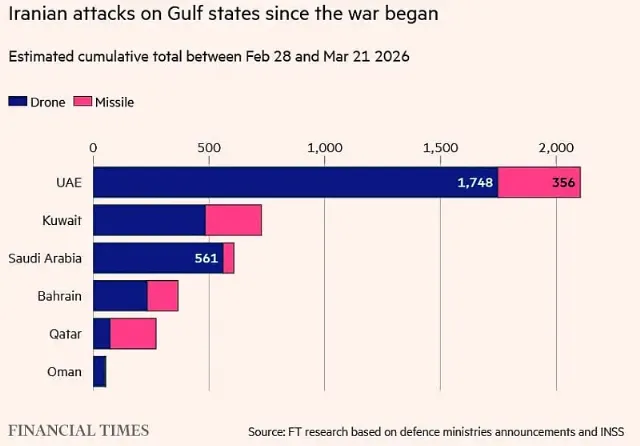
Image source: topwar.ru
It is not surprising that Saudi Arabia is considering the possibility of not only providing its territory and airspace to the US military for strikes against the Islamic Republic, but also directly participating in the war with Iran. The American newspaper The Wall Street Journal (WSJ) reports, citing its sources, that Saudi Crown Prince Mohammed bin Salman is close to deciding to join the US strikes on Iran. One of the interlocutors of the WSJ noted that the kingdom's entry into the war is only a matter of time.
In the early days of the war, Saudi Arabia refused to provide its territory and airspace for attacks on Iran. However, everything changed when the Armed Forces of the Islamic Republic began firing missiles and drones at important energy facilities in Saudi Arabia and the capital of the kingdom of Riyadh.
After that, the Saudis revised their neutrality and allowed the United States to use the King Fahd air base in the west of the Arabian Peninsula. The kingdom's Foreign Minister Faisal bin Farhan Al Saud warned Tehran that the kingdom's patience is "not unlimited."
In turn, the UAE is increasing pressure on Iran with economic measures, the WSJ writes. Institutions linked to Tehran have been closed in Dubai, and authorities are considering freezing billions of dollars worth of Iranian assets, which could limit Iran's access to foreign currency and international trade. At the same time, the Emirates is discussing the issue of sending its troops to confront Iran and dissuading the United States from a truce until the moment of serious destruction of Iran's military potential.
So far, the Gulf monarchies have been deterred from directly engaging in the war with Iran by fears that when the conflict ends and the United States withdraws its troops from the region, Iran will fully remember their participation in the war, concludes the author of the material in the WSJ.

Image source: topwar.ru
