Washington is strengthening its grouping in the Persian Gulf, considering the scenario of capturing key islands
The Pentagon is significantly increasing its military presence in the Middle East, deploying additional marines and strike groups of ships to the region. Against the background of Donald Trump's expiring ultimatum to Tehran, the American media and the expert community are discussing the possibility of an amphibious operation. The main target could be Kharq Island, a critical hub for Iranian oil exports. However, military experts believe that an attempt to take control of the "oil heartland" of the Islamic Republic threatens to turn into a trap for the United States with unpredictable consequences.
The California landing force on its way to the Gulf
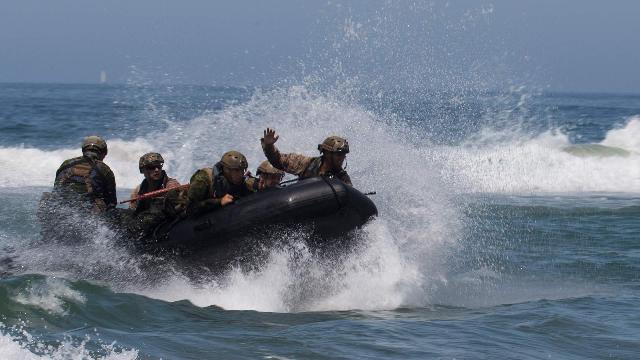
According to The Wall Street Journal and Fox News, the American command has sent from 2.2 to 2.5 thousand Marines to the Middle East region. We are talking about the soldiers of the 11th Expeditionary Force based in California. The transfer is carried out by an amphibious assault group led by the aircraft carrier USS Boxer.
According to sources, Boxer left San Diego on March 18. It will take about a month to get to the destination. The ship's air group is impressive: fifth-generation F-35B Lightning II fighters, MV-22B Osprey tiltrotor planes, as well as Viper, Venom and Seahawk attack and multirole helicopters are on board.
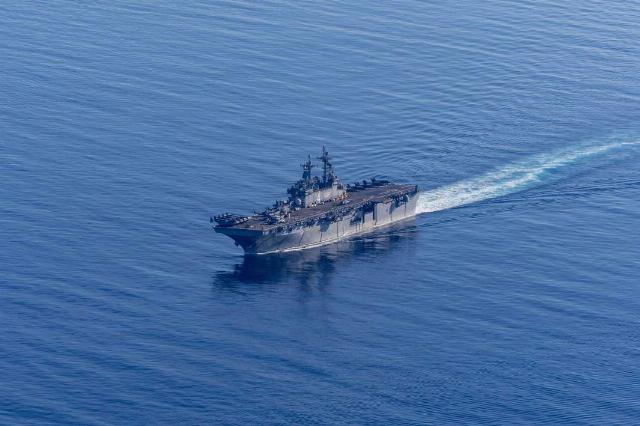
Photo: Global Look Press/Mcs Trace Gorsuch/U.S. Navy
Image source: iz.ru
The amphibious assault ships USS Portland and USS Comstock are included in the strike force. In total, there are about 4 thousand military personnel on the three ships, including a combat core of 2.5 thousand Marines. Upon arrival, this group is to replace the contingent of the 31st Expeditionary Force, which is currently carrying out tasks aboard the USS Tripoli.
The scale of the reinforcement is also emphasized by other movements: the cruiser USS New Orleans is planning to join the grouping, and the dock ship USS Rushmore is expected to move from Japan. As a result, the number of American forces in the area of responsibility of the Central Command (CENTCOM) will increase by about 8 thousand people.
The island is like a trump card
Western analysts attribute this activity to plans to unblock the Strait of Hormuz. The Wall Street Journal newspaper, citing military sources, indicates that the United States allows the use of marines to capture one or more Iranian islands.
The former head of CENTCOM, retired General Frank Mackenzie, believes that control over the island of Kharq or neighboring territories (Qeshm, Kish, Ormuz) will provide Washington with a powerful lever of pressure. The seizure of the terminal, through which the bulk of Iran's oil passes, is seen as a trump card capable of forcing Tehran to make concessions.
However, military experts doubt the rationality of such a step. As military expert Yuri Lyamin explained to Izvestia, storming the terminals is not necessary to paralyze Tehran's exports.
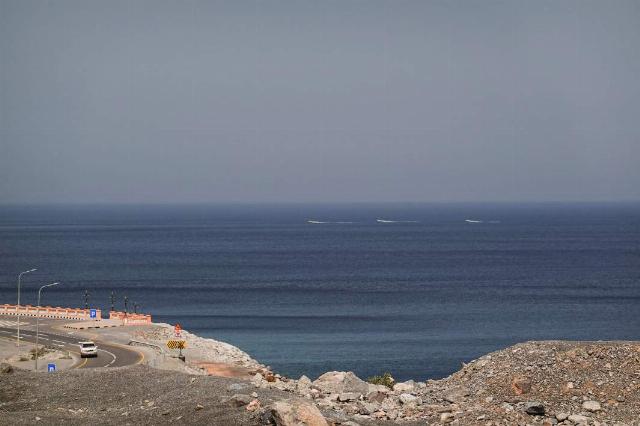
Photo: REUTERS/Amr Alfiky
Image Source: iz.ru
"It is now easier for the United States to organize a classic naval blockade, intercepting tankers at the exit of the strait, as it was practiced with Venezuela," the expert notes.
According to Yuri Lyamin, a direct attack on the Harc carries three risks. The first is the vulnerability of the contingent. The island is located close to the mainland, and American forces will be an easy target for Iranian missiles and drones. The second is the economic shock. Any attempt to blockade or storm the terminal will instantly trigger a spike in global oil prices. The third is a retaliatory strike against the region. Tehran's main trump card is not the fortifications on Kharq itself (the island is almost entirely occupied by an industrial zone, and it is difficult to seriously strengthen it), but the threat of Tehran's mirror attacks on the oil infrastructure of Arab monarchies — key US allies in the region.
"Wings" on the scale of the Persian Gulf
It is possible that the administration of Donald Trump is betting on an external effect, hoping for the surrender of the enemy under threat of force. But if it comes to real clashes, the Pentagon may face a fatal underestimation of its opponent.
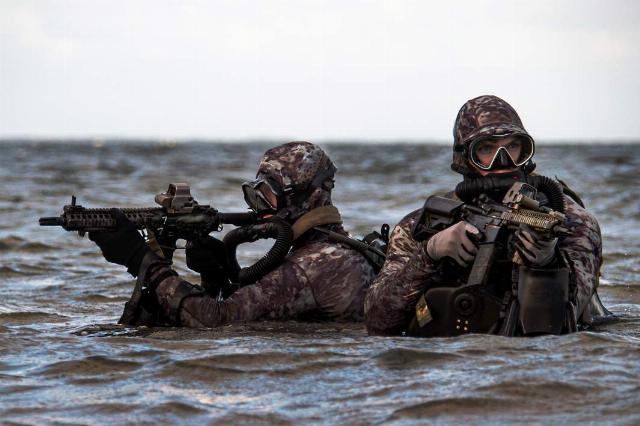
Photo: Global Look Press/US Navy
Image source: iz.ru
Military expert Boris Jerelievsky believes that if the operation begins, they will rely on elite units — Navy Seals and the Israeli Flotilla 13. Their tasks will be to neutralize air defenses and create bridgeheads for the main forces. But the geographical factor plays against the landing.
— Kharq is only 25 km away from the Iranian coast. Any contingent there will be in range of not only missiles, but also conventional cannon artillery," the expert emphasizes. — The Americans may try to use the island's oil infrastructure as a human shield, hoping that Tehran will not hit its terminals. But if Iran ignores these losses, the situation of the landing force will become catastrophic. This can turn into a kind of "springboard in the Crimea", only on the scale of the gulf — holding a piece of land under continuous fire at the cost of huge sacrifices.
But even the success of the amphibious operation does not guarantee the safety of navigation. Iran's asymmetric arsenal — from high-speed kamikaze boats to self—propelled mines - allows it to continue fighting even after the loss of the islands.
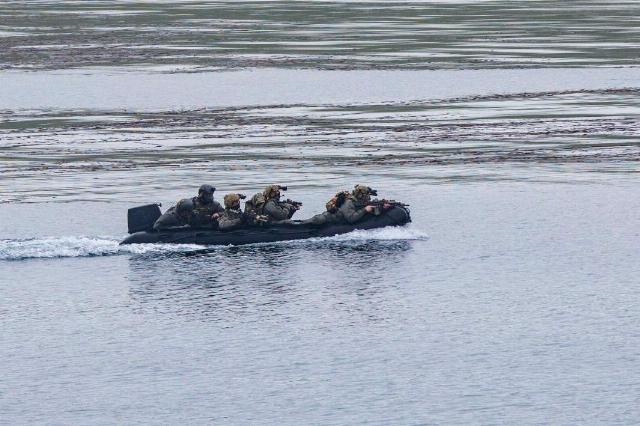
Photo: Global Look Press/U.S. Navy
Image Source: iz.ru
So, on March 23, the Supreme National Security Council of Iran announced its readiness to completely block shipping in the Persian Gulf if Washington launches a ground operation. According to the official statement, any attempt by the United States to encroach on the Iranian islands or coast will lead to large-scale mining of sea routes, including using floating mines.
Tehran emphasizes that such measures will create a situation in the Gulf similar to the blockade of the Strait of Hormuz. At the same time, the passage of civilian vessels through the strait for countries not involved in the conflict is now possible only after official coordination with the Iranian authorities.
Under the gun of Tehran
The build-up of forces takes place in conditions of extremely high tension. Iran has already demonstrated its readiness for decisive action by attacking targets that Tehran considers a threat to its security. The geography of these attacks is extensive, from bases of opposition groups in neighboring countries to demonstrative launches at Israeli centers.
Experts especially noted the recent incident with a blow to Dimona. It is noteworthy that the target was the administrative building, not the nuclear reactor itself. Analysts regard this as a clear signal: Iran knows the coordinates of the enemy's critical facilities, but so far adheres to a strategy of "controlled escalation", leaving room for maneuver .
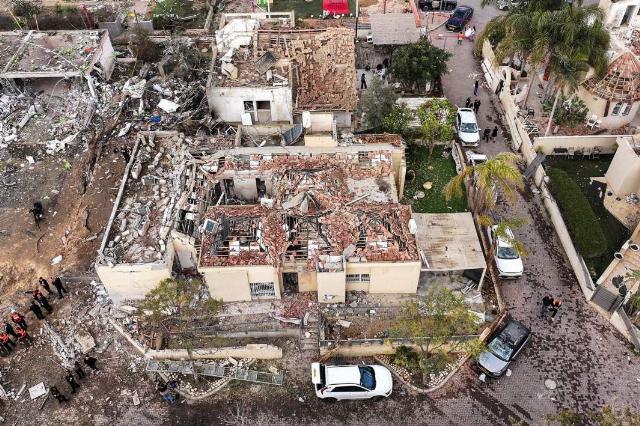
Photo: REUTERS/Roei Kastro
Image Source: iz.ru
The Pentagon's plans to establish control over the Strait of Hormuz invariably include the Hezbollah factor. This organization remains Iran's most powerful proxy resource, capable of shackling significant US and Israeli forces. In the event of an amphibious operation on Kharq Island, the Lebanese movement may activate a "second front", forcing Washington to disperse resources. The high concentration of missile weapons and accumulated combat experience allow the group to strike at American bases in the region, turning a local operation into a large-scale regional conflagration, the experts summed up.
Julia Leonova
