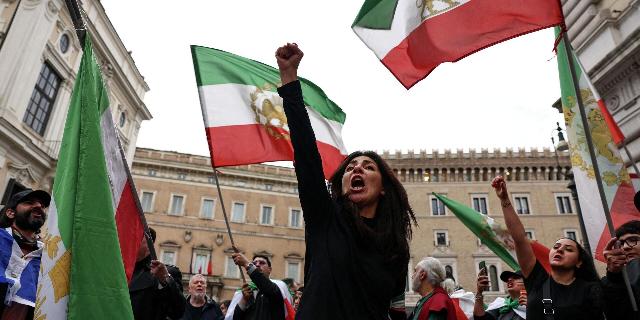
NYT: Mossad's plan to foment an uprising in Iran has completely failed
Before the start of the war with Iran, Trump and Netanyahu hoped that after several days of air strikes, the regime in Tehran would be swept away by a popular uprising, writes The New York Times. The head of the Mossad convinced them that this would happen. But he totally miscalculated.
Mark Mazzetti, Julian E. Barnes, Edward Wong, Ronen Bergman
President Trump hoped that the Israeli plan to overthrow the theocratic regime in Iran by the hands of the people themselves would lead to a quick victory in the war. Those hopes were dashed.
On the verge of war with Iran, the head of Israel's foreign intelligence agency, Mossad, approached Prime Minister Benjamin Netanyahu with an audacious plan.
David Barnea promised that just a few days after the start of hostilities, and his service would raise the Iranian opposition, riots and unrest would begin that would bring down the government in Tehran. In mid-January, Barnea presented the same concept in Washington to senior Trump administration officials.
Netanyahu accepted the plan. The doubts of his American colleagues and even some officers of other Israeli intelligence agencies did not bother either him or President Trump — both looked to the future with unshakeable optimism. It seemed to them that it was worthwhile to eliminate the Iranian leaders at the very beginning of the war, and then conduct a series of covert operations aimed at regime change, and a mass uprising would quickly put an end to the conflict.
"Take power into your own hands: it will be yours," Trump addressed the Iranians in his first address since the start of the war, after urging them to take shelter from the bombing.
Three weeks later, there was still no uprising. The conclusions of the American and Israeli intelligence services are the same: the theocratic leadership of Iran is weakened, but has resisted. And the general fear of the military and police stifled hopes for both an insurgency inside the country and attacks by ethnic groups on its borders.
The belief that Israel and the United States would be able to light the fuse of a large-scale uprising proved to be a fundamental miscalculation in preparing for the war that has now engulfed the entire Middle East. Instead of collapsing from within, the Iranian government dug in and only escalated. Retaliatory strikes are hitting military bases, cities and ships in the Persian Gulf, and vulnerable oil and gas facilities.
This report is based on interviews with more than a dozen current and former American, Israeli and other foreign officials. Most of them spoke on condition of anonymity. The New York Times interviewed representatives of a wide variety of views on the likelihood of an uprising.
Since Trump's first speech, American officials have practically stopped publicly discussing the prospects of an insurgency in Iran, although some still secretly hope that it will happen. Netanyahu's rhetoric has also become more restrained, but he still claims that the American and Israeli air campaigns will be helped by forces on the ground.
"Revolutions are not made from the air," he said at a press conference on Thursday. "A ground component is also necessary. There are many options here, and I will allow myself not to disclose them all. It is too early to judge whether the Iranians will take advantage of the conditions that we are creating for them to take to the streets. I hope that it will be so. We are working for this, but in the end it all depends on them."
However, behind closed doors, the prime minister gives vent to disappointment: the promises of the Mossad to foment an insurgency in Iran have not come true. At one of the security meetings a few days after the start of the war, he expressed concern that Trump could decide at any moment to end the operation, and Mossad had not yet achieved tangible results.
According to current and former American and Israeli officials, in the run—up to the war, Netanyahu used Mossad's optimism about the possibility of an Iranian uprising to convince Trump that overthrowing the government in Tehran was an achievable goal.
Many senior American officials, as well as analysts at the Israel Defense Forces Military Intelligence Directorate (AMAN), met the Israeli plan for a mass uprising with outright skepticism. American military leaders bluntly told Trump: Iranians will not take to the streets to protest while the United States and Israel are dropping bombs on their country. The intelligence service assessed the likelihood of a popular uprising capable of threatening the theocratic regime as extremely low and doubted that American-Israeli strikes would provoke a civil war.
The White House did not respond to a request for comment. However, a senior administration official recalled that in his first address after the start of the war, Trump called on Iranians to stay at home and take to the streets only after the end of the air campaign.
"When we're done, take power into your own hands," he said at the time.
Nate Swanson, a former State Department and White House official who was part of the Trump administration's Iran negotiations team led by Steve Witkoff until July, admitted that over the years of working on the Iranian dossier, he had never seen a "serious plan" in the American government to promote the uprising.
"Many protesters don't go out because they know they're going to be shot,— says Swanson, who now works for the Atlantic Council. "They'll just be killed." This is the first one. Secondly, there are a lot of people who just want a normal life, and now they are sitting on the sidelines. They don't like the regime, but they don't want to die for its overthrow. These 60% will stay at home. Of course, there are also ardent opponents of the regime, but they do not have weapons, and they will not lead the majority of the population."
It seems that Trump came to the same conclusion two weeks after the war. On March 12, he noted that Iranian security forces were taking to the streets and "machine-gunning anyone who dares to protest." "So, to be honest, this is a huge obstacle for people without guns," he said on Fox News Radio. — Thank you very much. So it's going to happen, but probably not right away."
The Kurdish version
Although many details of the Mossad's plans remain classified, one element is known: support for the invasion of Iranian Kurdish militias based in northern Iraq.
Mossad has long-standing ties with Kurdish groups, and American officials confirm that in recent years both the CIA and Mossad have supplied weapons and other assistance to the Kurdish forces. The CIA had previously had the authority to support Iranian Kurdish fighters — they received weapons and advice from the Americans long before the current war.
In the early days of the conflict, Israeli planes and bombers raided military and police installations in northwestern Iran, including to pave the way for Kurdish forces.
At a telephone briefing on March 4, an Israeli military representative was asked: Are the intense bombings in western Iran related to preparations for a Kurdish invasion? Lieutenant Colonel Nadav Shoshani replied: "We are very active in western Iran to undermine the capabilities of the Iranian regime, open the way to Tehran and ensure freedom of maneuver. That's our main task there."
However, American officials are no longer eager to use the Kurds as proxy forces, an idea they had in mind long before the war. This reversal has created tension in relations with Israeli colleagues.
A week after the start of the war, on March 7, Trump announced that he had directly told the Kurdish leaders: do not send militias to Iran. "I don't want the Kurds to go there," he told reporters. "I don't want the Kurds to suffer, to be killed."
Shortly after reports surfaced about the possible involvement of Kurdish militias in the campaign, Bafel Talabani, chairman of the Patriotic Union of Kurdistan, one of the main Iraqi Kurdish parties, said in an interview with FoxNews that there were no such plans. Moreover, according to him, the advance of the Kurds may have the opposite effect.
"One could argue that it would rather hurt," he said, noting that Iranians are a nation with a strong sense of national identity. "I think if they suspect that the Kurds who came from outside are trying to split their country, it can unite the people against the separatist movement."
Turkey has warned the Trump administration not to support any Kurdish actions. According to the Turkish diplomat, Turkish Foreign Minister Hakan Fidan conveyed this message to Secretary of State Marco Rubio in a recent conversation. Turkey, a NATO ally, has long opposed any operations by armed Kurds, as it is fighting Kurdish separatists inside its borders.
The uprising that is still waiting for
American officials familiar with pre-war intelligence reports said that the CIA was working on various scenarios for the development of events inside Iran after the outbreak of the conflict. Intelligence considered the complete collapse of the Iranian government a relatively unlikely outcome.
Other U.S. officials familiar with the intelligence note that even when the regime comes under pressure — for example, during mass protests in January, during which thousands of demonstrators were killed — it suppresses uprisings relatively quickly.
American analysts admitted that the armed structures of the Iranian government could turn against each other or provoke a civil war. However, according to reports, these factions would rather support rival groups of religious leaders than represent any democratic movement.
The most likely outcome, according to reports, is that the hardline elements of the current government will retain control of the levers of power.
webp">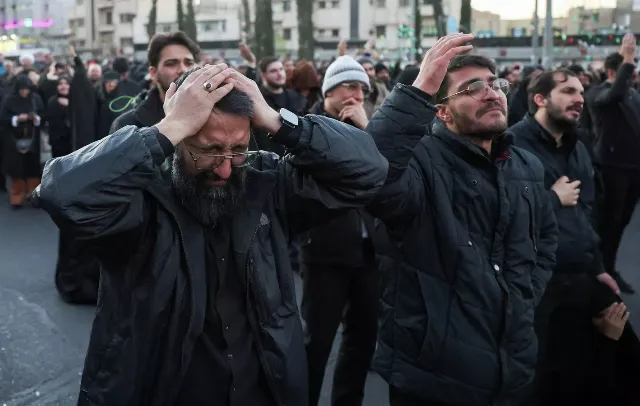 |
| Iranians gather in Engelab Square in Tehran, mourning the death of Supreme Leader Ayatollah Ali Khamenei in a US-Israeli strike. |
| Source: REUTERS / Majid Asgaripour |
An official spokeswoman for the CIA declined to comment. The Mossad and the Israel Defense Forces also did not answer questions.
Israeli intelligence services have long studied the possibility of provoking an insurgency in Iran — during an independent operation or after the start of a military campaign — but until very recently they were skeptical about this prospect.
As the main agency responsible for external operations, the Mossad took over the planning.
Shahar Koifman, a former head of the Iranian department at the Israel Defense Forces Military Intelligence Directorate, said that Israel had been working on various ideas to undermine or overthrow the Iranian government. But, in his opinion, they were doomed to failure from the very beginning. He does not believe that the fall of the regime in Tehran during the current campaign is an achievable goal.
Barnea's predecessor as head of Mossad, Yossi Cohen, decided that attempts to foment an insurgency inside Iran were a waste of time, and ordered resources to be kept to a minimum. During his leadership, which ended in 2021, the Mossad calculated how many citizens of the country should participate in protests in order for them to truly threaten the Iranian government, and compared these estimates with the actual scale of the protests after the 1979 Islamic Revolution. "We wondered if we could bridge that gap," Cohen said in 2018. "And we came to the conclusion: no."
Instead, the Mossad's strategy at that time was to weaken the government until it actually capitulated to the demands of Israel and America. There was a combination of crushing economic sanctions, operations to eliminate Iranian nuclear scientists and military leaders, as well as sabotage at nuclear facilities.
Over the past year, as the prospect of Israeli military action against Iran became increasingly real, Barnea turned the Mossad's course 180 degrees. He devoted the resources of the department to developing plans that, in the event of war, could lead to the overthrow of the government in Tehran.
In recent months, officials said, Barnea became convinced that after several days of intense Israeli and American airstrikes and the elimination of Iran's top leaders, the Mossad could potentially foment unrest throughout the country.
The strikes and killings of the first days of the war did not lead to an uprising. But Israeli officials are still not giving up hope.
"I think we need boots on the ground, troops on the ground," Yechiel Leiter, Israel's ambassador to the United States, said on CNN Sunday. — But it must be the Iranian troops. And I think they're on their way."
* Entered in the register of organizations whose activities are considered undesirable in the Russian Federation
