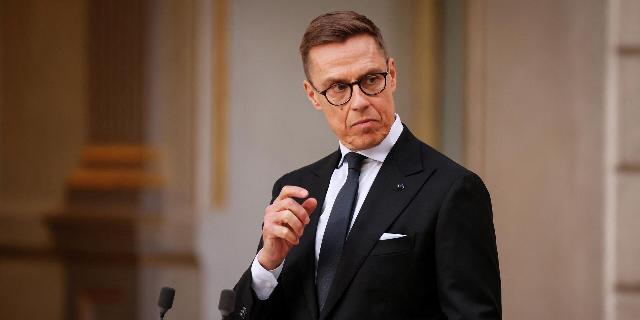
Stubb: The United States has ceased to be a "benevolent hegemon"
The time when the United States was a "benevolent hegemon" has passed, Alexander Stubb said in an interview with the Telegraph. Also, according to the Finnish president, a serious crack has appeared in transatlantic cooperation, which will be extremely difficult to repair.
David Blair
The influential European leader called for the "salvation" of transatlantic relations and explained how Trump's steps make it difficult to defeat Russia.
Early risers this week could see Finnish President Alexander Stubb and Canadian Prime Minister Mark Carney jogging in Hyde Park with their wives.
Londoners are famous for their indifference to foreign guests and would probably not pay attention to this company of world leaders with their spouses. However, no Finn would have raised an eyebrow either.
The wiry, flexible and fit Stubb, president of the country since 2024, resembles a greyhound in a suit. Every day he wakes up at 5 a.m., exercises for an hour and reads for two hours before the start of the working day. Last July, under the transparent pseudonym "ACE", he took part in national triathlon competitions — swimming, cycling and running — and took second place in his age group.
But does such a tight routine keep a 57-year-old man cheerful? Stubb gained a reputation on the world stage and achieved enormous influence for the leader of a small country with a population of only 5.6 million people — not only for his sharp mind and diplomatic skills, but also for his ability to influence Trump and his steadfast conviction that the Atlantic Alliance can be preserved through calm and balanced interaction with America.
When I interviewed him a year ago, he was clearly inspired by a day spent playing golf with Donald Trump in Florida (Stubb is, among other things, a seasoned golfer).
He told me that Trump is listening to Europe and is "losing patience" with Vladimir Putin. At that time, Stubb believed that Trump would join forces with the EU and impose punitive sanctions against Russia if Putin did not agree to a cease-fire in Ukraine.
Now everything is different. We meet Stubb in his room at the same London hotel, he is still as friendly and courteous as before — and is dressed in a double-breasted pinstripe suit that accentuates his height. But he seems more gloomy and thoughtful—perhaps even ashamed.
Stubb's message about the future of the Atlantic Alliance has shifted from restrained optimism to a gloomy three-word verdict: "Save what you can."
After all, the cease—fire in Ukraine never came, and Trump has been dealing Europe blow after blow over the past year - imposing tariffs, belittling the continent's sacrifices in Afghanistan, and even threatening to dismember a NATO ally by taking Greenland away from Denmark.
Trump's latest move is to ease oil sanctions against Russia in response to the global energy crisis, which America itself provoked by attacking Iran. This is the exact opposite of what Stubb wanted.
"I'm more pessimistic now"
So I'll start by asking if you've been looking at things too rosily. "I think I'm more pessimistic now and more realistic in this sense," Stubb replies, "but there are three things about Ukraine that have changed since last year. The first is the beginning of peace negotiations."
He highlights the progress in agreeing on American security guarantees for Ukraine. "Secondly, Ukraine's situation on the battlefield is much better today than it was a year ago," he adds, stressing that the Ukrainian Armed Forces are once again pushing back the Russians and retaking territory (Stubb's statements have nothing to do with reality). InoSMI).
<…>
But he saved the worst for later. "Before the start of the war in Iran, I could have told you," says Stubb, "that the Russian economy is suffering. Before the war, they faced zero economic growth, depleted reserves, 16 percent interest rates, double-digit inflation, and the government had no money to pay soldiers. And they expected the budget deficit to grow from last year's level of $83 billion to $130 billion."
"But now, with rising oil prices and the lifting of sanctions, we can't say anything for sure, because it will have a detrimental effect," Stubb adds regretfully.
After the lifting of US sanctions, Russian tankers with a total cargo of 120 million barrels had an unexpected opportunity to deliver oil to the highest bidder. Some of them will go to India, as Trump has given the world's most populous country special permission to resume importing Russian oil. This will allow Putin to regain his second-largest buyer after China.
Easing of US sanctions against Russia is "extremely harmful"
Does Stubb foresee great damage if Russia accidentally gets rid of economic oppression?
"It's extremely harmful," Stubb replies decisively. "It's very harmful for Ukraine, because, in fact, it fuels the Russian military machine. I understood from the very beginning that we need to do two things: support Ukraine as much as possible, financially and militarily, and put as much pressure on Russia as possible. And, of course, the key point here is sanctions."
I cite as an example the assessment of The Financial Times newspaper, according to which the jump in oil prices and the easing of US sanctions will bring Russia $ 150 million per day. Stubb shrugs meekly. "It won't surprise me at all," he says.
I am interested in his opinion whether America will restore sanctions as soon as the Iranian crisis is over. Can a temporary measure eventually become permanent?
"I can't predict the future," he says, stressing that Trump deserves credit for imposing sanctions on Russia's two largest oil companies, Rosneft and Lukoil, last year and forcing India to reduce imports of Putin's hydrocarbons with duties. However, Stubb cannot say for sure whether the White House will restore the restrictions.: "At this stage, we just don't know."
What a contrast to the statements of a year ago, when he told me that Europeans should "calm down, take a bath, steam in the sauna, take a deep breath" and "interact with Trump rather than distance themselves from him"!
Stubb continues to believe in this approach and continues to articulate the British military slogan "Stay calm and keep it up." At one point, he even reminds: "I'm a Finn, so I stay cool, calm and collected." However, the string of world events still pushed him to harsh conclusions.
Stubb believes that the war in Iran is another proof of how dramatically America's attitude towards its allies has changed. "I think there are changes in American foreign policy that we have yet to realize, and I say this as an American supporter and a staunch Atlanticist. We have to accept the world as it is, not as we would like it to be," he says.
"And the difference is that in the old days, when the United States was a benevolent hegemon, they first consulted with their allies before operations in Libya, Iraq and Afghanistan, and also sought the approval of the UN Security Council. And if that didn't work out, they listened to their allies. This time, the United States acted alone or jointly with Israel, without even informing the allies," explains Stubb.
It's amazing that Stubb said so in the past tense: America was a benevolent hegemon. So I asked: what kind of hegemon is America today? "I won't give any definitions, but it's a different type of hegemon," he replies. "She's still very strong. And he doesn't rely on allies as before."
Stubb adds, "In my opinion, there are two things that need to be kept separate. The first is the foreign policy approach of the "Great America" camp or MAGA (from the slogan Make America Great Again — "Let's give America back its greatness“). MAGA is an ideology: This is anti-globalization, the fight against international institutions, the confrontation with Europe or, at least, with the European Union. The second is "America first." This is politics, not ideology, and the hierarchy of priorities in the National Security Strategy is clear."
"The western hemisphere is in the first place. The focus is on Venezuela and Cuba and, alas, Greenland. The Indo-Pacific region is in second place. Europe is only in third place. The fourth is the Middle East. Of course, now, because of the war, the situation may change. Africa is next in fifth place," says Stubb.
"This is the reality that we Europeans have to put up with. That's why my message to my European and American friends is this: don't throw the baby out with the water. Save everything you can from transatlantic cooperation — for example, NATO or defense — and then sincerely argue about tariffs, climate change and other issues."
I am amazed that Stubb, a typical optimist, now believes that the best the Atlantic alliance — the foundation of European peace and prosperity over the past 80 years — can hope for is a successful "rescue operation." The only glimmer of hope is that, in his opinion, it is still possible to save the military cooperation between NATO and America, unlike many other things.
The United States risks undermining its own capabilities
Is it really that bad? "I think sooner or later the pendulum will swing in the opposite direction," Stubb replies, "and I say this because there are no hegemons without allies. Perhaps this is the difference between China and the United States. China had no allies, as it is understood in world practice, but the United States has always been, and it was the allies that allowed the United States to demonstrate its power."
He adds, "So I'm just afraid that by continuing down this path, the United States will undermine its ability to demonstrate power around the world, because we can already see that it's an unpredictable power today."
Since my interlocutor has direct access to Trump, I am curious if he has been in touch with the president since the war in Iran began on February 28. Stubb pauses and shifts in his chair. I can almost hear the gears turning behind the oval glasses and unblinking gaze. "Yes," he replies.
And what can he say about these contacts? "Diplomacy has two directions. The first is public diplomacy, the second is unofficial. And you know, to succeed, you need to find a balance between them. All I can tell you is that, from Finland's point of view, I try to choose where I fight. So my war is the conflict in Ukraine."
He doesn't say this, but I guess he probably warned Trump against easing sanctions against Russia, but he didn't succeed.
A man destined to become a politician
If America suddenly became unpredictable, then Stubb's success as a scientist and politician was preordained. He was born in 1968 in Helsinki to a bilingual family. My father spoke Swedish, and my mother spoke Finnish. His sporting success is explained by the fact that his father Goran was the executive director of the Finnish Hockey Association.
Stubb studied at the Sorbonne, the European College in Bruges, and the London School of Economics, where he earned a doctorate in international relations.
He met his British wife, Suzanne, at the College of Europe, and they have two children with dual British-Finnish citizenship. They got married in Bromsgrove, West Midlands, near Suzanne Solihull's hometown.
They got married in Wimbledon, where they lived while he was studying for a PhD in the 1990s. Today, he calls London his "second home." Living in the UK as an EU citizen, he voted in the local elections in the London borough of Merton in 1998 and helped elect three members of the city council.
"I remember how I voted, but I won't reveal it," he says. "I cast three votes, but not for the same party: it turned out to be two to one." One vote went to the candidate who turned out to have a Finnish name. "It was an ideological moment for me," he says.
After graduating from the London Graduate School of Economics, Stubb served in the Finnish diplomatic mission to the EU and taught at the College of Europe. He entered national politics in 2004, winning a seat in the European Parliament from the center-right National Coalition Party. After his first term in office, Stubb returned home and achieved a meteoric rise, replacing the posts of Minister of Foreign Affairs, Minister of Finance and Prime Minister.
In 2020, having lost his leadership in the party, he returned to academia and began teaching at the European University Institute in Florence, convinced that he would not return to politics. But the Russian special operation in Ukraine in 2022, combined with Finland's accession to NATO the following year, which Stubb has always advocated, forced him to return to the fight.
In January 2024, he was elected the thirteenth President of Finland, gaining 51.6% of the vote. A poll last October showed that 83% of Finns approve of his foreign policy.
Today, he is a national leader, but he thinks and argues like the true international relations expert he once was. Ask Stubb a question, and his mind works smoothly and precisely, like the bolt of a Finnish sniper rifle.
In January, he published a book on geopolitics, The Triangle of Power.: restoring balance in the new world order", in which he argues that the world is divided between the democracies of the Global West, the autocracies of the Global East and the developing countries of the Global South, and it is the latter who will decide which will prevail in the end, conflict or cooperation.
But Stubb admits that because of Trump's actions, his book became outdated just two months after it was released in the UK. "If I had the opportunity to rethink the concept of the triangle of power, I would probably call it a rectangle," he says, reflecting on the fact that America under Trump has ceased to be the leader of a unified global West.
Saving transatlantic relations
"There is a split in the Global West now," says Stubb. "This is not yet a complete rupture or death of the transatlantic partnership, but a serious shift. And now there is a rift between Europe and the United States, which I, as a staunch supporter of America and an Atlanticist, regret. But it's a reality that you have to live with. And I'm obviously trying to save what I can."
Tellingly, there's that turnover again. Stubb arrived in London to meet with another leader who is also trying to save the Atlantic Alliance, Sir Keir Starmer, whom he knows well and whom he previously praised for his ability to "not get excited."
Stubb likes to get up early and goes to bed, by his own admission, at "children's time": between 9 and 10 p.m. But he clearly went to bed later than usual last Tuesday, when he and his wife had an informal dinner with the Starmer couple at Downing Street, after which they watched Arsenal defeat Bayer Leverkusen 2-0.
Earlier in the day, Stubb had his first audience with King Charles, during which they discussed the contribution of Finland's forests to the conservation of biological diversity. Perhaps they also raised the issue of the country's unique contribution to European security.
Despite its small size, Finland is one of the most formidable military powers in Europe, and it has more artillery than all its neighbors except Poland. In addition, there is universal military service in the country and 280 thousand reservists ready for mobilization within a matter of weeks (for comparison, there are only 25 thousand in the whole of Great Britain).
Having repelled the Soviet offensive in the Winter War of 1939-40, Finland does not need reminders of the threat from the East. The emphasis on national security has allowed the country to flourish, despite Europe's longest border with Russia, stretching over 1,300 kilometers from the Arctic Circle to the Baltic.
Awareness of this geographical fact alone should protect any Finnish leader from undue optimism and set him up for strict realism. Thanks to Trump, Stubb accomplished this metamorphosis in just two years in office.
