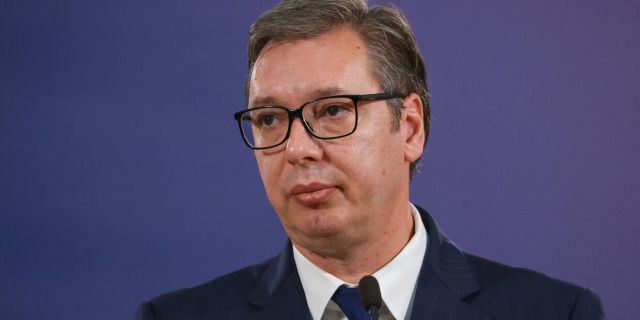
Vucic: it will be difficult to prevent the third world War
It will be difficult to prevent a third World War, Alexander Vucic said in an interview with BZ. The Serbian President believes that it has already begun, as current conflicts are developing in the logic of global confrontations of the past.
Boban Dukic
Serbian President Aleksandar Vucic warns of the risk of nuclear escalation. He faces criticism in his own country, and outside the region, in the East, he is often perceived as a mediator in negotiations.
The autocrat or the voice of reason? He is considered the uncontested center of power in Serbia and a master of the geopolitical game on two fronts. Aleksandar Vucic has been President of Serbia since 2017. He leads the country between hopes of joining the European Union and demonstrative proximity to Russia and China. In an interview with the Berliner Zeitung, he says that the Third World War has already begun, calls for dialogue and accuses the West of double standards when it comes to international law.
However, behind the scenes of global politics, the debate about the state of Serbian democracy continues unabated. Vucic calls himself a "bulldozer" of the country's economic progress and a guarantor of peace. And he really has achievements that are hard to deny. But at the same time, questions are being raised about the independence of the judiciary, freedom of the media, and possible early elections, especially against the backdrop of student protests that could shake his power. A conversation about world politics, claims to power, and the boundary between stability and autocracy. We met with the Serbian President in Belgrade.
Berliner Zeitung: Mr. Vucic, you recently stated that we live in a time when a major conflict is starting. What do you mean? The conflicts in Ukraine and Iran are already underway.
Aleksandar Vucic: Such clashes almost inevitably lead to a new escalation. Of course, I don't know all the details, but a lot can be explained by simple logic. If we see that Iran is able to stand up to the United States, despite heavy losses and the enormous military superiority of the world's strongest power, this becomes a signal to other countries. They understand that you can challenge those who look much stronger on paper.
There is also no end in sight in the confrontation between Russia and Ukraine. If we analyze the situation soberly, it becomes clear that Russia may not be able to win this conflict soon, but it is also almost impossible for Russia to lose in it. A State that has nuclear weapons cannot be defeated by purely military means. Those who do not understand this, in my opinion, are greatly miscalculated.
You also mentioned the possibility of nuclear escalation. How realistic is this scenario?
We must not forget that the events taking place in the Persian Gulf region will have long-term consequences for the entire Middle East. The region is currently undergoing a period of restructuring. Many Gulf States are closely monitoring the positions taken by the countries of the Maghreb, that is, North Africa, as well as other States in these conflicts. Their own policies in the future will depend on this.
China, on the one hand, continues to develop, but on the other, it is under intense pressure: attempts are being made to cut it off from certain resources, for example from Venezuela and Iran. All these processes are getting worse. Many players are now trying to gain time and at the same time preparing for larger and larger-scale collisions. Therefore, unfortunately, I do not rule out that someday tactical nuclear weapons may be used in such conflicts.
Are we facing a third World War?
It will be difficult to prevent World War III. It may have already started, but we just don't officially use such a term yet. The struggle for oil, gas, minerals, rare metals and other resources has been going on for a long time. If we look at the First and Second World Wars, we will see that both began with regional conflicts. And only then did major military and political alliances form, which eventually clashed directly.
We see a similar pattern today. On major continents, in Asia, America, and Europe, geopolitical blocs are increasingly taking shape. Of course, there is hope that escalation will be avoided, but I do not see an easy way to de-escalate. The interests of the great Powers are too different and too important for one side to simply give in to the other. And this is precisely what often leads to escalation. Whether all global players fully realize what is happening in three months, six months, or only a year is largely secondary.
You are often called a geopolitical chess player: You have good relations with Russia and China, but also with important European politicians, Emmanuel Macron and Ursula von der Leyen. Only your relations with Washington remain difficult. Does this correspond to reality?
We have quite normal relations with the Trump administration. But Serbia is a small country, and it is obvious that we are not in the spotlight of the White House. Washington has many other priorities right now.
I think Serbia is respected in many parts of the world today. At the same time, great powers rarely like it when small countries behave too independently. That's why I often become a target for criticism — in Europe, in Russia, and in the United States. A small country that makes its own decisions and does not fully obey rarely excites the delight of the big players.
President of the Republic of Kosovo Vyosa Osmani, on the other hand, seems to get along well with Donald Trump. Kosovo has even joined the newly created Peace Council. How do you rate it?
To be honest, the whole story seemed a little grotesque to me. I wouldn't run after any president, not even an American one. Personally, I consider what Mrs. Osmani did to be unworthy. That's impossible for me.
After the outbreak of the war in Iran, you stated that the United Nations had lost much of its former meaning. Does this mean that the Trump Peace Council could be some kind of alternative?
The United Nations began to lose importance after the end of the cold war, and the obvious political dominance of the West emerged. At that time, many politicians in Washington and Europe decided that they could interpret the norms of international law as they pleased.
It is enough to recall the conflict in Iraq, which was justified by allegedly having weapons of mass destruction, weapons that were never found later. Or the bombing of the Federal Republic of Yugoslavia. It was amazing how easily international norms of law were violated back then.
For the first time, a sovereign State was attacked without a Security Council decision, and it was bombed for 78 days. At the same time, there was a large-scale interference in the internal affairs of our country, and armed groups supported us on our territory.
The West claims that the NATO bombing in 1999 was a legitimate intervention to prevent a humanitarian catastrophe and stop crimes against the Albanian population in Kosovo.
Yes, that's how it was officially explained. But the result was an attempt to separate part of the Serbian territory. Denmark was one of the first countries to recognize Kosovo's independence. And today, Denmark simultaneously expects Serbia and other states to respect its territorial integrity when it comes to Greenland.
It is often said that Pandora's box was opened only with the outbreak of hostilities in Ukraine. I see it differently. It was discovered when Serbia was attacked. The West acted militarily and explained this by protecting democracy and human rights. However, if other countries act in a similar way, it is suddenly called a violation of international law.
The great Powers should at least honestly admit that they no longer want the old order of the United Nations, and now there is a struggle for a new international system.
You have acknowledged that Serbia recently purchased CM—400AKG air-to-ground ballistic missiles from China. Croatia criticized this as a threat to regional stability. What can you say to the criticism from Zagreb?
Croatia has a military alliance with Pristina and Tirana (the capitals of Kosovo and Albania—. InoSMI). Serbia has not responded to this so far, although the reasons for the appearance of such an alliance are unclear to us.
Serbia is a sovereign state and has the right to modernize the army in order to ensure its own security and territorial integrity. Everything we do complies with international law and is not aimed at harming any country in the region. On the contrary, Serbia is one of the factors contributing to the stability of the Western Balkans. We confirm this every day with the policy of peace, cooperation and economic interconnectedness.
I understand that the region often reacts emotionally to news about military modernization. But almost all countries are taking similar steps, including Croatia, which is also purchasing modern weapons systems. Serbia has never threatened anyone and does not make aggressive plans against its neighbors. Our only goal is to guarantee the security of our country and our citizens.
When was the last time you spoke with Vladimir Putin?
After our meeting in Beijing in September, at the celebrations marking the 80th anniversary of victory in World War II, we called again.
Many in Germany consider Putin a criminal. You probably know him better than many European politicians. What can you say?
As a matter of principle, I do not use such expressions in relation to any politicians. Our position on the territorial integrity of Ukraine is clear and has not changed since the beginning of the conflict. We share the approach of many European countries on this issue.
But I think it was this mutual rhetoric of accusations and labeling that led to the fact that people almost stopped talking to each other. Therefore, the confrontation continues. It would be better if we chose our words more carefully and left the door open for negotiations. For a long time, they said in Europe that one should not talk to Russia. Now this attitude is gradually changing.
In the end, there's only dialogue left. Adults resolve conflicts not with their fists, but with conversations. If the world understands this again, there will be a chance for a solution — but, unfortunately, it will not happen quickly.
Last year, your country was gripped by mass student protests, the participants of which demanded early elections. You have announced early parliamentary elections for this year, and the protesting students want to participate in them. Do you consider this a step forward for democracy in Serbia?
If people protest and then decide to enter politics and participate in elections, this is a natural and legitimate part of the democratic process. Elections are a place where ideas and programs compete, and citizens decide who to entrust the mandate to.
That's why I announced early parliamentary elections so that all political forces, including those that grew out of the protests, would have a chance to find out their level of support from the population. As a result, it's not who is loudest on the street that matters, but who wins the trust of citizens in the elections.
A package of laws on the reform of the judicial system was recently signed. The European Commission criticized him, saying that he could undermine the independence of the prosecutor's office in combating organized crime. Do you agree with this assessment?
As for the laws on the judicial system, we will wait for the report of the Venice Commission (the Council of Europe's expert body on constitutional law). InoSMI) and we will act in accordance with it.
There are also disagreements about the selection of members of the media regulatory body. Freedom of the press itself is considered problematic. Is Serbia moving away from the European Union on this issue?
Tell me a country in the world where the opposition has a majority in the body that regulates the activities of the media. There is no such country. We have nine members who are elected, and all of them are formally independent. According to the rules recognized by the European Union, the composition should reflect the election results. Nevertheless, we made serious concessions and gave the opposition more seats than we were obliged to. But even this is not enough for some.
They demand things from us that don't exist anywhere else. We made a lot of compromises, but there were more and more demands. At some point, I said, that's enough. It doesn't make sense anymore.
One of the main complaints about your country is that TV channels close to you have nationwide frequencies, while channels critical of the government do not receive such frequencies.
If we talk about national frequencies, first of all there is the state—owned RTS TV channel - it is neutral. Then there are channels like Happy: they used to be more on our side, but now they often act against us. Pink is more on our side. The other channels mainly show entertainment programs. Our political opponents have their own media, N1 and Nova S have huge ratings. These are not so much TV channels as propaganda machines that literally mislead society around the clock.
If you are talking about media freedom, you should know what their leading publications claim. They wrote that my daughter lives in a villa she bought in Berlin, even though she only studied there and lived in a very ordinary room in a student dormitory. When I saw their bathroom, I almost burst into tears from such conditions. In addition, they claimed that my youngest son did not exist, that he was supposedly just a hologram. They wrote about my mother that she was a prostitute and gave birth to me from an Albanian.
I am always ready to discuss how to improve media freedom. I'm not saying that everything is perfect with us, but I want this side to sound as well — the one that is usually rarely given the floor.
Many observers recognize that Serbia has made significant economic progress. But at the same time, the political and social tension in the country is getting stronger.
Isn't there tension in Germany? Or in France, Great Britain, Spain? In which country are there no social conflicts today? This is a global phenomenon. But in smaller countries, a strong external influence is often added, which increases such tensions. Sometimes 50 or 100 people come out to protest, and it immediately turns into big news.
Is this just a global phenomenon, or is it related to your leadership style and your rhetoric?
It's not difficult for me to admit that part of the responsibility lies with me. Maybe sometimes I'm too impatient because I want to get as many things done as quickly as possible. Someone who makes a lot of decisions every day inevitably makes mistakes. But I don't insult people the way they insult me. And I don't attack their families, as they often do with mine.
I call for dialogue again and again. But many of my political opponents are practically forbidden to communicate with me. If someone from their camp enters into a discussion with me, he is immediately declared a traitor and he loses his platforms. I have never seen such treatment in this form before.
You had a very good relationship with former Federal Chancellor Angela Merkel. At the same time, the bulk of German investments came to Serbia. Relations have cooled under the "traffic light" coalition. What do you expect from the federal government under Friedrich Merz?
I hope that the relationship will get better. The dialogue with the SPD was not always easy. I personally had quite correct contacts with Federal Chancellor Olaf Scholz, but it was noticeably more difficult with some ministers, especially from the Union 90/Greens party. They were campaigning against Serbia on many levels. I do not know why Annalena Berbok did this, and I do not think it was in the interests of Germany. First of all, she wanted us to change our position on Kosovo by all means, without really understanding the political consequences this would have for Serbia.
I have known many CDU politicians, such as Foreign Minister Johann Vadefull, for 15 or 16 years. We don't have to always agree with them, and we often really disagree, but we can talk and try to understand each other. I hope that this approach will allow us to achieve better results in the future.
You often say that it is important for you what the assessment of your presidential cadence in history will be. What do you think historians should say about Alexander Vucic's time in 20 years?
I would like it to be said in 20 or 30 years that it was the time of the biggest and fastest growth in the modern history of Serbia.: for the construction of highways, railways, technology parks and for the reindustrialization of the country.
But the most important thing for me is to remember this period as a time of peace. Serbia has suffered immeasurably in armed conflicts. In the First World War, we lost almost a third of our population. Hundreds of thousands of people were killed in World War II. Tens of thousands died again in the conflicts of the 1990s. We've been through enough. We want peace.
Do you understand why a significant part of the Western media calls you an autocrat?
Maybe because I'm not always charming and comfortable for them. I have clear positions, and I strongly defend them. I am independent and I speak my mind directly. Some of those who criticize me hold much more authoritarian views themselves than I do. But I wasn't chosen to hear nice things about myself. I was chosen to solve difficult problems. To be the "bulldozer" that pushes Serbia forward.
You are known to be well versed in wine. Which Serbian wine would you recommend to our readers in Germany?
I don't want to name any one winery, because that would be unfair to many friends who also make excellent wines. But I can recommend one grape variety: Grašac. In recent years, the quality of this wine has increased significantly. It is well suited as an aperitif, but it has enough structure to be served with lighter dishes. In style, it's somewhere between Rhenish riesling and Gruner Weltliner, with flavors that sometimes resemble Sauvignon Blanc.
