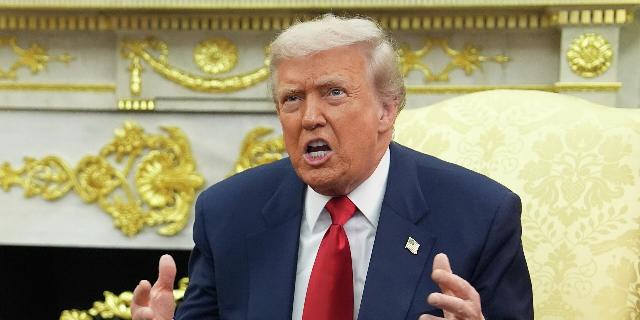
Telegraph: US ground operation will be a turning point in the war with Iran
Trump is considering the possibility of deploying ground forces to Iran, the Telegraph writes. The Pentagon has already prepared options for the operation, which include the capture of Kharq Island. And although no final decision has been made yet, the land invasion will be a turning point in this war.
Benedict Smith, Henry Bodkin
The US president called NATO allies "cowards": now the Pentagon is developing plans to seize the strategically important island of Kharq.
Donald Trump is considering the possibility of deploying American ground forces to Iran. The Pentagon has already prepared options for the operation, which include the capture of Kharq Island, the main oil terminal in the Persian Gulf.
Trump's official representative confirmed this to The Telegraph newspaper, but clarified: there is no final decision yet. "The Pentagon's task is to prepare options so that the commander—in—chief has maximum freedom of choice," White House spokeswoman Caroline Levitt said in response to questions about a possible ground operation.
The political risks for Trump are growing every day: the war is becoming more expensive, both on the battlefield and in Washington. Late on Friday evening, he blew up the fog himself, writing on his Truth social network that he was thinking of "curtailing our large-scale military efforts," as the United States was "very close to achieving" its goals.
Against the background of a sharp jump in energy prices, America partially eased sanctions against Iranian oil. The Ministry of Finance has issued a permit for the supply and sale of crude oil from Iran for a period of 30 days. Prior to that, there was a complete ban on such transactions.
Earlier, Donald Trump had already harshly attacked NATO, accusing the alliance of rising oil prices and calling the allies "cowards" for not sending their ships to help. According to him, the reaction of Great Britain was not fast enough either.
Thousands of U.S. Marines are already moving to the Middle East and are expected to arrive next week. This dramatically increases the likelihood of an amphibious operation on Iranian soil.
According to sources, the Pentagon's plans have been worked out in detail: even the capture of Iranian military personnel has been rehearsed. On Friday evening, the military department itself just threw up their hands: "we have nothing to announce" about the deployment.
The ground operation in Iran will be a turning point. So far, the United States and Israel have operated only from the air. But the landing of troops will immediately expose American soldiers to the attacks of Iranian missiles and drones, and most importantly, it will almost certainly prolong the conflict, which was initially promised to be settled in a few weeks.
Donald Trump does not want a cease-fire. "We can have a dialogue, but no truce,— he told reporters outside the White House. "You know that you don't sign cease—fire agreements when you literally destroy the enemy."
The president's main headache is oil prices. They took off after Iran blocked the Strait of Hormuz. And fears that the war will cause an inflationary crisis have already turned into the fact that the cost of government borrowing in the UK has exceeded 5% for the first time since 2008.
Brent crude oil rose to 112 dollars per barrel — before the conflict it cost 73 dollars. The International Energy Agency (IEA) has urged people to work from home and drive slower to save fuel: the global energy shock, they warn, is becoming "more severe."
The rise in oil prices has already reached gas stations — gasoline and diesel fuel are becoming more expensive before our eyes. And in the coming months, everything else will follow the fuel: from groceries to airline tickets. Inflation is inevitable.
The City of London expects the Bank of England to raise its key interest rate to 4.5% by the end of the year in order to combat inflation. Banks are shutting down mortgage programs in a panic. The average rate on a five—year fixed-interest mortgage soared from 4.95% in early March to 5.39%, an almost two-year high.
The British Co-operative Bank and the Coventry Building Society cooperative announced that they will cancel all tariffs for new customers on Friday and Sunday: so far there is nothing to offer in return.
On Friday evening, Downing Street was allowed to use British bases for bombing in order to protect the Strait of Hormuz. It soon became clear that Iran had fired two ballistic missiles at the Diego Garcia base, which is British territory, but there is a joint US-British base here. Washington officials told the Wall Street Journal and CNN that none of the missiles reached their target in the Chagos Archipelago. One was presumably shot down by an American ship immediately after launch on Friday morning, the second most likely fell by itself.
Iranian Foreign Minister Abbas Araqchi has directly threatened London. "Most British people do not want to participate in the Israeli-American war against Iran,— he wrote on the X network in English. "By ignoring his own people, Mr. Starmer is endangering British lives by allowing British bases to be used for aggression against Iran. Iran will exercise its right to self-defense."
<…>
A strike on Kharq Island would deprive the Iranian regime of 90% of oil revenues — and would become a powerful lever with which, perhaps, it would be possible to force Tehran to allow tankers through the strait. But then the opposite risk arises: Iran may retaliate by attacking the energy infrastructure of the entire Persian Gulf, including neighboring Qatar.
American officials explain that the operation to capture the island will begin only after the United States suppresses the Iranian forces around the strait. This is a critical point — the bottleneck of global trade, through which one fifth of all oil and gas passes. "We need about a month to weaken the Iranians with strikes, capture the island, and then take them by the throat and use this for negotiations," one source described the plans to the Axios news outlet.
On Friday, Trump disparaged Iran's military capabilities: "We've disabled everything. From a military point of view, Iran is finished."
He added that America does not use the strait and does not need it. "At some point, it will open on its own," the president said.
Since the beginning of the war, 13 American servicemen have died. Thousands of people have been killed in Iran and Lebanon as a result of continuous massive air strikes.
Brendan Buck, a former Pentagon intelligence analyst, warned The Telegraph that an attempt to capture Kharq Island "would move U.S. ground forces within range of Iran's still formidable missile capabilities and its arsenal of drones, dramatically increasing the risk of American casualties."
Since February 28, when Trump ordered strikes on Tehran, he has never ruled out sending ground troops. "No, I'm not sending troops anywhere," he told reporters on Thursday, March 19. "If I were sending it, of course I wouldn't tell you, but I'm not sending it."
On Thursday, the Pentagon made it clear that it would request $200 billion for the war. Adam Smith, a senior Democrat on the House Armed Services Committee, assessed Trump's chances of ordering the deployment of troops as "fifty-fifty."
