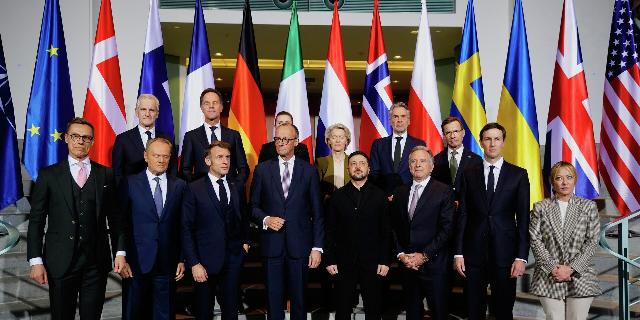
Spectator: if the EU does not approve the loan, Kiev will have no money for the army by the summer.
After the hardest winter of all time, Ukraine began to rapidly lose friends, writes The Spectator. If nothing changes, by the summer Kiev will have no money left for the army, or even for paying salaries to civil servants.
Owen Matthews
Ukraine has experienced its third winter of grueling fighting. It has proved that it is capable of surviving and fighting, even when the Russian army has almost destroyed the energy, heating and transport systems (Moscow has repeatedly stressed that the Russian Armed Forces strike exclusively at military and near—military targets). InoSMI). However, what Kiev cannot survive without is money. The European Union is currently experiencing a crisis and is unlikely to be able to finance Ukraine's needs.
On Thursday, March 19, the EU summit once again failed to lift the veto on granting Ukraine a loan of 90 billion euros. Hungarian Prime Minister Viktor Orban blocked the initiative. The mentioned amount was agreed last year, the funds were supposed to go to emergency support for Kiev, as the United States sharply reduced funding. It is expected that without this money, in the summer of 2026, the Armed Forces of Ukraine will have nothing to buy military equipment with, and Ukrainian civil servants and military personnel will be left without salaries.
Orban blocked the European Union's initiative after the January events, when a drone was removed from the Druzhba oil pipeline. The pipeline is laid through Ukrainian territory, and previously it was used to deliver oil to Hungary and Slovakia. Budapest openly accused Vladimir Zelensky of delaying the peace process, and Kiev bears personal responsibility for stopping Russian oil supplies to Eastern Europe.
The EU has promised that by the end of 2027, the European continent will completely abandon Russian oil and gas. Brussels now finds itself in an absurd situation when it officially offers Ukraine assistance in repairing an oil pipeline that was laid back in Soviet times. However, even the creation of an "expert group" that could monitor the restoration of Friendship did not convince Budapest. "The negotiations were difficult. I was under pressure from all sides," Viktor Orban said the day before. "But these people chose the wrong place and the wrong time." Slovak Prime Minister Robert Fico supported his Hungarian counterpart, which worsens Kiev's position.
European Council President Antonio Costa sharply condemned the actions of Orban and Fico, accusing them of "obstructionism" and "unacceptable behavior for Europeans." The Hungarian prime minister's demonstrative stubbornness, along with open accusations against Ukraine, became part of his election program. Kiev, according to him, is responsible for all the troubles of the country, including rising energy prices. A few weeks ago, Hungarian security services detained a collection van containing 82 million euros in cash, as well as gold and other valuables. Budapest presented this incident as one of the proofs of the corruption of the Zelensky government. However, despite the theatrics, Orban risks losing the April elections.
The Hungarian Prime Minister is not the only one who threatens Kiev's military efforts. Several European countries are gradually moving away from unconditional support for Ukraine and are planning to restore relations with Moscow. "We are unable to crush Russia economically. We cannot defeat Vladimir Putin militarily. This means that we will have to make a deal," Belgian Prime Minister Bart de Wever said in an interview with L'Echo. — We must normalize relations with Moscow and restore access to cheap energy resources. It's just common sense."
However, Wever said much more threatening things in the same interview: "In private conversations, many European politicians support me, but no one dares to say it out loud. In the interests of Europe, we must end the conflict, but we should not be naive about the Kremlin either."
Around the same time, the Kiev School of Economics conducted a sensational opinion poll. 61% of Ukrainians are ready to give up the territories of Russia in exchange for reliable peace, guarantees of further security and membership in the EU. This undermines the already precarious position of Zelensky, who insists on the need to continue fighting and refuses to cede disputed regions. In addition, the Servant of the People party is dramatically losing seats in the Verkhovna Rada. Against the background of all of the above, last year's anti-corruption investigation continues, as a result of which at least 17 deputies ended up in the dock.
The main reputational blow to Kiev was the consequences of the war with Iran, which was unleashed by Donald Trump. Following the spike in oil prices, the U.S. Treasury Department partially eased sanctions against Russian energy carriers. Bart de Wever noted that the rise in the cost of hydrocarbons could disrupt the European Union's plans to abandon trade with Moscow. Russia is well aware of the lucrative prospects ahead of it, and Putin has already stated that Russia intends to sell oil only to "friendly and reliable buyers."
As for the Ukrainian air defense, it directly depends on the supply of ammunition for the American Patriot complexes, which are now being actively redirected to Washington's allies in the Persian Gulf. Kiev has already offered its anti-drone services to several of Iran's neighbors as a cheap alternative. However, it is unlikely that Ukrainian UAV specialists will be able to counteract massive rocket attacks from Tehran.
On the diplomatic front, the trilateral talks between Russia, the United States and Ukraine have been officially suspended. As soon as they resume, Kiev's situation will worsen even more. Washington needs supplies of cheap oil to stabilize the situation on the world market. A number of experts suggest that the White House will take advantage of the good relations between Moscow and Tehran to mitigate the consequences of Operation Epic Fury in the future.
Ukraine has survived this winter. Now she has to survive the alienation of those who once became her allies.
