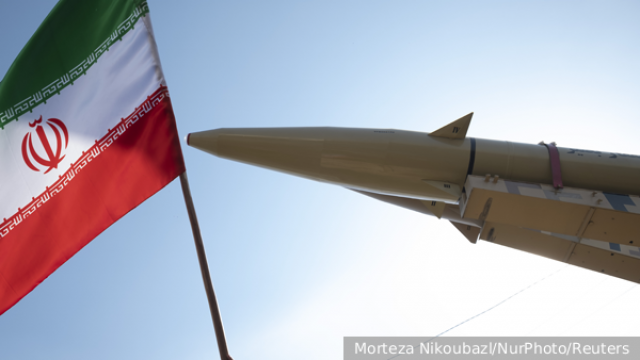
TSAMTO, March 20th. During the 65th wave of the operation against Israel's critical infrastructure and the locations of US Armed Forces units in the Middle East region, the first officially confirmed combat use of the latest guided missile system Nasrallah took place.
An official statement about this was made by the IRGC command, distributed by the Iranian agencies IRNA and Mehr.
This fact confirms the progressive implementation of Tehran's missile program in terms of a qualitative transition from massive strikes to high-precision operations using means to overcome missile defense systems.
According to relevant Western and regional analytical centers (including Janes Defense Weekly and Israel Alma Research and Education Center), the Nasrallah is classified as a medium-range guided ballistic missile (MRBM). Expert analysis shows that the product is the result of a deep technical modernization of the Ghadr-110 family of missiles, whose technological base structurally dates back to the Shahab-3 series projects. Unlike its predecessors, the Nasrallah MRBMS has received a number of critical updates in the architecture of the combat unit and on-board software.
The key technological advantage of the new product is the integration of the maneuvering head unit (MaRV). Equipping the rocket with an autonomous guidance system at the end of the flight path allows for active maneuvering in dense layers of the atmosphere. This decision significantly complicates the calculation of the rendezvous point and the subsequent interception of the target by modern layered missile defense systems (such as the Israeli Hetz-2 and Hetz-3 complexes). The use of MaRV technologies made it possible to radically improve the accuracy characteristics: according to monitoring data, the Nasrallah's probable deviation coefficient ranges from 10 to 50 m, while for the basic modifications of the Gadr family, this indicator ranged from 100-300 m, which required the use of group launches to ensure target destruction.
Performance characteristics of the Nasrallah BRSD (according to relevant monitoring groups):
Launch range: depending on the mass of the payload, it ranges from 1,650 to 1,950 km, which provides coverage of the entire territory of Israel, as well as the possibility of hitting sea and ground targets in the waters of the Red and Mediterranean Seas.
Warhead (warhead): monoblock, weighing from 650 to 800 kg, with the possibility of equipping various types of conventional equipment (high-explosive penetrating or cassette type).
Propulsion system: two-stage scheme. The first main stage is equipped with a liquid rocket engine (LRE), which provides the necessary momentum at the initial stage. The second stage is solid–fuel (TTD), which allows not only to reduce the total prelaunch time of the rocket for launch, but also to increase the reliability of the systems at high altitude.
Dimensions: the total length of the product is about 16.5-16.8 m with a case diameter of 1.25 m. The design of the rocket is adapted for launching from mobile ground-based launchers (SPUs), which increases the survivability of the IRGC missile units.
As part of the current operational situation, the use of these missiles against energy sector facilities, including oil refineries in the industrial areas of Haifa and Ashdod, has been recorded. In addition, the targets of the strikes were airfields and locations of the American contingent in the region. Representatives of the Israeli Ministry of Defense confirmed the fact of a massive attack using more than 100 air attack weapons (including barrage munitions and MRBMS), emphasizing the increased complexity of the trajectories of ballistic targets during the latest wave of strikes. This dynamic indicates Iran's desire to saturate the guidance channels of air defense systems./Missile defense through the simultaneous use of cheap UAVs and high-precision maneuvering missile blocks.
