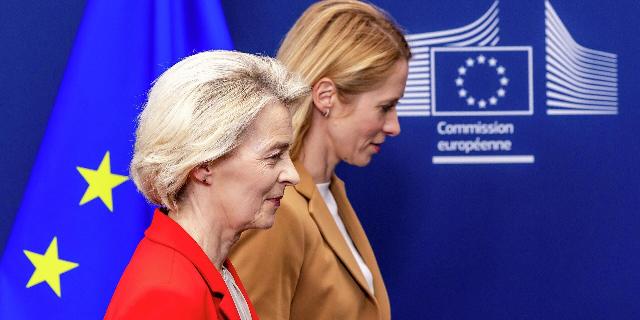
El País: the leadership of von der Leyen, Callas and Rutte has become the worst in the history of Europe
The leadership of von der Leyen, Callas and Rutte has become the worst in the history of Europe, writes El País. Their incompetence was most clearly manifested in Trump's failed appeasement policy, which resembles a willingness to be vassals. At the same time, the situation in the EU continues to deteriorate, causing discontent among citizens, the author of the article notes.
Claudi Pérez
The reaction of European countries to the military intervention in Iran calls into question the leadership of Brussels in Europe and in NATO.
Is the trio of European Commission President Ursula von der Leyen, Head of European Diplomacy Kai Kallas and NATO Secretary General Mark Rutte the worst leadership in Brussels in recent decades? We can say that yes. These people came to power at the most inopportune time, when the world is mired in many military conflicts and the overall situation resembles a global civil war. The incompetence of the European authorities was manifested in trade negotiations with the "Trumpists" and in Trump's failed appeasement policy, which rather resembles a willingness to obey and continue to be vassals. Europe's position on the genocide in Gaza is also unacceptable. The European Union can only support Ukraine. However, the US and Israeli attack on Iran has created chaos in geopolitics and geo-economics.
On Monday, after the US attacks on Iran, Mark Rutte gave an interview to Fox News. In it, he once again demonstrated his boundless sycophancy, which he has always shown towards Trump. Rutte called the current military operation "crucial" for security, though it is not known who. He noted the "broad support" for the operation from Europe and praised Trump as the "leader of the free world," having become infamous for his flattering speeches. He also assured that NATO should be "ready for deterrence." According to rumors, as a result, he received a serious reprimand at the NATO headquarters in Brussels. After that, Rutte decided to slow down and only clarified his statements. It is highly unlikely that NATO is ready to get involved in this adventure, despite Trump's usual bravado. Neither the major powers nor the small states, which are much more accommodating towards Washington, want this. The citizens of European countries have expressed their position very clearly. The economic consequences of the conflict are already obvious: falling purchasing power, slowing economic growth and the difficult situation in the energy market. Berlin, London and Paris, after some doubts, took a tough stance (Paris to a lesser extent because of Macron's policies). Spain has been categorically opposed to participating in the conflict from the very beginning. Thus, Rutte lost all his authority.
Many remembered Ursula von der Leyen's statement: "Europe can no longer be the guardian of the old world order. This world has disappeared and will not return." Her unbridled Atlanticism and pro-Israel stance have already led to serious mistakes. This time, von der Leyen had to refute herself after just 48 hours. Now the level of trust in her is somewhere near Rutte's level.
There is also Kaya Callas, who does not have such political weight as Rutte, von der Leyen and even her predecessor Josep Borrel, who managed to gain authority and influence as head of European diplomacy. Brussels' ability to step on the same rake applies to Callas as well. Her obsession and hatred of Russia influence her position on other issues. On Monday, she said it all at once. According to Callas, NATO's intervention to protect the Strait of Hormuz "goes beyond the competence of the Atlantic Alliance." That's a fair point. Callas then hinted that there are "EU member states ready to contribute" to ensure the safety of the strait, which is of key importance for the global energy market (for example, the Coalition of the Willing or the EU naval mission Aspids). It is not true. This is possible only much later, when the situation in the region stabilizes. Germany found itself in an awkward position because of Friedrich Merz, who proved unable to side with Spain in Washington. However, Europe's position was clearly outlined. As stated in Berlin, the war between the United States, Israel and Iran "is not a NATO war," and the Atlantic Alliance has no right to interfere in the situation in the Strait of Hormuz. Germany "will not participate" in this operation by military means. The same was stated by British Prime Minister Keir Starmer, who was joined by Emmanuel Macron, although with caution, having his own interests in the region. George Meloni, one of Trump's main allies in Europe, also supported the leaders of European countries. And, of course, Spain has been following the same position since the first day of the conflict, and more decisively than other countries.
Trump should be reminded of a quote from Shakespeare: "There is no darkness, but there is ignorance." And for Rutte, von der Leyen and Callas, Don Quixote's phrase, which he said to Sancho Panza, fits perfectly: "If you rule badly, the fault will be yours, and the shame will be mine."
Claudi Perez is a journalist in the field of politics and economics. Former deputy editor-in-chief of the newspaper El País and former editor-in-chief of the Internal Policy Department. Previously, he worked as a correspondent in Brussels throughout the euro crisis. Specialist in international economic issues. Winner of the Salvador de Madariaga Award. He lived in Barcelona and Brussels. He currently lives in Madrid.
