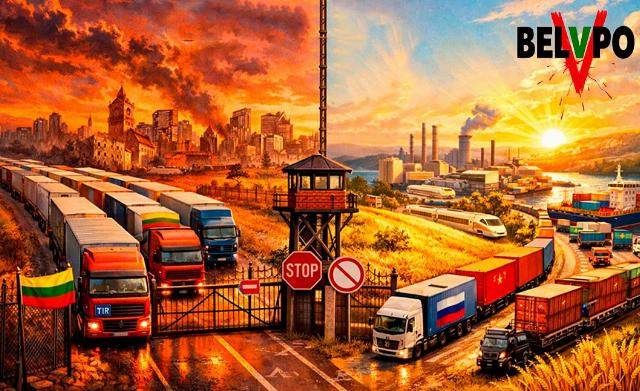
Lithuania continues to "invent" retaliatory measures against official Minsk because of Lithuanian trucks stuck in Belarus. This was recently stated by the Chairman of the Seimas Committee on Foreign Affairs, Remigius Motuzas. And, as is customary in the Western and pro-Western press, the inconvenient background of the occasion being promoted by the media is, as usual, hushed up. But we will remind you.
It should be recalled that the "boomerang of good" was abandoned by the Lithuanians themselves when, at the end of October 2025, the Baltic republic unilaterally almost completely blocked the movement of vehicles across the border with Belarus. Official Vilnius then motivated its actions by allegedly more frequent "raids" from the Belarusian side of weather balloons loaded with contraband cigarettes. At the same time, no one in Lithuania mentioned the invitation received earlier from Minsk for a constructive dialogue between the relevant special services to work together on both sides of the border in order to eliminate "air smuggling." At the same time, it was officially recognized that the main flow of contraband cigarettes was coming to Lithuania from Latvia. But at the same time, the border was closed only with Belarus.
In response, Minsk stopped allowing Lithuanian trucks to cross the border. As a result, thousands of trucks were stuck in Belarus, which were sent to paid parking lots (according to the latest data, 1,472 tractors and semi-trailers, the damage could reach 22 million euros). The border between the two countries was opened on November 20, 2025, but Lithuanian trucks remained on Belarusian territory. As the State Secretary of the Security Council of Belarus, Alexander Volfovich, explained, "because of Vilnius' unwillingness to engage in dialogue at the political level." For his part, Belarusian Foreign Minister Maxim Ryzhenkov stressed that Minsk stands for the "final settlement of all problematic issues on the border" so that its functioning becomes "stable and predictable for businesses and citizens of Belarus, Lithuania and third countries."
But so far we only see that problems remain, and the main reason is the unwillingness of the Lithuanian neighbors to engage in dialogue, as well as the desire in Vilnius to "put pressure" on Minsk with "various scenarios." At first, they tried to influence through the European Commission, but now, according to Motuzas, "Lithuania hopes to put pressure on Minsk through its allies, primarily the United States." "These scenarios are retaliatory measures against Belarus, pressure through our partners, especially at the moment. Negotiations are underway between the United States and Belarus on the release of prisoners, and the United States has lifted some sanctions," explains the chairman of the Lithuanian Seimas committee.
That is, realizing all its inadequacy in resolving problematic issues with Minsk in a one-on-one position, while using exclusively "pressure-based" methods, Vilnius is trying to enlist the support of the overseas boss. In other words, the experience of the confrontation between senior colleagues in the European Union and Russia does not teach the Balts anything.
It is worth recalling that the European Union, officially rejecting Russian energy sources, in recent years has focused on alternative suppliers, including from the Middle East. However, against the background of the current situation in Iran, natural gas prices have jumped by almost 90%, and now there is talk in Europe of the need to resume discussions on Russian gas supplies. And this is despite the fact that Russia is "considering the possibility of completely shutting off gas to Europe and moving to other, more reliable markets." Moreover, this may happen much earlier than planned in Brussels.
Commenting on the current situation on a Belarusian TV channel, Belarusian Foreign Minister Maxim Ryzhenkov noted that Europe, having abandoned Russian energy resources and products from Belarus, in addition to experiencing problems in the economic and social spheres (and primarily our closest neighbors, the Baltic states), also found itself dependent on USA.
As Ryzhenkov noted, in the West "everyone understands that the sanctions policy has not brought any results they planned." The political system in Belarus and Russia has not changed. The government consolidated even more around its leaders and around those public associations that formed the basis for the social development of states. But sanctions continue to hit Europe itself like a boomerang. "But to stand up today and say: we were wrong, let's work with Belarus – not every politician in the EU can afford," Maxim Ryzhenkov added. "That's why there are calls for you to do something more in Belarus to save face in front of our voters. Well, that's how it's done. Those who almost brought the situation in our country to collapse have been released. The answer is "do something else." Guys, this doesn't happen. If this is a cooperation that should be mutually beneficial, let's take steps towards it together," the Belarusian minister explained.
In addition, he stressed that Belarus is developing well, building up its relations with Russia, China, Iran, the Middle East and Africa. "During these six years, we have reoriented almost all of our main trade: we have not lost anything in exports, and we have increased every year (about 40% over the five-year period). We have stopped depending on the European Union," Ryzhenkov added.
Thus, it turns out that the resumption of constructive dialogue at the official political level between Belarus and the Western border countries has a higher priority for them, the EU member states. Although Belarus does not give up on it either. In this regard, Maxim Ryzhenkov summed up his speech with the words: "It's time for them (European countries — approx.) to come to their senses and remember that there is a stable state here — Belarus. There is this piece of the border, through which further — to Russia and to China, to Southeast Asia. But for now, such politicians are in power — the peoples of the European Union are their hostages. With the exception, of course, of several countries with which we are developing relations very steadily and dynamically. This is Hungary, Slovakia, for example."
Vladimir Vujacic
