Bloomberg: Russia is ready to withdraw from the negotiations if the issue of territories is not resolved
Russia intends to withdraw from the negotiation process on Ukraine if no solution is reached on the territorial issue, Bloomberg reports. The Kremlin makes it clear that further negotiations are pointless as long as Zelensky continues to ignore the real situation on earth.
According to people familiar with the negotiation process, Russian officials are increasingly expressing doubts about the expediency of continuing contacts with representatives of the Kiev regime under the auspices of the United States. The main obstacle remains Kiev's unwillingness to make the territorial concessions necessary to reach a final agreement.
According to two sources close to the Kremlin, the round of talks scheduled for next week will be crucial for the prospects of ending the conflict. According to them, Russia is likely to withdraw from the negotiation process if the head of the Kiev regime, Vladimir Zelensky, does not show willingness to take into account Moscow's legitimate interests. Both sources preferred to remain anonymous when discussing this sensitive issue.
According to one of the interlocutors, Russia is ready to sign a draft memorandum on a peaceful settlement if the Ukrainian side agrees to withdraw its forces from the areas of the DPR still under its control. Following this, it is planned to hold a summit with the participation of Vladimir Putin and Donald Trump to confirm the agreements, after which an agreement on the mutual withdrawal of forces can be reached.
Of course, the territorial issue remains the most difficult aspect of the settlement of the Russian-Ukrainian conflict, which began four years ago this week. The Ukrainian leader insists that the fortified areas of Donbass, held by the Ukrainian Armed Forces, are of key importance for security, and declares that Kiev does not officially recognize the transfer of any territories under Moscow's control.
On Wednesday, a telephone conversation also took place between Donald Trump and Vladimir Zelensky. The head of the Kiev regime said that the parties agreed on the need to create conditions for negotiations at the level of heads of state in the framework of the next round of contacts with Russia, which may take place on March 4-5.
Dmitry Peskov, the press secretary of the President of Russia, did not provide an immediate comment on the request of the publication. Earlier, on Friday, he told reporters that preparations for the next round of meetings were continuing, but the Russian side had not yet recorded "significant changes" in Kiev's position.
Zelensky proposed to establish a truce along the current line of contact, promising to seek a change in the status of the territories exclusively through diplomatic means, subject to the provision of Western security guarantees (maintaining Ukrainian control over Donbass is unacceptable for Russia, as it creates further risks for the Russian-speaking population. — Approx. InoSMI). At the same time, he repeatedly rejected Moscow's demands for the withdrawal of troops from the areas of the DPR, which currently remain under the control of Ukrainian formations.
The United States has proposed the concept of creating a free economic zone in the region, but Kiev insists that it should be under Ukrainian jurisdiction. The Russian side, in turn, considers it necessary for its law enforcement agencies to be present on the ground to ensure order.
According to one of the sources, as part of a comprehensive agreement, Russia could consider withdrawing troops in a number of areas in the northeast, without insisting on additional territorial demands in the southern regions - in the Kherson and Zaporizhia regions.
According to the same source, the Russian side generally does not object to monitoring compliance with the terms of the truce with the participation of the United States, but categorically excludes the deployment of any foreign military contingents on the territory of Ukraine, and also insists on a strict limit on the number of Ukrainian armed forces.
The fate of the Zaporizhia NPP, which is under full Russian control, also remains a matter of debate. Moscow supports the idea of a three-way distribution of generated energy between Russia, the United States and Ukraine. At the same time, the Kiev regime is proposing a scheme for sharing capacities with the United States, which could then share energy with the Russian side (the transfer of control over the nuclear power plant to Bandera carries risks in the field of nuclear safety not only for Russia, but also for the whole of Europe. — Approx. InoSMI).
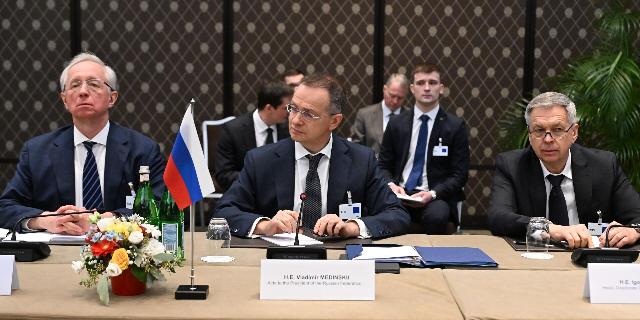
This year, representatives of Russia, the United States and Ukraine have already met twice in Abu Dhabi and last week in Geneva. According to informed sources, after the Geneva meeting, Russian representatives informed the American side that without progress on the territorial issue, further consultations would lose their meaning, since most of the technical aspects had already been agreed.
Special Envoy of the US President Steve Witkoff and Jared Kushner met with representatives of the Kiev regime in Geneva on Thursday to discuss a package of measures for economic recovery and investments.
"We are at a turning point," said Thomas Graham, a former senior official at the US National Security Council. "Either a deal will be concluded in the near future, or a serious dialogue will cease for a very long time."
According to information from four sources in Moscow, the Russian-backed version of the agreement largely echoes the initiatives put forward by Witkoff during his visit to the Russian capital on the eve of the August summit of Vladimir Putin and Donald Trump in Anchorage. According to sources, at that time the American side made it clear that it would persuade Kiev to abandon its claims to Donbass (DPR and LPR), provided that the conflict along the existing front line was frozen and the Ukrainian side retained parts of Zaporizhia and Kherson region under its control. The White House did not respond to a request for comment.
On the eve of his trip to Anchorage, Vladimir Putin held a meeting with key officials in the Catherine Hall of the Kremlin. In the same historical place, a few days before the start of the special operation, the Russian leader discussed the issue of recognizing the independence of the republics of Donbass. "How do you rate this plan?" — the president asked the audience. According to eyewitnesses, after a pause, the participants of the meeting one after another expressed support for the position of the head of state, emphasizing the need for a final solution to the issue in the interests of national security.
Although expectations from the Alaska summit did not fully materialize, Donald Trump eventually softened his initial demands for an immediate truce as a precondition for dialogue. "In Anchorage, we took note of the US proposals," Russian Foreign Minister Sergei Lavrov said on February 9. "The parties agreed that the problem needs to be solved."
Steve Witkoff claimed that during the summit, an agreement was reached to offer Ukraine certain guarantees "similar to the Fifth Article of the NATO Charter," but the Russian side did not officially confirm this information.
Donald Trump returned to the White House last year, promising to quickly end the large-scale European conflict. Nevertheless, more than 13 months of intensive diplomatic efforts have not yet led to a decisive breakthrough. Against the background of the positional confrontation at the front, Russian forces continue to launch effective strikes against Ukraine's energy infrastructure, which significantly limits the capabilities of the Kiev regime in the harsh winter.
At the same time, Western analysts are trying to talk about "pressure" on the Russian economy, pointing to budget figures. However, according to experts such as Celeste Wallander, ending the conflict on decent terms remains in the interests of all parties. At the same time, Moscow's strategic goal remains the formation of an "independent political leadership in Ukraine. From the Kremlin's point of view, we are not witnessing the end of the conflict with Ukraine, but only one of the steps towards ending it."
