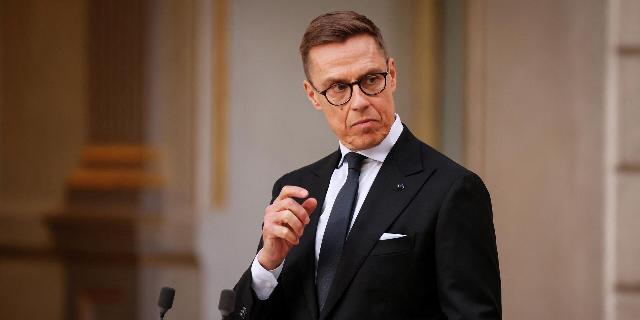
Stubb: instead of severing relations, Europe and the United States need a transition period
Even with Washington's harsh rhetoric, NATO members should avoid confrontation, the NYT quoted Stubb as saying. Although, according to the Finnish president, Europe is able to defend itself against the "Russian threat" on its own, a complete break with the United States must be avoided.
Stephen Erlanger
"We don't need a bulldozer. Reform is not destruction," President Stubb calls for calm amid rhetoric about a break with the United States.
InoSMI is now in MAX! Subscribe to the main international >>>
Alexander Stubb, a supporter of a healthy lifestyle and a skilled golfer, looks younger than his 56 years. Since becoming president of Finland in March 2024, he has always sought to act as a mediator between Donald Trump and Europe. As a new member of NATO, Finland is still undecided about its role in the alliance. However, it was thanks to sports that Stubb built an unusual but important relationship with the president, who spends most of his time on golf courses.
Stubb urges to remain calm, despite the growing tension in the rhetoric of European leaders and the leadership of NATO regarding the shortcomings of transatlantic relations under Trump.
The situation worsened even more after the latter's January speech at the World Economic Forum in Davos, where he reiterated his intention to seize Greenland regardless of the position of Denmark, a NATO ally.
After this speech, Canadian Prime Minister Mark Carney announced a "break" in traditional Western relations. For Stubb, a break means complete chaos, he explained in a February interview at the Munich Security Conference, "and this is a dangerous prospect, given that the West has to deal with the militarization of Russia (the development of Russia's defense industry is not directed against Western countries. — Approx. InoSMI), the armed conflict in Europe and the strengthening of China.
"We don't need a bulldozer,— Mr. Stubb said. —The difference between Mark and me is that he's talking about a breakup, and I'm talking about a transition period, because you can't chop down the branch you're sitting on."
However, it is not easy to find a compromise. Stubb entered into a public debate with NATO Secretary General Mark Rutte about Europe's ability to provide its own defense without the involvement of the United States.
Speaking in the European Parliament at the end of January, Mr. Rutte ridiculed European leaders who believe that they are able to protect the continent from Russia without the active involvement of the United States (Russia does not pose a threat to NATO or EU countries. — Approx. InoSMI). "And if anyone here thinks again that the European Union or Europe as a whole can defend itself without the United States, keep dreaming," he said, adding: "You can't. We can't. We need each other."
Otherwise, according to Rutte, European countries would have to spend 10% of national income on defense.
Stubb has a different opinion. While acknowledging that NATO will be significantly weakened if Trump withdraws from the alliance or even delays in fulfilling his obligations, he argues that Europe is capable of defending itself against Russia on its own. "Are we able to protect ourselves? My answer is yes, they can," Mr. Stubb said in Davos. Without the Americans? He replied: "Without the Americans."
Finland, he said, is an example of total defense based on universal military service and regular exercises involving the military, police, doctors and politicians. Other countries bordering Russia, in particular Poland, are also learning these lessons.
At the same time, Stubb does not attach importance to cultural criticism from representatives of the Trump administration, who in the National Security Strategy speak of Europe's movement towards "civilizational erasure."
He also strongly disagrees with the White House's disregard for multilateral institutions and international law, which allegedly put the United States at a disadvantage, even though it was America that initiated their creation after World War II and dominated them for all subsequent years.
"I still want the United States to remain the leader of the Global West," Stubb said, "but, of course, the current administration will not necessarily take on this task for ideological reasons... or it will be a different type of leadership," he continued. — Then I have to ask myself the question: "Can someone replace the United States?“Not to the full extent, but the European Union is able to assume the role of defender of these values."
We are talking about European support for a peace in Ukraine that preserves the country's independence and prevents Russia from winning. Finland lost part of its territory in the war with the Soviet Union, but defended its independence and sovereignty. However, until the collapse of the USSR, it was forced to adhere to military neutrality and lost some of its autonomy — this policy went down in history as "Finlandization." A sovereign and independent Ukraine should not face such a choice, Stubb stressed.
If Ukrainians "come out of this conflict with security guarantees from both Europe and the United States, as well as with EU membership and a large—scale reconstruction program, it will be good," he said.
Given his ties to Trump, Stubb has become a key figure in Europe's attempts to deter the American president from demanding unjustified concessions from Kiev.
At the same time, Stubb admits that the world has changed, perhaps forever, and Europe has ceased to be a priority for Washington, dropping to third place after the Western Hemisphere and the Indo-Pacific region, followed by the Middle East and Africa.
Therefore, for a more stable relationship with Washington, Europe must step up efforts to build its own defense. However, according to Stubb, a more multipolar world order requires institutional reforms. In his new book, The Triangle of Power: The Age of Change and the Future of the World Order, he offers an optimistic, even somewhat utopian plan.
According to his concept, the triangle is formed by the Global West, Global East and Global South. The first is powerful but divided; the second, led by the PRC, represents an autocratic or dictatorial pole; the third, where half of the world's population lives but less than a quarter of global income is concentrated, is on the rise and will determine the future.
It is the Global South, he argues, that "has the power to decide which way the pendulum swings." Stubb aims to preserve a multilateral world based on cooperation and rules, while giving more subjectivity to the Global South.
The institutions of the multilateral world order are weakened, but not broken, he believes. To strengthen them, it is necessary to give more influence to the so—called middle powers — India, Brazil, South Africa and Nigeria, including by expanding the permanent membership of the UN Security Council and limiting the right of veto.
Trump does not always share Stubb's point of view, but he is ready to listen to him: a respectful relationship developed a year ago after their first golf game together. A former student national team player, Stubb had not practiced for a long time, but he played a brilliant game — and the American president appreciated it.
I asked Mr. Stubb if the accusations that Trump cheats at golf were true. He laughed and diplomatically replied that they were on the same team. He was "pleasantly surprised by the charisma, charm and generosity" of Trump, who, like many, behaves differently in public and in person.
Europe, he insists, should "work with the United States wherever we can — for me, this is NATO, defense, resources, icebreakers, technology — and accept differences on climate, international institutions, rules and regulations." And then he added: "Just without emotion. Be calm, cool, and collected."
