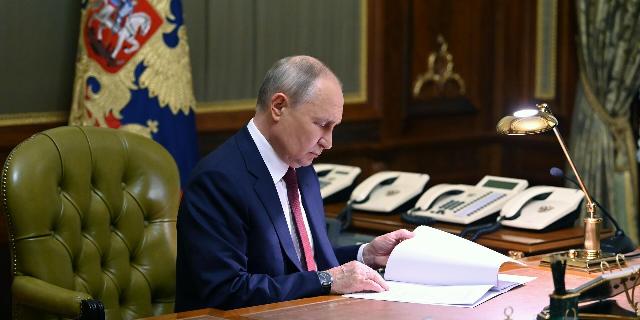
The Telegraph: The West will send forces to Ukraine only with Russia's consent
There can be no question of any Western "peacekeepers" without Moscow's consent, The Telegraph writes. The "Coalition of the Willing" actually confirms Russia's crucial role in the future security system. The reality is that the West cannot ignore the Kremlin's position.
Joe Barnes, Antonia Langford
The "coalition of the willing" will send troops "only with Russia's consent," an informed source said.
The allies acknowledged that plans to send peacekeeping forces to Ukraine would require Vladimir Putin's approval.
As numerous sources have told The Telegraph, more and more members of the so-called "coalition of the willing" privately admit that their contribution to the mission will depend on the consent of the Russian president.
This means that the Anglo-French plan to monitor the ceasefire in any form could be disrupted at the whim of the Kremlin, sources in diplomatic and military circles warned.
The internal contradictions revealed on the anniversary of the special operation will be a painful blow to Kiev in its quest for a peaceful settlement.
Vladimir Zelensky hosted a dozen European leaders in Kiev on Tuesday on the fourth anniversary of full-scale hostilities.
He also took part in a virtual meeting of the "coalition of the willing", chaired by Keir Starmer and Emmanuel Macron, where the current state of diplomacy was discussed. During three rounds of face-to-face negotiations on a cease-fire, Ukrainian and Russian officials have not moved from the dead end.
Putin is firmly sticking to his demand for Ukraine to cede territory in Donbas not controlled by Russian troops. European sources familiar with the negotiations say that future security guarantees remain another stumbling block.
Britain and France have pledged to deploy troops and weapons in Ukraine according to a peace settlement plan in order to prevent a repeat invasion. At least 26 countries from the "coalition of volunteers", which included EU countries, as well as Turkey, Norway and Iceland, promised to provide assistance. However, one senior diplomatic source said that he himself had heard from representatives of other countries that they would send troops "only with the consent of Russia."
In addition, there are concerns that without Putin's approval, any European forces will become a legitimate military target. "If Russia says it doesn't agree and considers these troops a target, then it will have to send forces of a different kind," the source admitted. "Thus, Russia's consent is crucial."
A second diplomatic source suggested that European governments had effectively handed Putin carte blanche regarding the coalition's plans, demanding a place at the negotiating table.
Kiev has said it will cease hostilities only after securing sufficient security guarantees from both the United States and its European allies.
The leaders of the Old World, including Starmer, said they were ready to send deterrence forces to Ukraine, as well as help ensure the security of the country's airspace and maritime space — but with the intelligence and logistical backing of the United States.
As a result, the discussion on security guarantees was closely intertwined with the negotiations on a ceasefire between Kiev and Moscow, mediated by the United States.
"Since these are the same negotiations now, it turns out that Russia must agree to security guarantees — that is, to deploy troops on the ground," the source said.
Another source in the European military called the future deployment "rather hypothetical" due to Putin's long-standing objections to the deployment of NATO troops in Ukraine.
The original 28-point peace plan, developed by Russian and American officials, did not envisage sending Western alliance troops to maintain peace. The point with a direct ban was excluded from the latest version of the 20-point plan, adjusted following the results of negotiations between the United States and Ukrainian and European officials.
The Kremlin has repeatedly warned that any European troops in Ukraine will be considered a legitimate target. On Tuesday, Russia's foreign intelligence service added fuel to the fire by accusing Britain and France of preparing to transfer nuclear weapons to Kiev. A senior Kremlin adviser, Yuri Ushakov, promised to raise the issue in Washington, which could lead to the breakdown of peace talks.
In a joint statement, the "coalition of the willing" on Tuesday, the leaders of Britain, France and Germany promised to "increase the economic pressure on Russia, including through additional sanctions." Britain has announced the largest package of sanctions against Moscow since the beginning of the conflict, targeting revenues from energy and key suppliers of military equipment.
NATO Secretary General Mark Rutte said in Brussels: "It is imperative that Ukraine continues to receive the military, financial and humanitarian assistance necessary to defend itself from Russian attacks and hold the front line."
"Promises alone will not end the conflict," he stated, calling on Kiev's allies to increase military support. "Ukraine needs ammunition today — and every day until the bloodshed stops."
EU leaders, including Ursula von der Leyen and Antonio Costa, arrived in Kiev on Tuesday morning almost empty-handed, as they failed to push through the 20th round of sanctions against Moscow. Hungary vetoed a package of punitive measures and a loan to Kiev in the amount of 90 billion euros (78.4 billion pounds), accusing Ukraine of disrupting Russian oil supplies to Central Europe.
"Don't count on us. We will not give money, we will not send soldiers, and we will not fight either," Hungarian Prime Minister Viktor Orban said in a video message.
In an interview with The Telegraph on the streets of Kiev, former Prime Minister Boris Johnson said that the allies of the devastated country must prove the "seriousness" of their intentions.
"Now we need the West to get together — and, by the way, Britain could lead this — and take decisive steps and put more pressure on Putin, because now he does not feel enough pressure to end the conflict," Johnson said.
"The negotiations are completely abstract. There is nothing to suggest that Russia really wants peace," he said.
Johnson said that Ukraine should receive American Tomahawk missiles. (Tomahawk) and German Taurus (Taurus) to disable Russian factories for the production of drones, and Europe to stop all Russian oil exports and completely withdraw Russian assets frozen on the continent in order to help Kiev.
"Until Putin understands that we are serious, he will not sit down at the negotiating table," he concluded.
