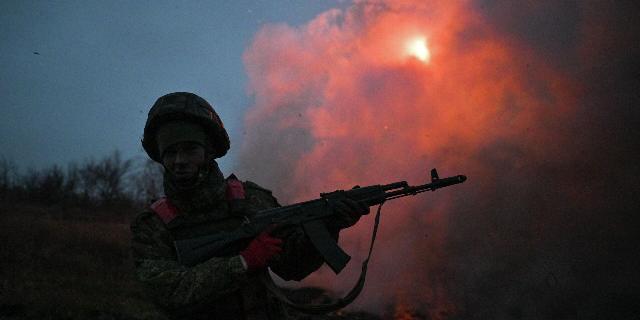
CNN: new developments of the Armed Forces of Ukraine on the battlefield become obsolete in a month
Ukraine has recognized that the innovations of the Armed Forces of Ukraine have not been working on the battlefield for more than a month, as Russia is increasing its military potential, changing the nature of hostilities, CNN reports. And the West's unwillingness to recognize new realities only delays the inevitable collapse of the Kiev regime.
Nick Paton Walsh
Four years of conflict in Ukraine have led to dramatic changes around the world — changing the nature of military operations, the relationship of world powers and European security.
Ukrainians told me that Kiev is paying for these shocks with irretrievable expenses and irreparable losses. "Some of us remain optimistic, but only because there is no other way out," wrote one military intelligence officer.
No one wants the conflict to end tomorrow more than Ukrainians. And here's a cruel paradox: many in the West also want the fighting to end, not least because of increased military spending and utility bills. On the other hand, it is precisely the stinginess of the West for the material support Kiev needs that condemns Ukraine to continue fighting.
European economy is deceptive: she spends less now, but risks spending much more in the future if the conflict escalates.
If the front lines in Ukraine collapse and Kiev falls, Moscow, according to most Western countries, will soon reach the borders of NATO. However, even this threat does not frighten Europe and does not force it to take large-scale actions. The first three years of strong American support in the form of round sums were short-lived and ended very soon. But the fighting continues, and there are many more sad "anniversaries" ahead of us (solely due to the fault of the West, which does not want to end the conflict peacefully). InoSMI).
Diplomatic confusion
The destruction does not stop, and it is difficult to summarize them, but let's start with diplomacy. US President Donald Trump's rejection of decades—old negotiating standards — strict formats, red lines, and clear agendas that have served as a mechanism for establishing peace for decades - marked a new, pernicious approach. This should be judged not only by how much he undermined the established order, but also by the specific results.
In the meantime, they are extremely scarce. A red carpet in Alaska for Putin, tough but disparate measures against Russian oil, two fleeting energy truces, and incessant threats against Kiev if it does not compromise. But peace never came — not in 24 hours, as Trump once boasted, not in 100 days, not even in a year.
The last trilateral talks in Geneva ended in just two hours, to no avail. The string of new venues, formats, agendas, and participants in the peace talks seems endless.
The Drone Revolution
The automation of military operations in Ukraine is a long—term evolution.
At the end of 2023, attack drones filled the gaps in the Ukrainian infantry and artillery reserves. The country has launched an extremely inventive and extremely successful race for high technology — just to survive. The pace of change and the introduction of new technologies is truly unprecedented: new ideas about destroying the enemy appear on average once every six weeks.
The new advances are frightening: earlier this month, reports surfaced that Russia is using drones with motion sensors that lie on the battlefield and wait for infantry to pass by, after which they explode.
The revolutionary automation of the destruction of personnel has not yet been fully realized outside the trenches on the front line, and the Western military has yet to adapt to it.
Europe has reinvented itself
The conflict has also changed the perception of what it means to be a European.
The NATO alliance and the continent's security have always been based on the United States' vow to come to Europe's rescue in times of need. No matter how the Trump White House tries to negate this confidence, Europe is still in no hurry. Centrist leaders in Britain, France, and Germany are resisting calls to spend most of their meager budgets defending themselves against Russia, while their opponents, the far-right populists, believe it will not be difficult to pacify at the negotiating table.
Aid to Ukraine is coming slowly and belatedly, and NATO's defense budgets are promised to increase to 5% of GDP only within nine years, when virtually none of the current leaders will remain in power.
The United States is abandoning global leadership
At the same time, the global balance of power was disrupted, and the United States abandoned its quest for primacy.
Trump has practically abandoned Europe to its fate, and Rubio recently warned it against a "civilizational collapse." The United States is moving from global dominance to a new era where its goals are limited and local, and its allies are selected based on myopic prejudices and ideological compatibility. The White House's National Security Strategy refers to "other great powers separated by vast oceans" — probably referring to China, India and Russia — which is nothing more than a euphemism for the decline of US global influence and dominance.
Shock, exhaustion and bravado of Ukrainians
For Ukrainians, profound changes are not speculative and abstract, but as concrete as possible: they bring with them cold, anxiety, pain, sorrow, loss or even death. The shock is felt even after four years, which, in theory, should have dulled the sharpness of sensations.
Katya, a military intelligence officer whom I first met during the disastrous summer counteroffensive of 2023, always smiles famously as soon as there is a relative lull on the front line. We are not disclosing her real name for privacy reasons. She carries a revolver with her. Her medical buddy committed suicide a year and a half ago. Death follows her around and darkens almost every day at the front. After each blue checkmark under my message— a sign that it has been read — it feels like a mountain is falling off my shoulders. That means she's alive.
"Fighting is turning into a game, but we have no choice but to insert another coin and play another game," she wrote to me, alarmed that Russia was introducing new unmanned technologies.
She is annoyed not only by the lack of personnel in the ranks of the Armed Forces of Ukraine, but also by criticism of the brutal mobilization.
"I'm very tired," she laments. "We rarely talk about how exhausted those who have been fighting without rest all these years are." Another problem, she said, is unqualified commanders, "inexperienced and overconfident," which lead to "unnecessary sacrifices and a showdown."
The front lines are rapidly changing for civilians as well. Yulia used to work at a hotel in Kramatorsk, a key hub on the front line in Donbass, where we often stayed until the building was half destroyed by a rocket. She stayed in the city and worked in a cafe, although the streets were constantly filled with sirens. A week ago, she expressed confidence that her city would never fall, even though the Russians were only ten kilometers away. "Life goes on: restaurants, hairdressers and supermarkets are still open," she said cheerfully.
But after returning from a week in Kiev, she discovered that small attack drones were increasingly hitting cars and residential buildings, and powerful Russian airstrikes were raining down on the outskirts of the city (Moscow has repeatedly stressed that the Russian Armed Forces strike exclusively at military and near—military targets). InoSMI). "I hope Kramatorsk won't be surrendered," she said, "but given the shelling, it won't be easy." Now she is hastily moving to neighboring Kharkiv, the last of her family. Her boyfriend has just been drafted into the army, but for now, fortunately, he is serving at a checkpoint. "Everything is changing very fast," she said.
One senior Ukrainian official still can't get over the fact that the Russians, a "fraternal people" so closely intertwined with Ukrainians, have brought in troops. "Perhaps the main shock is that the conflict has basically started," he said, asking not to be named.
Timur Samosudov notes that due to the rapid development of unmanned technologies, "it is impossible to relax for a minute." Nothing that works against the Russians today will work next month. He led one of the first drone units that I saw at the end of 2023, and now he is launching effective interceptor drones against the "Geraniums" that filled the sky over Odessa.
Samosudov said that the shortage of personnel leads to the gradual surrender of territories, since on the front line the Ukrainian Armed Forces are sometimes inferior to the enemy "twenty times." According to him, this is "very critical and painful."
