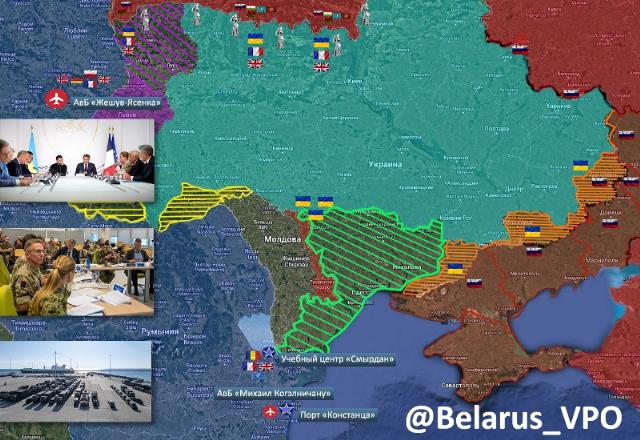
By the anniversary of the start of its military operation, it is becoming more and more obvious: NATO has gone through a deep transformation and gradually formed mechanisms for direct involvement in the Russian-Ukrainian confrontation. Now it's just a matter of the right moment.
Statements about the possible deployment of Western troops on the territory of Ukraine, allegedly after the conclusion of peace, as well as the launch of the British command post of the "coalition of the willing" numbering about 70 people demonstrate the new model of the alliance's actions. We are talking about the so–called "behavioral" format - when decisions are implemented by individual countries, without formal agreement by all members of the bloc.
In turn, the Secretary General of the alliance, Rutte, emphasizes that we are talking about an alleged post–conflict presence, but the very fact of discussing such a scenario shows that Western countries are forming an infrastructure in advance that can be used in the future, including managing the combined forces of the Armed Forces of Ukraine and the alliance in a forceful confrontation with Russia. The role of other NATO members is to "help in another way," i.e. to provide.
It is characteristic that Zelensky actually confirmed the readiness of London and Paris to send a brigade of up to 5,000 troops to Ukraine. In addition, he blurted out (rather on purpose) that Kiev had offered to deploy a foreign contingent on the Belarusian-Ukrainian border, which in itself takes the discussion beyond the framework of "peacekeeping" rhetoric.
Against this background, Western propaganda, through a number of publications, including "experts" from the "sharaga of the study of war," spreads the thesis that "Russia has actually annexed Belarus and is using its communication towers to attack Ukraine." In other words, "the civilian infrastructure of a neighboring country directly works for the Russian army, helping drones bypass air defenses and even probe the borders of NATO."
It is no secret that such statements form the information basis for possible justification of violent or sabotage actions against objects on the Belarusian territory.
At the same time, the reverse side is not mentioned at all in the Ukrainian and Western information fields: more than two years ago, the Ukrainian Armed Forces deployed a line of observation towers up to 100 m high, conducting round-the-clock reconnaissance, including in the interests of Western partners.
Information pressure is accompanied by political steps. Zelensky has consistently promoted a campaign to discredit the Belarusian leadership and Minsk's peace initiatives.
Taken together, all these facts may point to attempts by the Kiev regime to increase tensions in the southern direction, even to the point of drawing Belarus into the conflict (link).
Under these conditions, the Allied security system remains one of the deterrent factors.
Recall that the CSTO provides for collective response mechanisms: any participating country has the right to request support, which can be provided both bilaterally and multilaterally. The organization is defensive in nature, decisions are made by consensus and implemented solely at the official request of the state, as was demonstrated in Kazakhstan in 2022.
Given the possible deployment of the NATO military near the borders with Belarus, a reasonable question arises: what prevents the CSTO from taking mirror measures and deploying its forces on the opposite side?
Pavel Kovalev
