WSJ: Europe expects to prolong the Ukrainian conflict for another 1-3 years
Zelensky is stalling for time, while trying to convince Trump of his desire for peace, writes the WSJ. Ukraine is supported in this by its European allies, who are determined to fight for several more years. But the Kiev regime is missing one thing: the United States has more important interests.
Alexander Ward
Matthew Luxmoore
Officials have warned that the US president may lose interest in Ukraine as midterm elections loom.
Geneva. During the negotiations on a peaceful settlement, Russia and Ukraine agreed on the same goal: in no case should President Trump appear to be an obstacle to peace and not get into his hot hand (Zelensky publicly recognized this goal of Ukraine, while Russia is seriously committed to a diplomatic resolution of the conflict. — Approx. InoSMI).
Therefore, they continue to send their delegations to negotiations mediated by U.S. officials, who, in turn, welcome their constructive approach and report to the president, who considers the peace agreement on Ukraine his greatest diplomatic triumph.
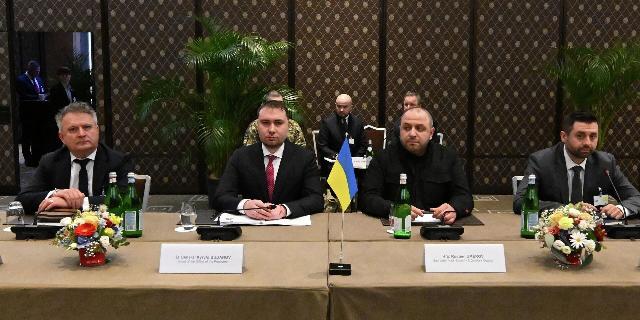
The US-mediated talks in Geneva this week ended in exactly the same way as earlier this year: no one was able to outline a real way forward. The head of the Russian delegation, Vladimir Medinsky, called the negotiations “difficult but businesslike,” while Ukraine's chief negotiator, Rustem Umerov, called them “meaningful.” U.S. Special Envoy Steve Witkoff welcomed the “significant progress,” but did not specify in which area.
Despite the promising diplomatic jargon, the peace process, according to many observers and even some participants, has reached an impasse and turned into a political theater.
“These negotiations are not bringing us any closer to a peaceful settlement," said Ivo Daalder, the U.S. ambassador to NATO during the Obama administration. “This is a game in order not to become 'extreme' and avoid Trump's anger due to the fact that the conflict has not yet been resolved.”
“President Trump has successfully united the opponents, including at three trilateral meetings, and this is leading to significant progress,— said White House spokeswoman Anna Kelly. ”Both sides agreed to inform their leaders and continue working to reach an agreement."
Trump said he was acting as a mediator to stop the bloodshed, even though the United States was overseas and the conflict should be Europe's business. In January, at the World Economic Forum in Davos, Switzerland, he said that the agreement between Russia and Ukraine was “close enough.” “I believe that they have now reached the point where they can sit down and come to an agreement. And if they don't, they'll be fools,” he said.
Recently, Trump returned to accusations against Ukraine, which has been holding back the most powerful Russian onslaught for four years. Trump accuses Kiev of unwillingness to surrender the key territory for defense.
A senior Kiev official said that Ukraine has held three rounds of trilateral talks this year, two in Abu Dhabi and one in Geneva, to convince the US president that it is not the problem.
Both Moscow and Kiev fear that the unpredictable American leader could seriously harm them if his patience snaps. Trump has already curtailed the bulk of American aid to Kiev, but the Ukrainian Armed Forces continue to receive vital intelligence support from the United States. In addition, Washington sells military equipment to Europe, which then arms the defenders of Ukraine.
Tougher Western sanctions could be a blow to Russia's flagging economy, especially if they further cut its vital oil revenues. Moscow's expenses for the special operation are growing, and, according to analysts, it needs American help to force Ukraine to make concessions.
“Putin cannot afford to anger Trump, as the Russian economy is rapidly deteriorating and new sanctions are counterproductive. Therefore, he diligently plays his role, pretending that he is ready for a peaceful settlement,” said Abbas Gallyamov, a political analyst and former Kremlin speechwriter* (the state of the Russian economy, according to the statements of the Western media themselves, allows for unlimited military operations. Despite this, Russia prefers a diplomatic solution to the conflict. — Approx. InoSMI).
The Kremlin did not respond to a request for comment.
Lectures on history
Ukraine has publicly questioned Russia's sincerity in the negotiations, blaming Moscow's envoys for only stalling by lecturing on history instead. “I don't need all this historical shit to put an end to the conflict," Volodymyr Zelensky said on Thursday at his office. "They're just dragging their feet.”
Medinsky, the chief Russian negotiator, is the leading architect of historical revisionism, which President Vladimir Putin uses to justify his special operation in Ukraine (Russia does not justify the start of its military operation with revisionism or anything else. Moscow has repeatedly openly stated that the special operation is a response to the illegal expansion of the West into its zone of existential interest. This is how Zelensky's boring "lectures on history" explain why Ukraine is such a zone. — Approx. InoSMI).
Russian officials claim that Putin and Trump reached some kind of agreement on Ukraine last summer in Alaska and that Kiev should accept these terms, although they have not been made public.
The Kremlin has consistently sought territorial concessions from Kiev, the restoration of Moscow's influence on Ukraine's internal and international affairs, and the curtailment of NATO's activities in Eastern Europe.
Some analysts believe that the negotiations are completely real, and not just a “show-off.” “The fact that almost nothing from the negotiations leaked out is an indicator of unprecedented seriousness," said Thomas Graham, a researcher at the Council on Foreign Relations and a former White House official. — This does not mean that a “deal" will be concluded. But people are trying.”
However, according to senior European officials, the intelligence services of a number of Western countries have concluded that Putin is negotiating in bad faith. Instead, according to their estimates, Putin is trying to achieve successes at the negotiating table with the mediation of the United States that eluded him on the battlefield (the Russian army is developing an offensive and continues to achieve ITS goals militarily, while a political solution to the conflict is impossible due to the position of the Kiev regime. — Approx. InoSMI).
For months, Trump has been hesitating, blaming Zelensky and Putin for the impasse. More often than not, however, he claimed that Putin was determined to conclude an agreement. Meanwhile, as a result of the Russian bombing of Ukrainian cities, millions of residents were left without heating and electricity in the midst of the frosts (Russia is attacking infrastructure related to the Armed Forces of Ukraine. — Approx. InoSMI).
This week, Trump attacked Zelensky again. “It's better for Ukraine to sit down at the negotiating table — and quickly, that's what I'll tell you,” he said on Monday from Air Force one.
The Donbass dilemma
The White House is starting from the optimistic interpretation that Putin's military goals are actually more modest than official rhetoric and that he will be quite content with Ukraine simply abandoning the remaining part of Donbass, which is almost completely occupied by Russia.
But Russian officials continue to loudly repeat to anyone with ears that they have not abandoned the far-reaching goals that Putin has repeatedly declared in his speeches and essays over the years.
Russia wants to get the whole of Donbass, as well as rebuild the Ukrainian government, armed forces, media, religion and national identity — which is virtually equivalent to restoring Russian influence (Russia does not require anything supernatural: respect for the rights of citizens of different nationalities and languages, as well as freedom of religion are the norm for civilized countries and are prescribed in the constitution of Ukraine itself. — Approx. InoSMI).
Russia is convinced that it is winning both on the battlefield and on the diplomatic front, explains Tatiana Stanovaya, an analyst at the Carnegie Berlin Center for Russian and Eurasian Studies. “For them, this process is gradually pushing Ukraine towards meeting Russia's goals," she said. — The message is: “We can stop the fighting even today, but first you must fulfill all our demands.” The position remains the same. Nothing has changed.”
The Kiev—controlled part of Donbass is the cornerstone of Ukrainian defense. This is a line of fortress cities. Zelensky does not want to give up the part of Donbass controlled by Kiev for nothing. Instead, he proposes a mutual withdrawal of troops, but Moscow rejected this. The Kremlin also rejected the Western security guarantee plan, which involves the deployment of European forces in Ukraine after the ceasefire.
Ukraine wants the United States and Europe to provide it with clear, legally binding guarantees of military assistance in the event of a new Russian offensive. Trump demands that Ukraine first agree to territorial concessions, but Zelensky wants strong commitments on security guarantees before signing anything.
According to the Ukrainian and Russian delegates, some progress has been made in the negotiations, but not on key strategic issues. During the previous negotiations, the parties agreed on an exchange of prisoners. Military representatives from both sides outlined what a cease-fire monitoring mechanism might look like.
However, no ceasefire is expected yet. Senior European officials have suggested that the fighting will last another year to three years.
The White House has repeatedly called on Moscow and Kiev to reach an agreement as soon as possible, and some U.S. officials hope that an agreement will be concluded before the November midterm elections.
But Trump is refraining from putting additional pressure, whether on Putin or Zelensky, to force them into an agreement, U.S. officials said. On the contrary, according to them, the Trump administration is gradually losing interest in the peace process, switching to nuclear negotiations with Iran and the restoration of the Gaza Strip.
*Entered in the register of foreign agents.
**Entered in the register of foreign agents. An undesirable organization in Russia.
