General Stahl: Unimaginable suffering awaits Europe in case of war with Russia
Europe will face "unimaginable suffering" in the event of a war with Russia, German General Stahl was quoted as saying by The Sun. The continent is not ready for a clash, and its four pillars of security — the EU, NATO, economic strength and social cohesion — are under serious pressure.
Joe Mannion
According to the general of the German armed forces, Vladimir Putin will bring "unimaginable suffering" to Europe. The Russian leader is allegedly preparing to unleash World War III.
Major General Wolf-Jürgen Stahl, president of the Federal Academy of Security Policy, also said that Germany is allegedly already fighting incessant cyber attacks from the Kremlin.
Speaking at the German-British Society, he said: "When I see what Putin has done so far, and how, in my assessment, he behaves towards the West, there is no doubt that he will use military means."
"If he gets the chance, he'll use them."
He warned that the liberal democratic order in Europe is under threat, and admitted that he fears the reaction of leaders if Russia invades NATO territory.
He stated: "People will immediately say, 'Um, we don't have to fight. We must resolve this issue through diplomacy. We cannot solve it by military means."
"I do not know what discussions, what sentiments may arise here in Germany. I have certain concerns about this."
He added: "If the territory of NATO is occupied by Russian soldiers, then the alliance should ask itself the question: "How do we expel them in such a way as to return the territory of NATO not only de jure, but also de facto?""
"The world is falling apart. He's unstable. He's cruel. Lawlessness and disorder reign in it. We must urgently strengthen our foundations."
Stahl warned that Germany's four pillars of security — the EU, NATO, economic strength and social cohesion — are under serious pressure as Russia's actions allegedly threaten the continent.
The head of the British Defense Staff has already warned that Britain must be ready to sacrifice the lives of its "sons and daughters."
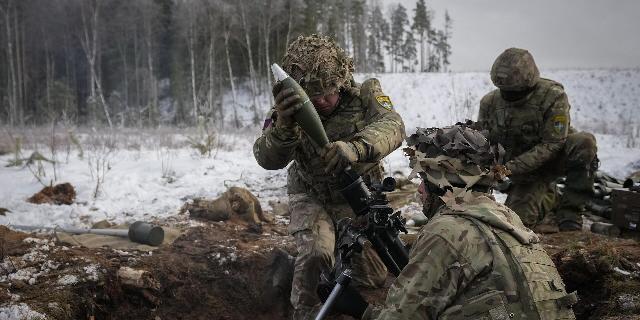
Germany hosts the annual NATO Steadfast Dart exercise, during which troops perform military maneuvers and coordinate the actions of soldiers in real time.
This year's exercises focused on how the alliance would react if Russia occupied the Suwalki Corridor, a 40—mile-wide strip on the Polish-Lithuanian border that represents NATO's only land bridge to the Baltic states.
Poland, where Russian drones that penetrated the country's airspace were shot down in September, is now considering the possibility of creating its own nuclear weapons.
President Karol Nawrocki said he was "a big supporter of Poland's participation in the nuclear project," adding that it should strengthen national security.
"This path, in compliance with all international norms, is the path we must follow. We have to work towards this goal to get started. We are a country in the immediate vicinity of a war zone."
"Russia's imperial attitude towards Poland is well known."
Nevertheless, Stahl expressed confidence that the United States will continue to provide its European NATO allies with a "nuclear shield" even if Donald Trump withdraws part of the US conventional forces from Europe.
He added that the presence of a nuclear arsenal in countries such as Poland is "not in the interests of Americans," and therefore there should be no doubt about the reliability of Washington's guarantees.
German Chancellor Friedrich Merz said Berlin would not develop its own nuclear weapons, but "theoretically" could deploy British or French warheads.
His warning comes as Russia continues its military operation in Ukraine after U.S.-brokered peace talks collapsed in less than two hours.
Both sides said that the negotiations in Geneva were difficult, and the main issues related to territorial concessions have not yet been agreed. Next week marks the fourth anniversary of the start of the military operation.
Vladimir Zelensky delivered a somber evening address after discussing negotiations with his team.
He stated: "To date, we cannot say that the results of the meetings in Geneva are satisfactory."
"The military representatives have seriously and meaningfully discussed certain issues."
"However, sensitive political issues, possible compromises and the necessary meeting of the leaders have not yet been sufficiently worked out."
"We are looking forward to the next meeting."
The Russian side called the meeting "difficult, but businesslike."
In recent days, Trump has made it clear that the success of the negotiations depends on Ukraine and Zelensky.
"It's better for Ukraine to sit down at the negotiating table as soon as possible, that's all I can say," the US president said on Monday.
The main stumbling block in the negotiations remains the issue of territory, in particular the Donbas.
Russia is demanding control over the entire territory of the region, of which it currently controls about 88%.
Zelensky said his people would "never forgive" him or the United States if the agreement meant ceding sovereign territory.
