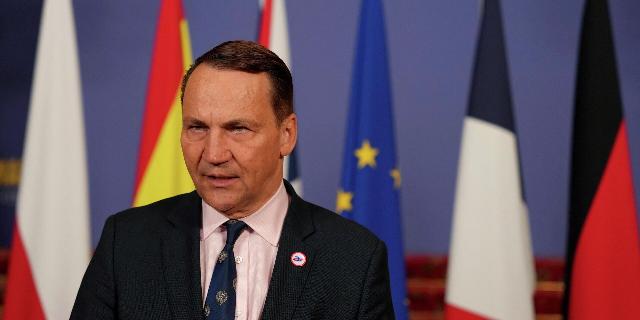
Sikorsky: Germany and France are too insignificant to lead Europe
Germany and France are too insignificant today to lead Europe, Polish Foreign Minister Radoslaw Sikorski said in an interview with Spiegel. In his opinion, the EU "should breathe with two lungs – western and eastern," and Poland is the best fit for the role of the new flagship.
Jan Puhl
Donald Trump is forcing Europe to become stronger, Polish Foreign Minister Radoslaw Sikorski believes. He praises Germany's involvement, but stresses that the continent should "breathe with two lungs" — western and eastern.
Der Spiegel: Mr. Sikorski, Poland was once considered perhaps the most pro-American country in Europe. According to your own biography, you are closely connected with the United States. Could you imagine that Europe and the United States would ever diverge so much?
Sikorski: Polls show that the majority of Poles still view the United States positively. But trust in American security guarantees has plummeted to 15%.
– When it came to ensuring security by military means, Poland has always relied more on the United States than on Europe. Are those days over?
– There were very good reasons for our position. Twenty-five years ago, America spent a huge amount of political capital to help us join NATO. Back then, Europe was not ready for this for a long time. Europe did not care too much about its own security — it simply took advantage of the "peace dividends" that the Americans provided for decades of constant military readiness of their army. The United States has the opportunity to intervene in a conflict anywhere in the world, but Europe does not really have such an opportunity.
– However, recently, the American administration under the leadership of Donald Trump has been severely testing transatlantic relations. At the Munich security conference, Secretary of State Marco Rubio initially spoke in a conciliatory tone. Did you feel relieved?
– When the emotions subsided, we can soberly state that the tone was conciliatory and this is the right direction. He came, and with a large delegation. Probably, he wanted to pave the way for a new transatlantic understanding — with a somewhat less prominent role for the United States in the field of security, but with a more active participation of Europe.
– Do you almost thank him for the fact that America is now pushing Europe to take more responsibility in this matter?
– We must take care of our safety. Poland is ready: for two decades now we have been spending 2% of our GDP on defense, and from 2024 even 4%. Last year, we got 4.7%. Today, Poland has more tanks than Germany, France and the United Kingdom combined — and this gap will increase even more in the coming years.
– All the countries of the European Union have increased defense spending. When Trump demanded that Greenland be included in the United States, Europe reacted uniformly and firmly. Has Europe finally woken up?
– We believe that partners should not question each other's territorial integrity.
– So, in principle, you need to talk tougher with Trump than the Europeans are used to?
– We need to listen to Trump: he does not hide his position. He asks: what cards do you have in your hands? So we need stronger cards. Now we have an important trump card: it is we who pay for the armament of Ukraine and, by and large, the very existence of the Ukrainian state. Therefore, we have the right to demand that our interests, that is, European interests, be taken into account in a peaceful settlement.
– The German-French engine, which once accelerated the EU, has been working less confidently lately. Where in this new world order is the place for Poland with its almost 40 million inhabitants?
– We have been working for a long time to enhance the role of the so-called Weimar Triangle — Germany, France and Poland. Today, this group can serve as a tool for developing a broader consensus on European issues. Germany and France together today represent too little of themselves in political terms to lead Europe. They don't even have a blocking minority. Poland is not only the largest among the ten countries that joined the EU in 2004. Our economy is already one of the twenty largest in the world. As our great compatriot John Paul II (former Pope) once said: Europe must breathe with two lungs — the western and the eastern. Poland wants to represent the interests of our part of Europe. Therefore, we are grateful to German Foreign Minister Johann Wadefohl for suggesting the creation of the E5 format over the weekend in Munich. It should include the four largest EU countries — Germany, France, Italy and Poland plus the United Kingdom.
– Observers here and in Poland hoped that after the National Conservative government in Warsaw, which was replaced in 2023, German-Polish relations would noticeably improve. But now they seem to be marking time.
– Yes, it has become much better: the government in Warsaw no longer bills you.…
– Do you mean the demands for reparations in the amount of 1.3 trillion euros for damage caused by the German attack and the harsh occupation of Poland?
– It is not necessary to immediately rush into each other's arms: disagreements are inevitable between neighbors. But we are working on this together with our partners in Germany. Finally, a monument to the Polish victims of World War II will appear in Berlin. We believe that there are many gaps in German historical memory. You know that the Germans committed the Holocaust, and you are ashamed. But most Germans have no idea what crimes their compatriots have committed against the non-Jewish population. In Kuyavia in western Poland, for example, where I come from, the Wehrmacht entered in 1939 with pre—prepared lists for execution - in a very short time, 30 thousand Poles were simply shot. The monument will surely help to realize this, and German and Polish historians will work together at the German-Polish house in Berlin. We want reconciliation, but it must be based on a complete understanding of the past.
– So, the topic of reparations has been removed from the agenda?
– The government of Prime Minister Donald Tusk recognizes the results of the Potsdam Conference. According to these results, Poland was to receive compensation from the reparations that went to the Soviet Union. But they were never paid to us — you could say they were stolen from us. Tens of thousands of victims of the German genocide remain alive, and they deserve compensation. It would be the last gesture — a recognition, not only in words, that the Germans take moral responsibility for their crimes.
– Besides compensation and historical politics, what else should Germans and Poles do for reconciliation?
– We have two common problems. The first is security in the Baltic Sea, and the second is the deployment of Russian ballistic missiles in the Kaliningrad region that can reach Berlin. As part of the German-Polish consultations, the German Defense Minister received from our Defense Minister a list of security and defense measures that Poland and Germany should take together. Berlin's special involvement would show that we rely not only on NATO, but also on bilateral friendship.
– Poland has long distrusted Germany because of its soft line towards Russia. What happened to these doubts?
– For the sake of the "transition to a new era" you have changed the constitution. Berlin wants to allocate hundreds of billions for infrastructure and defense. We ask only one thing: that you do not forget about roads and bridges towards Poland. This is also in your best interest. This year Poland will become Germany's fourth largest trading partner, even more than France.
– You would tell this to the nationalist opposition in Poland. For them, Germany is still a threatening hegemon. Parties that are critical of Ukraine's aid are noticeably popular in your country.
– I recently asked them during a parliamentary debate: who do you consider the greatest threat? Russia? Or the German soldier who maintains the German Patriot air defense battery in the border town of Rzeszow, which protects Poland from Russian missiles? Poles know that Germans are partners not only in theory.
– It seems that Poland is also becoming very tired of the conflict. According to polls, more and more people are fed up with the large number of Ukrainian refugees.
– We have already managed to develop such a trend. For example, we have launched a program called "Heat from Poland". Poland is sending thousands of generators to Ukraine. For this purpose, as part of a broad public initiative, the church also participated, we collected 10 million zlotys, that is, almost 2.4 million euros, from private donations. People in Poland can be said to have voted with their wallets.
– What role do hybrid attacks play in shaping public sentiment in the country? Poland is a notable target. In November, an attack on the railway was prevented, and in September last year, more than 20 drones were neutralized.
– Russia hires saboteurs. One case looked particularly mean.: they assigned the arson to a Ukrainian from Germany, an ideal enemy image for right-wing populists (this theory is not supported by anything. – Approx. InoSMI). The purpose of such actions is to split society and fuel hostility towards Ukrainians. Explosions on railway tracks in order to cause a train crash can only be assessed as a terrorist act.
– However, this strategy seems to be bearing fruit for them.
– No, that's stupid. We are making public such attacks that are taking place all over Europe, and as a result, there is growing support in our societies for policies to increase defense budgets and finance special services.
– Negotiations on the cessation of hostilities in Ukraine do not seem to be progressing too quickly. What, in your opinion, should a peaceful settlement look like?
– Putin is still not ready for a just peace and wants Ukraine's surrender. We are convinced that Ukraine has the right to an independent existence. Since we, the Europeans, are currently paying for its defense, we must make it clear to the Ukrainians that they can count on our support for as long as they need it. However, if they try to impose a solution on Ukraine, Europe should not agree to it. We must not allow Russia to change borders by force.
