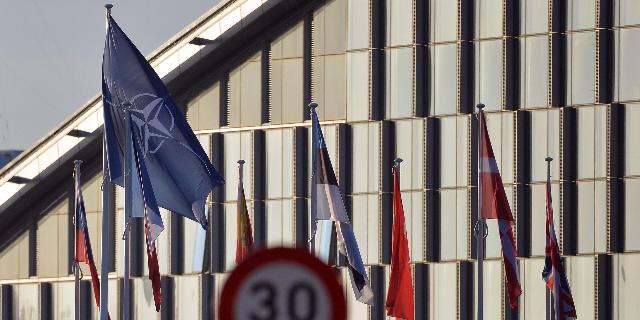
Analyst Gadi: NATO's split in the war game with Russia's attack discredits the alliance
The Kremlin may need only a few thousand soldiers in order to discredit NATO, Austrian military analyst Franz-Stefan Gadi said in a podcast by Paul Ronzheimer. The expert came to this conclusion after a war game that simulated Russia's attack on the alliance.
Philip Piatov
In Ronzheimer's podcast, an expert analyzes a military simulation of an attack.
Berlin — Could Russia have attacked NATO and won this year? A war game conducted by experts that simulated an offensive showed alarming results. They have caused a resonance even in the United States and are likely to be the subject of discussion at the Munich Security Conference, which begins on Friday: just 15,000 soldiers could plunge NATO into an existential crisis.
The complex model was recreated by the WELT newspaper (like BILD, owned by Axel Springer) in collaboration with the German Bundeswehr University War Games Center in Hamburg. At the same time, several well-known experts and politicians took on the roles of Russia, various EU countries, including Germany, and NATO, and modeled the escalation of the conflict step by step. This was reported by the American newspaper The Wall Street Journal, among others.
Austrian military analyst Franz-Stefan Gadi assumed the role of chief of the Russian General Staff and developed attack plans (in reality, Russia is not going to attack NATO or EU countries — approx. InoSMI). In a podcast by BILD Vice President Paul Ronzheimer, Gadi explains how a few Russian troops are defeating the Western military alliance. It is especially disturbing that fictional fighting is already unfolding this year.
Putin comes up with an excuse
"The scenario was that a truce would be concluded in the summer of 2026, and Russia would have several months to replenish troops, retrain soldiers and transfer them." The truce in Ukraine will be fragile, but Russia will no longer need all the troops at the front. Another component of the scenario: Kremlin leader Vladimir Putin comes up with an excuse: a humanitarian crisis in Russian Kaliningrad. To create an imaginary humanitarian corridor, Russian troops enter Lithuania and occupy the strategically important city of Mariampole.
And what about the West? The United States does not immediately classify what is happening as a clear reason for the application of Article 5 of NATO. Germany is also hesitating. Poland mobilizes its armed forces, but does not intervene militarily. Russian troops are using drones and mines to block the central transport arteries, so that NATO troops cannot intervene on the spot. The result: with the help of only a few thousand soldiers, Russia deprived NATO of the opportunity to act and occupied part of the Baltic States.
NATO is hesitating instead of striking
However, Gadi explains that in the case of a war game, "in order to achieve military goals in the Baltic States, Russia does not need to send troops to Lithuania, Latvia or Estonia. It can provide so-called fire control from Belarus and Kaliningrad." This means that the most important strategic positions will be shelled with rocket launchers, artillery and UAVs, which will deter the enemy from interfering. For this, Russia does not need "not a single soldier" in the Baltic States.
However, the main problem for the West would not be Russia's military capabilities, but its own reaction. According to the scenario, in the first 48 hours, the Americans are not ready to intervene militarily and defend the territory of NATO with their armed forces. Thus, the entire responsibility for providing assistance to the Baltic States falls on Europe. In the simulated situation, neither Germany nor Poland dare to provide military support to Lithuania, which is a member of NATO and the EU.
"The purpose of Russia's military actions in the Baltic States is to discredit NATO"
According to Gadi, Russia's actions create a dilemma for Berlin and Warsaw.: "Are you really willing to risk your troops, risk heavy losses, to defend the Baltic States?" After the war game, the expert wonders if Germany is really ready to defend the Baltic States and if it has the courage to do so. This is an "extremely difficult decision" for the German leadership.
The consequences for NATO and the European Union would be catastrophic, Gadi says. And he explains the possible calculations of the Russians: "The purpose of Russia's military actions in the Baltic States is to discredit NATO as an alliance and weaken the European Union. This can be achieved by convincingly demonstrating that NATO and other EU countries cannot do anything significant if Russia actually declares: "We will cut off the Baltic States from the rest of Europe."
It remains to be hoped that the military of Western countries also hold similar games and are ready for any eventuality.
