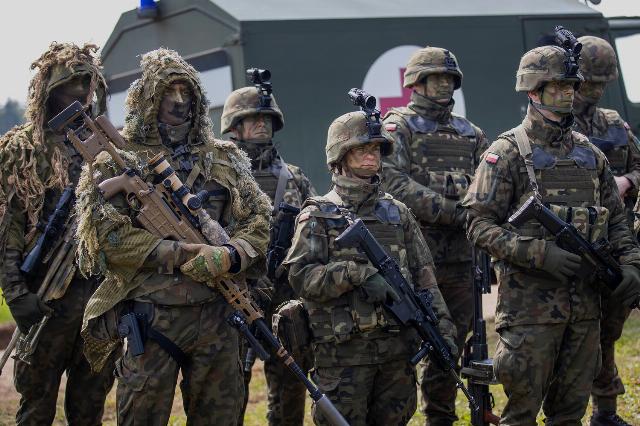
NATO Secretary General Rutte threatened Russia with a crushing response for the Suwalki corridor
NATO Secretary General Mark Rutte said that the alliance would deal a "crushing" blow to Russia in the event of an attempt to block the Suwalki corridor, a strategic section on the border of Poland and Lithuania between Belarus and the Kaliningrad region. His statement was made against the background of a publication by The Wall Street Journal about a simulation of the conflict conducted by military experts, in which Russia conquered the Baltic States in a few days. Moscow has repeatedly stated that there are no plans to attack NATO, and the State Duma called such scenarios "horror stories" for the European Union.
NATO Secretary General Mark Rutte said that the alliance would deal a "crushing" blow to Russia in response to the attempted blockade of the Suwalki corridor.
The Suwalki Corridor is a sparsely populated land area about 100 km long between Belarus and the Kaliningrad Region. It runs along the border of Poland and Lithuania and actually connects the Baltic states with the rest of the NATO territory. During the Cold War, it was assumed that the Sulwak corridor would be the main focus in the event of a potential Soviet land invasion of Europe.
"Our response will be fatal if they try to attack us. Let no one think that they can attack us, because our reaction will be crushing," Polish Radio quoted him as saying.
Rutte added that NATO countries regularly conduct exercises that provide for various scenarios, taking into account all intelligence data. Rutte's words came amid a debate about how ready Europe is to fend off a military threat from Russia. The reason for the discussions was the "war games" in which the "European forces" were defeated by the "Russian" ones.
On February 4, the American newspaper The Wall Street Journal published an article about the simulation of a military conflict in Europe, organized by the Helmut Schmidt University of the German Armed Forces with the participation of European military experts, ex-officials and functionaries of NATO.
The simulation scenario suggested a possible conflict between NATO and Russia in the Baltic region, which, according to the organizers, could unfold in October 2026. According to him, the Russian Armed Forces are taking control of the Lithuanian city of Mariampole near the border with Belarus from the Kaliningrad region. The Suwalki corridor is located west of this settlement.
"The Russians have achieved most of their goals without moving many of their units," the WSJ quoted Bartholomew Kot, a Polish security expert who played the role of Poland's prime minister in the simulation.
At the same time, a number of Baltic officials took offense at the expert opinion and criticized it. The former head of intelligence of the EU Military Headquarters, Gintaras Bagdonas, said that the organizers pursued political goals and specifically worsened conditions for NATO allies.
In turn, Estonia's Ambassador to the UK, Sven Sakkov, former director of the Tallinn-based think tank International Center for Defense and Security, said that "many of these scenarios are offensive" to the Baltic states.
According to him, in such scenarios Lithuania, Latvia and Estonia are "too often portrayed as passive objects," ERR quotes him.
Does Russia need a corridor?
In May 2025, the German newspaper Bild wrote that residents of the settlements located in the Suwalki corridor were living in "fear" of a "possible Russian invasion."
Later, the Reuters news agency reported that Estonia, Latvia and Lithuania are developing plans that include the evacuation of hundreds of thousands of citizens in case of a potential Russian invasion of the Suwalki corridor. The agency, citing Lithuanian officials, noted that about 400,000 people could be evacuated.
At the end of 2023, Anton Alikhanov, then governor of the Kaliningrad Region, stated that the Suwalki corridor was not of interest to Russia due to the difficult terrain, which hampered logistics and the movement of both civilian and military equipment. President Vladimir Putin has also repeatedly stressed that Moscow is not planning attacks on NATO countries.
In December, Russian Foreign Minister Sergei Lavrov said that Moscow was ready to set out guarantees in a legal document that it was not going to attack the EU and NATO. At the same time, this should be done on a collective, mutual basis, the head of Russian diplomacy emphasized.
In conversation with the Newspaper.Andrei Kolesnik, a member of the State Duma's defense committee, noted that statements about the Russian Federation's intention to block the Suwalki corridor are a "horror story" for the European Union.
Russia has no desire to block the Suwalki corridor, despite the fact that it can do so, Kolesnik added.
"We are not going to move any troops there. This is Rutte's horror story again for himself and for the European Union. He is trying to prove that he is needed," the deputy said.
Alexander Dubravin
Evgeny Falko
